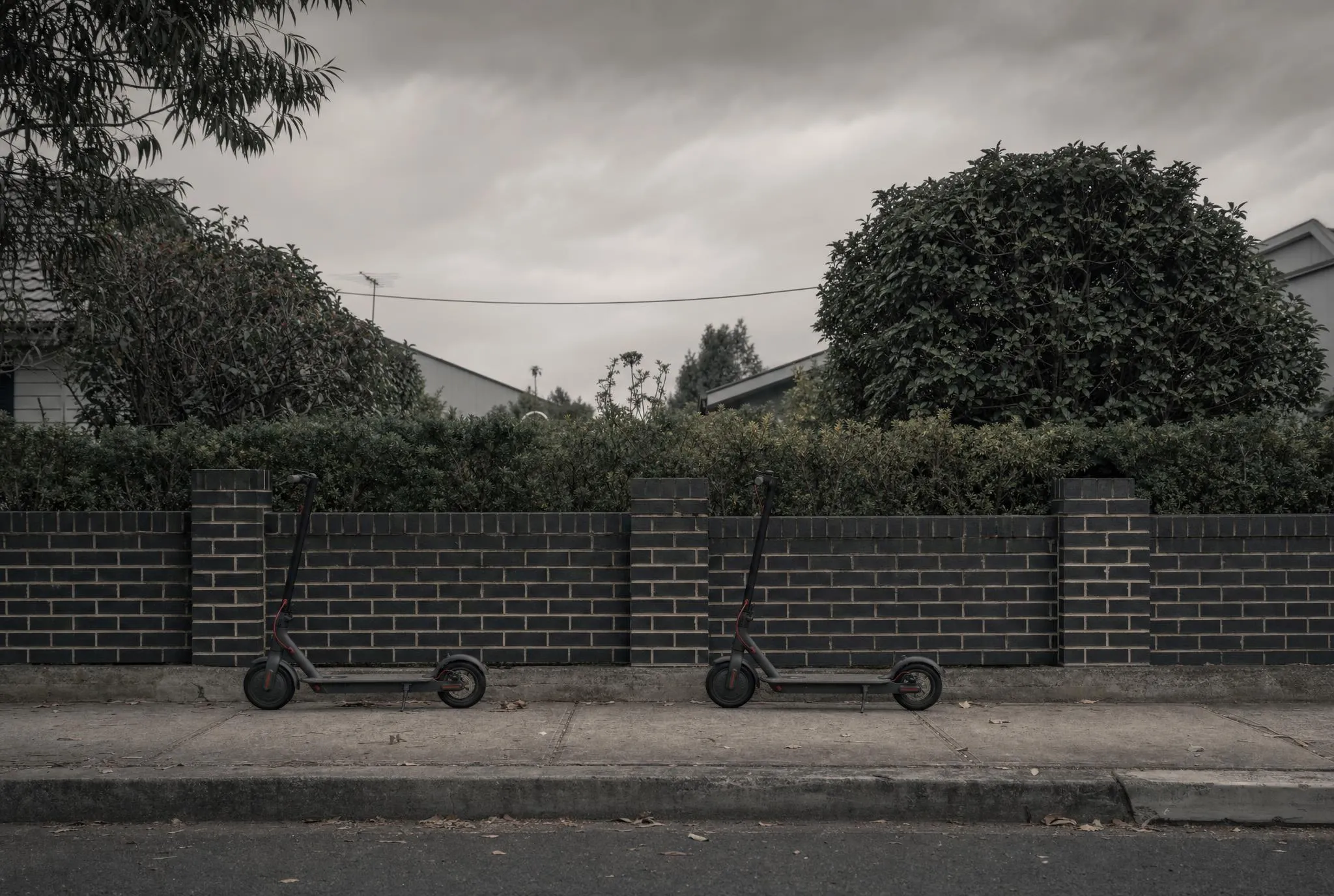
Are e-scooters legal in South Australia?
Yes. Private e-scooters became legal on 13 July 2025, as personal mobility devices. You need to be 16 and wear a helmet. It's 10 km/h on footpaths, 25 km/h on roads signed to 50 km/h. No licence or rego.
- Footpaths
- Yes, and beaches too. Keep left and give way to pedestrians 1
- Which roads
- Only roads signed 50 km/h or less, plus bike lanes on 60 km/h roads 1
- Your top speed
- 10 km/h on footpaths, beaches and crossings · 25 km/h on roads and bike paths 1
- Minimum age
- 16, and letting an under-16 ride is its own offence 1
- Helmet
- Required. The rules treat you as a bicycle rider, so the cyclist helmet rule applies 1
- Licence & rego
- Neither is required. PMDs sit outside the motor vehicle definition 3
- Passengers
- Not allowed. No towing either, and no riding side by side 1
- Fines
- $222 for speeding, $484 for riding a prohibited road 2
South Australia is the newest member of the legal-e-scooter club. Private e-scooters have only been road-legal since 13 July 2025, when the personal mobility device reforms started. 3 A 12-month review is under way. Public consultation closed on 16 August 2026 and the outcomes are still pending, so South Australia’s rules are the newest in the country and the most likely to change.
What counts as a legal e-scooter in South Australia?
A personal mobility device has to be electric, built for one person, and fitted with an effective stopping system. It has to fit the size caps, weigh 45 kg or less empty, and have no sharp protrusions. It also has to meet the electrical safety standards that apply. 2
reg 3(6b) What counts as a personal mobility device Road Traffic (Miscellaneous) Regulations 2014 (SA) 2
For the purposes of the definition of personal mobility device in section 5(1) of the Act, a vehicle that— (a) has 1 or more wheels; and (b) is propelled by 1 or more electric motors; and (c) is designed for use by a single person only; and (d) has an effective stopping system controlled by using brakes, gears or motor control; and (e) is not more than 1 250mm in length, 700mm in width and 1 350mm in height; and (f) weighs not more than— (i) if the Minister has specified a weight by notice in the Gazette in relation to a vehicle of that kind—that weight; or (ii) in any other case—45 kilograms, when the vehicle is not carrying a person or other load; and (g) has no sharp protrusions; and (h) meets any applicable electrical safety standards; and (i) is not— (i) a bicycle; or (ii) a motorised wheelchair, is prescribed.
Here’s something unusual. SA’s device definition has no speed-capability or power ceiling. Queensland and Victoria make a fast scooter illegal as a device. SA regulates how fast you actually ride. 2
Where can you ride an e-scooter in South Australia, and how fast?
Footpaths and shared paths are legal at 10 km/h. So, uniquely, are beaches, at the same cap. 1
reg 30A(4) Speed limits Road Traffic (Road Rules—Ancillary and Miscellaneous Provisions) Regulations 2014 (SA) 1
A person must not ride a personal mobility device at a speed greater than— (a) if the person is riding on a road, bicycle path or separated footpath designed for bicycles—25 kilometres per hour; or (b) if the person is riding on a footpath or shared path, a beach, or crossing a road—10 kilometres per hour; or (c) if a lesser speed is required in the circumstances to allow the person to stop safely in order to avoid endangering any person—that speed. Maximum penalty: $2 500.
Roads are allowed where the limit is 50 km/h or less, at up to 25 km/h, keeping as far left as you reasonably can. E-scooters can also use bicycle lanes on roads up to 60 km/h. Bicycle paths and separated footpaths take the 25 km/h cap. Crossing a road is capped at 10 km/h, and there’s a general duty to slow to whatever speed lets you stop safely. 1
reg 30A(5) Roads you can't ride on Road Traffic (Road Rules—Ancillary and Miscellaneous Provisions) Regulations 2014 (SA) 1
Subject to subregulations (6), (7) and (8), a person must not ride a personal mobility device on a length of road on which the speed limit is greater than 50 kilometres per hour. Maximum penalty: $2 500.
How old do you have to be to ride an e-scooter in SA?
You have to be 16 or older, and SA enforces this at both ends. The under-age rider faces a court matter rather than a fine, and whoever let them ride the scooter commits a separate offence. 1
reg 30A(11)–(12) Minimum age — and adult responsibility Road Traffic (Road Rules—Ancillary and Miscellaneous Provisions) Regulations 2014 (SA) 1
(11) A person under the age of 16 years must not ride a personal mobility device on a road or a road-related area. Maximum penalty: $2 500. (12) A person who has possession or control of a personal mobility device must not cause or permit a person under the age of 16 years to ride or be carried on the device. Maximum penalty: $2 500.
Do you need a helmet on an e-scooter in SA?
Yes, an approved helmet. The rules treat a personal mobility device rider as a bicycle rider, so the cyclist helmet rule applies to you. 1 4 Going without is a $133 fine. 2
No passengers, no towing, and no riding side by side with another scooter or wheeled device. 1
At night you need a white front light, a red rear light and a red rear reflector. The scooter also needs a working bell or horn and at least one effective brake. 4
Do you need a licence, registration or insurance for an e-scooter in SA?
No, and here’s the full chain. The registration and licence duties only apply to a “motor vehicle”, and both Acts define that with a built-in exclusion hook. 6 7
s 5(1) "Motor vehicle": the definition with the exclusion hook Road Traffic Act 1961 (SA) 6
motor vehicle means a vehicle built to be propelled by a motor that forms part of the vehicle but does not include a device or vehicle of a kind excluded from this definition by the regulations
ss 5, 9(1), 74(2) The rego and licence duties only bite "motor vehicles" Motor Vehicles Act 1959 (SA) 7
motor vehicle means a vehicle that is built to be propelled by a motor that forms part of the vehicle but does not include a device or vehicle of a kind excluded from this definition by the regulations […] 9(1) A person must not drive an unregistered motor vehicle, or cause an unregistered motor vehicle to stand, on a road. Maximum penalty: $7 500. […] 74(2) Subject to this Act, a person who— (a) drives a motor vehicle of a particular class on a road; and (b) is not and has never been authorised […] to drive a motor vehicle of that class on a road, is guilty of an offence.
The regulations then use that hook for personal mobility devices, by name. That happens under the road-traffic rules, and under the registration rules too, through a matching 2025 amendment to the Motor Vehicles Regulations. 2 3
reg 3(6a) PMDs are excluded from "motor vehicle" Road Traffic (Miscellaneous) Regulations 2014 (SA) 2
The following kinds of devices and vehicles are excluded from the definition of motor vehicle in section 5(1) of the Act: (a) personal mobility devices; (b) power-assisted pedal cycles.
There’s a flip side. No compulsory third-party insurance covers one of these, so injury cover is your own affair. The government recommends checking whether your home or personal insurance responds. 5
Can you drink and ride an e-scooter in SA?
Riding under the influence is an offence, and it’s handled in court. SA Police don’t issue on-the-spot fines for it. 5
Phone use while riding is an offence too. The rules treat you as a bicycle rider, so the same hand-held phone ban that covers cyclists covers you. 1
One thing to watch on all of these. Most of these on-the-spot fines carry a victims-of-crime levy on top of the listed fee. It’s $108 for an adult, or $20 for a rider under 18 — which matters here, because you can ride at 16. These are the 2026–27 amounts, re-indexed every 1 July. 8
What happens if you’re caught in SA?
Two things about South Australia’s enforcement are easy to miss, and both cost more than the headline fine.
The levy. Most on-the-spot fines here carry a victims-of-crime levy on top of the listed amount — $108 for an adult, $20 for a rider under 18. So for an adult the $222 speeding fine is $330 in practice, and the $484 prohibited-road fine is nearly $600. 8
Some things can’t be fined at all. Under-age riding is serious enough that there is no on-the-spot option: it goes to court, with a $2,500 maximum. Riding under the influence is the same — SA Police charge you and it is decided in court. Letting an under-16 ride your scooter is its own separate offence. 1 5
There is also no insurance behind any of this. Because a personal mobility device sits outside the motor vehicle definition, no compulsory third-party cover attaches. If you injure someone, or someone injures you, the compulsory scheme that would cover a car is simply not there. The government’s own advice is to check whether your home or personal insurance responds. 5 6
What it costs to get it wrong
| Offence | Penalty | Source |
|---|---|---|
| Exceeding the speed limits (reg 30A(4)) | $222 expiation (court maximum $2,500) | 2 |
| Riding on a road over 50 km/h (reg 30A(5)) | $484 | 2 |
| Riding without an approved helmet (ARR r 256(1)) | $133 | 2 |
| Carrying a passenger (reg 30A(10)), or permitting an under-16 to ride (reg 30A(12)) | $133 each | 2 |
| Riding under 16 (reg 30A(11)) | Not expiable — a court matter, maximum $2,500 | 1 |
| Towing, riding two abreast, or passing a no-wheeled-devices sign (reg 30A(9), (13), (14)) | $72 each | 2 |
| Riding under the influence of alcohol or drugs | Court only — no on-the-spot fine (SA Police states a maximum of $500) | 5 |
Common questions
When did e-scooters become legal in South Australia?
13 July 2025, the day the Personal Mobility Devices reforms started. Before that, a privately owned e-scooter counted as a motor vehicle you couldn't register, so you couldn't ride it in public at all. 3
Can you ride an e-scooter on the footpath (sidewalk) in South Australia?
Yes, at up to 10 km/h, keeping left and giving way to pedestrians. The same 10 km/h cap applies on shared paths, on beaches, and when you cross a road. 1
Do you have to wear a helmet on an e-scooter in SA?
Yes. The road rules treat a personal mobility device rider as a bicycle rider, so the cyclist helmet rule applies to you. 4
How old do you have to be to ride an e-scooter in SA?
16. Under-age riding is serious enough that it can't be handled with an on-the-spot fine. It goes to court, with a maximum $2,500 penalty. Letting an under-16 ride your scooter is a separate offence. 1
Do you need a licence or registration for an e-scooter in SA?
No. Personal mobility devices sit outside the motor vehicle definition, so registration and driver licensing don't apply. That also means no compulsory third-party injury insurance covers you, and the government recommends checking your own cover. 3
How fast can you legally ride an e-scooter in South Australia?
25 km/h on roads, bicycle paths and separated footpaths. 10 km/h on footpaths, shared paths, beaches and crossings, and slower whenever you need to be able to stop safely. SA is unusual here: it doesn't cap what the scooter itself can do, only how fast you actually ride. 1
Can you ride an e-scooter on the road in SA?
Yes, on roads with a speed limit of 50 km/h or less. Otherwise it's a $484 fine. E-scooters can also use a bicycle lane on roads up to 60 km/h. You can cross a faster road by the shortest safe route. 1
Can you drink and ride an e-scooter in SA?
No. Riding one under the influence is an offence, because a personal mobility device counts as a "vehicle" under the Road Traffic Act. There's no on-the-spot fine for it. SA Police charge you and it goes to court. 5
Every source on this page
The small numbered marks throughout this page point to this list — 1 means source 1 below.
- Road Traffic (Road Rules—Ancillary and Miscellaneous Provisions) Regulations 2014 (SA), regs 30, 30A (version 12.2.2026)
- Road Traffic (Miscellaneous) Regulations 2014 (SA), reg 3(6a)–(6b); Sch 4 (expiation fees, Schedule pages current as at 2.7.2026)
- Statutes Amendment (Personal Mobility Devices) Act 2024 (SA) + commencement proclamation and amendment regulations, Gazette No 35, 26 June 2025, pp 2059–2072
- Australian Road Rules (as published under the Road Traffic Act 1961 (SA)), rr 250, 256, 258, 259
- My Licence SA — Personal mobility devices
- Road Traffic Act 1961 (SA), s 5(1) — definitions
- Motor Vehicles Act 1959 (SA), ss 5 (definitions), 9(1), 74(2)
- Victims of Crime (Fund and Levy) Regulations 2018 (SA), Sch 1 cl 1(a)(i) ($108 adult), cl 3(a)(i) ($20 under 18) — version 1.7.2026
Sourced from the South Australian Legislation website at 10 Oct 2026. For the latest information on South Australian Government legislation, please go to www.legislation.sa.gov.au/. Despite any headers, footers or other markings, this legislation is NOT published under the Legislation Revision and Publication Act 2002. To access legislation that is published under the Legislation Revision and Publication Act 2002, please go to www.legislation.sa.gov.au/. © Government of South Australia. Licensed under CC BY 4.0. Reproduced without changes. Creative Commons Attribution 4.0 licence.
© State of South Australia. Sourced from governmentgazette.sa.gov.au at 27 Aug 2026. Reproduced without changes. This is not an official version.
Sourced from the South Australian Legislation website at 27 Aug 2026. For the latest information on South Australian Government legislation, please go to www.legislation.sa.gov.au/. Despite any headers, footers or other markings, this legislation is NOT published under the Legislation Revision and Publication Act 2002. To access legislation that is published under the Legislation Revision and Publication Act 2002, please go to www.legislation.sa.gov.au/. © Government of South Australia. Licensed under CC BY 4.0. Reproduced without changes. Creative Commons Attribution 4.0 licence.
Sourced from the South Australian Legislation website at 28 Aug 2026. For the latest information on South Australian Government legislation, please go to www.legislation.sa.gov.au/. Despite any headers, footers or other markings, this legislation is NOT published under the Legislation Revision and Publication Act 2002. To access legislation that is published under the Legislation Revision and Publication Act 2002, please go to www.legislation.sa.gov.au/. © Government of South Australia. Licensed under CC BY 4.0. Reproduced without changes. Creative Commons Attribution 4.0 licence.
Other rules for South Australia
- Are e-bikes legal in South Australia? Legal, with conditions
- How high can a fence be in SA? Legal, with conditions
- Is it legal to record a conversation in South Australia? Legal, with conditions
- What are the pool fence rules in SA? Legal, with conditions
E-scooters rules elsewhere
- Australian Capital Territory Legal, with conditions
- New South Wales Illegal
- Northern Territory Illegal
- Queensland Legal, with conditions
- Tasmania Legal, with conditions
- Victoria Legal, with conditions
- Western Australia Legal, with conditions
Page history
Every change to this page
- 10 Oct 2026
- Fines re-read from the South Australian registers. The speeding, prohibited-road, passenger, towing and helmet fines are unchanged, and each is now cited to Schedule 4 of the Road Traffic (Miscellaneous) Regulations 2014, where it is set. The $133 no-helmet fine now points to the bicycle helmet rule in the Australian Road Rules, which applies to e-scooter riders. We removed a $72 figure for phone use, because the regulations do not print a separate phone fine for e-scooter riders. The victims-of-crime levy is now cited to the Victims of Crime (Fund and Levy) Regulations 2018: $108 for an adult, and $20 for a rider under 18, which we have added. Verdict unchanged.
- 27 Aug 2026
- First published. Current to South Australia's personal mobility device rules, which started on 13 July 2025.