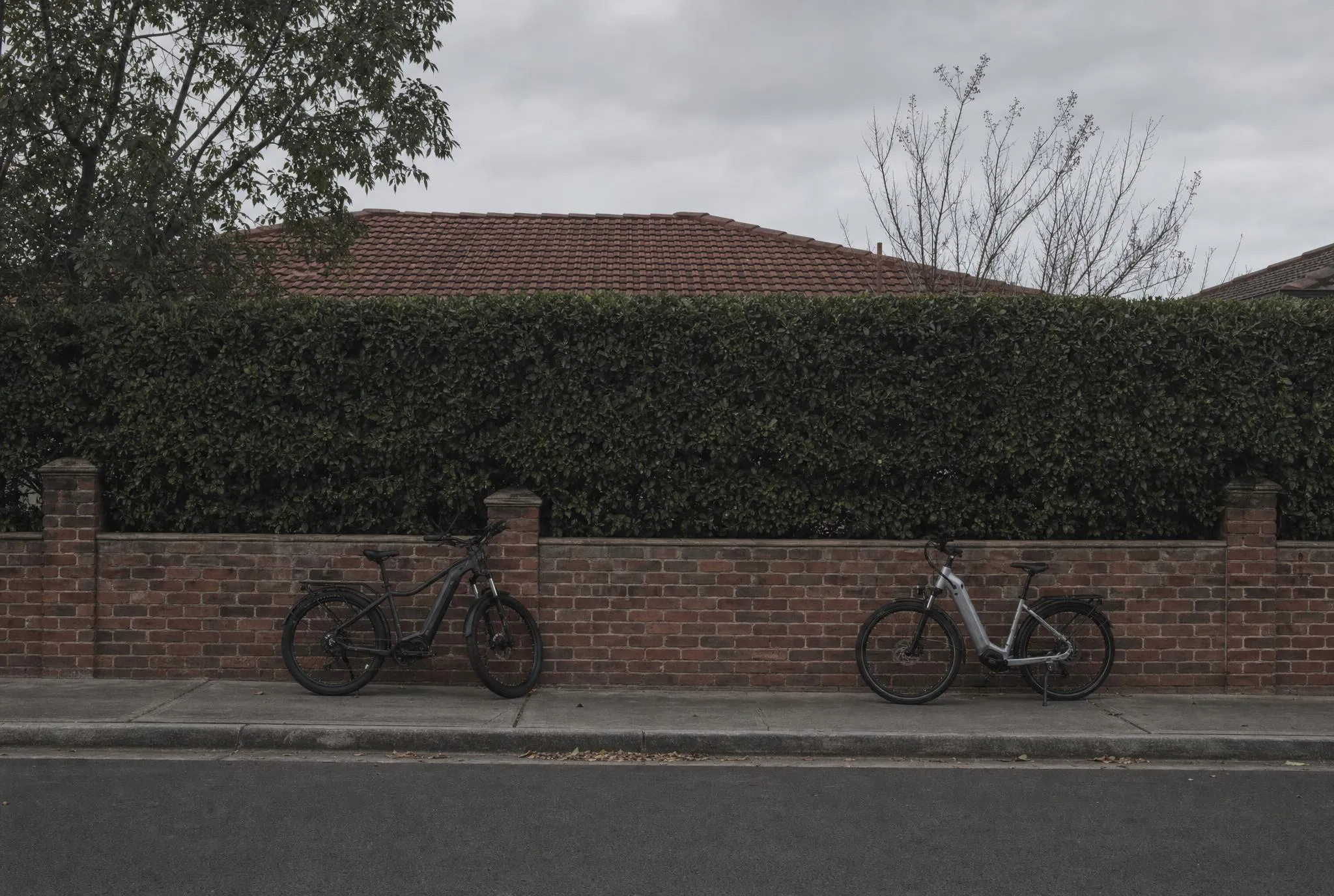
Are e-bikes legal in Western Australia?
Yes, if your e-bike meets WA's power standard, so it counts as a bicycle: 250 watts for a pedelec meeting EN 15194, or 200 watts otherwise. No licence or rego, but you need a helmet and must be 16 to use the motor.
- What counts as an e-bike
- A bike built to be propelled by human power, with auxiliary motors whose combined maximum output stays inside 250 watts (pedelec meeting EN 15194) or 200 watts (any other kind). A stronger build isn't one 3
- Footpaths
- Yes for most paths. Not allowed on the pedestrian part of a separated footpath, or where a 'no bicycles' sign applies. Keep left and give way to people on foot 1
- Your top speed
- No special cap for an e-bike. You follow the speed limit for the road you're on, and 10 km/h when riding across a pedestrian or children's crossing 1
- Minimum age
- 16 to ride with the power on. A child under 16 may pedal one with the motor off 1
- Helmet
- Required at all times on a road or path. A securely fastened protective helmet, for you and any passenger 1
- Licence & rego
- Neither. No vehicle licence (rego) because a compliant e-bike is not a motor vehicle for registration purposes. No driver licence because WA law authorises riding one without a licence 5
- Lights at night
- Required in darkness or poor visibility. A white front light and a red rear light, each visible 200 m, plus a red rear reflector. A brake and a warning device are needed at all times 1
An e-bike is legal to ride in Western Australia if it is the right kind of e-bike. The law treats a compliant one as a bicycle, so ordinary bike rules apply. 1 You need no driver licence to ride it 5, and there is no general minimum age. 1
WA’s regulations write the power figures out in full. 3 That makes the test for a legal e-bike clear here.
The picture is very different from the e-scooter, which WA calls an electric rideable device. An e-scooter is capped at 25 km/h, drops to 10 km/h on footpaths, and is banned from roads over 50 km/h. An e-bike is a bicycle, so none of those limits reach it. 1
What counts as a legal e-bike in WA?
A bike built to be propelled by human power, with one or more auxiliary motors. WA’s name for it is a power assisted pedal cycle. 2
s 4, definition power assisted pedal cycle What a power assisted pedal cycle is Road Traffic (Administration) Act 2008 (WA) 2
power assisted pedal cycle means a vehicle — (a) designed to be propelled through a mechanism operated solely by human power; and (b) to which is attached one or more auxiliary propulsion motors having a combined maximum output not exceeding the amount of power prescribed for the purposes of this definition;
So two things have to be true. The bike is designed to be propelled by human power. And its motors’ combined maximum output stays inside a set limit. 2
WA’s regulations set that limit directly, with two levels. 3
reg 4(1)–(2) The power cap: 250 W pedelec (EN 15194) / 200 W Road Traffic (Administration) Regulations 2014 (WA) 3
4. Power assisted pedal cycles (1) In this regulation — pedalec means a vehicle that meets the standard of the European Committee for Standardization entitled EN 15194:2009 or EN 15194:2009+A1:2011 Cycles — Electrically power assisted cycles — EPAC Bicycles. (2) For the definition of power assisted pedal cycle in section 4, the amount of power is — (a) for a pedalec — 250 W; and (b) for any other kind of power assisted pedal cycle — 200 W.
The higher level is a “pedalec” (often spelled “pedelec”). It is a bike that meets the European safety standard EN 15194 (the 2009 version, or its 2011 amendment). Its motors’ combined maximum output may be up to 250 watts. Any other kind of power-assisted pedal cycle is held to 200 watts. 3
Because the bike is built to be propelled by human power with auxiliary motors inside those limits, the law counts it as a bicycle. 1
reg 3(1), definition bicycle A compliant e-bike is a bicycle Road Traffic Code 2000 (WA) 1
bicycle means a vehicle with 2 or more wheels that is built to be propelled by human power through a belt, chain or gears (whether or not it has an auxiliary motor) and — (a) includes a pedicab, penny-farthing, tricycle and power assisted pedal cycle; but (b) does not include a wheelchair, wheeled recreational device, wheeled toy, any vehicle (other than a power assisted pedal cycle) with an auxiliary motor capable of generating a power output over 200 watts (whether or not the motor is operating), or an electric rideable device;
That is why you ride it under bicycle rules. Registration and licensing are settled by other laws, covered below. A motor whose combined output exceeds 200 watts, and that is not a compliant pedelec, takes the bike out of the bicycle definition. 1
Do you need a licence or registration for an e-bike in WA?
No to both. The two answers come from different parts of WA law, though.
No vehicle licence (registration). For registration and vehicle-licensing purposes, a power assisted pedal cycle is not a motor vehicle. 2
s 4, definition motor vehicle (paras (a)–(b)) Motor vehicle: two contexts, one PAPC carve-out Road Traffic (Administration) Act 2008 (WA) 2
motor vehicle — (a) in relation to authorisation to drive, means a vehicle that is built to be propelled by a motor that forms part of the vehicle; (b) otherwise, means a self-propelled vehicle that is not operated on rails and — (i) includes a trailer, semi-trailer or caravan while attached to the vehicle; but (ii) does not include a power assisted pedal cycle;
The vehicle-licensing rule requires a vehicle licence only for a motor vehicle or a trailer. 4 A compliant e-bike is not a motor vehicle for this purpose, 2 so that rule never reaches it. 4
reg 15(1)–(2) Vehicle licence required for motor vehicles Road Traffic (Vehicles) Regulations 2014 (WA) 4
15. Vehicles required to be licensed (1) For section 4(1), a vehicle licence is required for a vehicle that is a motor vehicle or a trailer. (2) However, a vehicle licence is not required for a motor vehicle or trailer that is — […] (c) a motor vehicle that is designed so as not to be capable of a speed exceeding 10 km/h; or (d) a vehicle declared as an electric personal transporter […]; or (e) a motorised scooter or electric rideable device.
No driver licence. WA regulations authorise riding a power assisted pedal cycle on a road without a driver licence. 5
reg 55(1)–(2) No driver licence needed for a PAPC Road Traffic (Authorisation to Drive) Regulations 2014 (WA) 5
55. Certain motor vehicles may be driven without licence (1) A person may drive on a road a motor vehicle referred to in subregulation (2) even though the person is not authorised to do so other than by this regulation. (2) The motor vehicles that this regulation authorises a person to drive on a road are these — (a) a motor vehicle used only on a railway or tramway; (b) a motor vehicle designed to be controlled by a person walking next to it; (c) a motor vehicle propelled by a motor having a maximum power output not exceeding 200 W; (d) a power assisted pedal cycle; (e) a motorised wheelchair that cannot travel at a speed above 10 km/h; […]
Reg 55(2)(d) names a power assisted pedal cycle in the list of vehicles a person may drive on a road even without a licence. 5
What happens with a non-compliant build? A motor whose combined output exceeds 200 watts and that is not a compliant pedelec takes the bike out of the bicycle definition. 1 What is left is a self-propelled vehicle, which falls under the motor-vehicle definition. 2 A motor vehicle needs a vehicle licence before it can be used on the road. 4 Using an unlicensed one on a road is an offence. 6 Its driver also needs to be authorised to drive it, and driving without that authority is a separate offence. 7
s 4(1)–(2) Using an unlicensed vehicle on a road is an offence Road Traffic (Vehicles) Act 2012 (WA) 6
4. Vehicle licences (1) A vehicle licence is required for a vehicle of a prescribed class. (2) A responsible person for a vehicle and each person who uses the vehicle on a road commits an offence if, at the time the vehicle is used on the road — (a) a vehicle licence is required for the vehicle; and (b) a licence has not been granted in respect of the vehicle or a licence has been granted in respect of the vehicle but is not current. Penalty: a fine of 10 PU, and in addition, the court is to order the accused to pay a further penalty equal to the charges payable under this Act for the grant of a vehicle licence for the vehicle concerned for a period of 6 months. […]
s 49(1)(a) Driving a motor vehicle without being authorised to drive Road Traffic Act 1974 (WA) 7
49. Driving while unlicensed or disqualified (1) A person who — (a) drives a motor vehicle on a road while not authorised under the Road Traffic (Authorisation to Drive) Act 2008 Part 2 to do so; or […] commits an offence. Penalty for this subsection: (a) unless subsection (3) applies — (i) for a first offence, 6 PU; (ii) for a subsequent offence, 12 PU; […]
Where can you ride an e-bike in WA, and how fast?
On the road, and on paths. In WA, “path” takes in footpaths, bicycle paths, separated footpaths and shared paths, and a bicycle may ride on them, with two exceptions. 1
reg 253(1)–(2) Bicycles may ride on paths Road Traffic Code 2000 (WA) 1
253. Driving on paths (1) A person must not drive a vehicle on a path. Modified penalty: 2 PU (2) Subregulation (1) does not apply to — […] (e) a person riding a bicycle, electric rideable device or motorised scooter on a path;
On a path, keep to the left and give way to anyone on foot. 1
Two path restrictions apply. You must not ride on the part of a separated footpath designated for pedestrians only. 1 And you must not ride on a length of road or path where a “no bicycles” sign or road marking applies. 1
You also can’t ride in a pedestrian mall. 1
reg 292 No riding in a pedestrian mall Road Traffic Code 2000 (WA) 1
292. Restrictions on traffic in pedestrian mall A person must not drive a vehicle in a pedestrian mall unless that vehicle is — (a) a public bus; or (b) an emergency vehicle; or (c) a special purpose vehicle; or […] Modified penalty: 1 PU
There is no separate speed limit for an e-bike. You follow the same speed limits as any vehicle on that road. 1 One rule is just for bikes. Ride no faster than 10 km/h onto and across a pedestrian or children’s crossing, and give way to people on it. 1
reg 214 10 km/h across a pedestrian or children's crossing Road Traffic Code 2000 (WA) 1
214. Riding across a crossing The rider of a bicycle or electric rideable device riding across a carriageway, or part of a carriageway, on a children’s crossing, marked foot crossing or pedestrian crossing must — (a) enter the crossing from the path connected to the crossing and not from the carriageway; and (b) approach and ride on the crossing at a speed not exceeding 10 km/h; and (c) keep to the left of the crossing unless it is impracticable to do so; and (d) give way to any pedestrians on the crossing. Modified penalty: 1 PU
An e-scooter is held to 25 km/h everywhere, and to 10 km/h on a footpath. Neither of those numbers applies to an e-bike. 1
How old do you have to be, and do you need a helmet, in WA?
There is no minimum age just to ride. The main age rule is about the motor. 1
reg 228(1) Under 16 only with the power off Road Traffic Code 2000 (WA) 1
228. Minimum age to ride power assisted pedal cycle or electric rideable device (1) A person who is under 16 years of age must not ride a power assisted pedal cycle with the power assistance engaged. Modified penalty: 1 PU
A person under 16 must not ride with the power assistance engaged. 1 A younger child can still pedal the bike with the motor switched off.
You also need to be 16 to carry a child in a child seat, or to tow a trailer with a child in it. A child in a trailer must be under 10. 1
reg 212(2) 16 to carry a child in a child seat Road Traffic Code 2000 (WA) 1
212. Carrying persons or animals on bicycles or electric rideable devices […] (2) The rider of a bicycle must not carry a child in a child carrying seat on a bicycle unless the rider — (a) is at least 16 years of age; and (b) has an uninterrupted view to the front of the bicycle from a normal seated position; and (c) has unhindered access to all equipment, required by this Part, to be fitted to the bicycle. Modified penalty: 1 PU […]
reg 223(1) 16 to tow a trailer with a person in it Road Traffic Code 2000 (WA) 1
223. Riding with person on bicycle trailer (1) The rider of a bicycle must not tow a bicycle trailer with a person in or on the bicycle trailer, unless — (a) the rider is 16 years of age, or older; and (b) the person in or on the bicycle trailer is under 10 years of age; and (c) the bicycle trailer can safely carry the person; and (d) the person in or on the bicycle trailer is wearing a protective helmet securely fitted and fastened on the person’s head. Modified penalty: 1 PU […]
A helmet is required on any road or path. It has to be a protective helmet, securely fastened, and the same goes for anyone you carry. 1 Riding without one is a $50 fine on the spot. 1 There are exemptions for religious or cultural headdress, and a medical exemption the CEO may grant in writing. 1
reg 222(2) Helmet for rider and passenger Road Traffic Code 2000 (WA) 1
222. Riders of bicycles to wear and ensure passengers wear protective helmets […] (2) Except as provided in this regulation, a person must not ride a bicycle on a road or any path unless — (a) that person is wearing a protective helmet securely fastened on his or her head; and (b) where any other person is being carried on that bicycle, that other person is wearing a protective helmet securely fastened on his or her head. Modified penalty: 1 PU […]
What are the lighting and equipment rules at night?
After dark, or in hazardous weather that cuts visibility, you need lights and a rear reflector. 1
reg 224(1)–(2) Lights and brakes required — bicycle Road Traffic Code 2000 (WA) 1
224. Lights and other equipment on bicycles and electric rideable devices [(1A) …] (1) A person must not ride a bicycle or electric rideable device during the hours of darkness, or in hazardous weather conditions causing reduced visibility, unless the bicycle or electric rideable device, or the rider, displays — (a) a flashing or steady white light that is clearly visible for at least 200 m from the front of the bicycle or electric rideable device; and (b) a flashing or steady red light that is clearly visible for at least 200 m from the rear of the bicycle or electric rideable device; and (c) a red reflector that is clearly visible for at least 50 m from the rear of the bicycle or electric rideable device when light is projected onto it by a motor vehicle's headlight on low-beam. Modified penalty: 2 PU […] (2) A person must not ride a bicycle that does not have — (a) at least one effective brake; and (b) a warning device in working order. Modified penalty: 2 PU
You need a white front light and a red rear light, each visible from at least 200 metres. You also need a red rear reflector visible from 50 metres when a vehicle shines low-beam headlights onto it. The fine for riding without them is $100 on the spot (2 penalty units). 1
Your bicycle also needs at least one effective brake and a working bell or horn at all times, not just at night. That rule carries the same $100 fine (2 PU). 1 At night, yellow side reflectors on each wheel and yellow pedal reflectors are each a separate $50 offence (1 PU). 1
What happens if you get a fine in WA?
WA sets its fines in penalty units, and each unit is $50. 2 A code offence carrying “1 PU” costs $50; “2 PU” costs $100. The amount on the ticket is the modified penalty stated in the regulation. 1 3 If a case goes to court instead, a first offence against the Code can carry up to 64 penalty units, which is $3,200. 1
reg 9(1)–(2) Court maximum for an offence under the Code Road Traffic Code 2000 (WA) 1
9. Penalties (1) A person who contravenes or fails to comply with any of the provisions of these regulations, commits an offence. […] (2) Except as provided in subregulation (1A), a person who commits an offence against these regulations is liable — (a) for a first offence, to a penalty not exceeding 64 penalty units (64 PU); and (b) for a subsequent offence, to a penalty not exceeding 96 penalty units (96 PU).
The on-the-spot fines for equipment and behaviour offences are all $50 or $100. No helmet: $50 (reg 222, 1 PU). Under-16 with the motor on: $50 (reg 228, 1 PU). Not giving way or not keeping left on a path: $50 (reg 216, 1 PU). No front or rear light or rear reflector at night: $100 (reg 224(1), 2 PU). No brake or bell: $100 (reg 224(2), 2 PU). 1
For a non-compliant build, the issue is the bike’s class. A build outside the power limits is not a bicycle — it becomes a motor vehicle. A motor vehicle must hold a vehicle licence to be used on the road. 4 Using an unlicensed motor vehicle on a road is an offence. The court fine is up to $500 (10 PU), plus six months’ licence charges. 6 Driving it without being authorised to drive is a further offence: $300 (6 PU) for a first offence, and more, including prison, if your licence was refused, suspended or disqualified. 7
What it costs to get it wrong
| Offence | Penalty | Source |
|---|---|---|
| No helmet, rider or passenger (reg 222) | $50 on the spot; up to $3,200 in court (first offence) | 1 |
| Riding under 16 with the power assistance engaged (reg 228) | $50 on the spot; up to $3,200 in court (first offence) | 1 |
| Not giving way to people on foot, or not keeping left, on a path (reg 216) | $50 on the spot; up to $3,200 in court (first offence) | 1 |
| No front/rear light or rear reflector in darkness or poor visibility (reg 224(1)) | $100 on the spot; up to $3,200 in court (first offence) | 1 |
Common questions
Are e-bikes legal in Western Australia?
Yes, if it's a compliant one. A power-assisted pedal cycle within WA's power limits counts as a bicycle, so ordinary bike rules apply. You need no licence and there's no general riding age, but you must wear a helmet, have lights at night, and be 16 to ride with the motor on. 3
How many watts can an e-bike have in WA?
250 watts if it's a pedelec that meets EN 15194 (the 2009 version, or its 2011 amendment), or 200 watts for any other kind. WA's regulations state both figures. 3
Do you need a licence or rego for an e-bike in WA?
No. For registration: a compliant e-bike is not a motor vehicle for vehicle-licensing purposes under WA law, so no vehicle licence (rego) is required. For a driver licence: WA regulations authorise riding a power assisted pedal cycle on a road without one. 5
Can you ride an e-bike on the footpath in WA?
Yes, on most paths including footpaths. Two restrictions apply: you must not ride on the part of a separated footpath marked for pedestrians only, and you must not ride where a 'no bicycles' sign or road marking applies. On any path, keep left and give way to people on foot. You also can't ride in a pedestrian mall. 1
How old do you have to be to ride an e-bike in WA?
16 to ride with the power assistance engaged. There is no general minimum age to ride: a child under 16 can pedal a power-assisted pedal cycle with the motor switched off. You also need to be 16 to carry a child in a child seat, or to tow a trailer with a child in it. 1
How fast can you ride an e-bike in WA?
There is no separate speed limit for an e-bike. You follow the speed limit for the road you're on. One rule is just for bikes: ride no faster than 10 km/h across a pedestrian or children's crossing. The 25 km/h and 10 km/h footpath caps in the Code apply to e-scooters; an e-bike has no such cap. 1
Do you need a helmet on an e-bike in WA?
Yes. A protective helmet, securely fastened, for you and any passenger, on any road or path. Riding without one is a $50 fine on the spot. 1
Do you need lights on an e-bike in WA at night?
Yes. At night or in poor visibility you must have a white front light visible from 200 m, a red rear light visible from 200 m, and a rear red reflector visible from 50 m. The fine is $100 on the spot. Your bike also needs an effective brake and a working bell or horn at all times. 1
Every source on this page
The small numbered marks throughout this page point to this list — 1 means source 1 below.
- Road Traffic Code 2000 (WA), regs 3(1) (bicycle, path), 9(2), (4), 11, 15, 210B, 212, 214, 215, 216, 218, 222, 223, 224, 228, 253, 292
- Road Traffic (Administration) Act 2008 (WA), s 4 (power assisted pedal cycle; motor vehicle), s 7 (1 PU = $50)
- Road Traffic (Administration) Regulations 2014 (WA), reg 4 (power assisted pedal cycle — 250 W pedelec / 200 W, EN 15194), reg 24 (infringement notices and modified penalties)
- Road Traffic (Vehicles) Regulations 2014 (WA), reg 15 (vehicle licence required for motor vehicles)
- Road Traffic (Authorisation to Drive) Regulations 2014 (WA), reg 55(2)(d) (power assisted pedal cycle — no driver licence required)
- Road Traffic (Vehicles) Act 2012 (WA), s 4 (vehicle licence required; offence of using an unlicensed vehicle on a road)
- Road Traffic Act 1974 (WA), s 49(1)(a) (driving a motor vehicle on a road while not authorised to do so)
Sourced from the Western Australian Legislation website at 13 Oct 2026. For the latest information on Western Australian legislation, visit www.legislation.wa.gov.au. © State of Western Australia. Licensed under CC BY 4.0. Reproduced without changes. This is not an official version and its use is not endorsed by the State. Creative Commons Attribution 4.0 licence.
Sourced from the Western Australian Legislation website at 15 Oct 2026. For the latest information on Western Australian legislation, visit www.legislation.wa.gov.au. © State of Western Australia. Licensed under CC BY 4.0. Reproduced without changes. This is not an official version and its use is not endorsed by the State. Creative Commons Attribution 4.0 licence.
Other rules for Western Australia
- Are e-scooters legal in Western Australia? Legal, with conditions
- How high can a fence be in WA? Varies by area
- Is it legal to record a conversation in Western Australia? Legal, with conditions
- What are the pool fence rules in WA? Legal, with conditions
E-bikes rules elsewhere
- Australian Capital Territory Legal, with conditions
- New South Wales Legal, with conditions
- Northern Territory Legal, with conditions
- Queensland Legal, with conditions
- South Australia Legal, with conditions
- Tasmania Legal, with conditions
- Victoria Legal, with conditions
Page history
Every change to this page
- 15 Oct 2026
- First published.