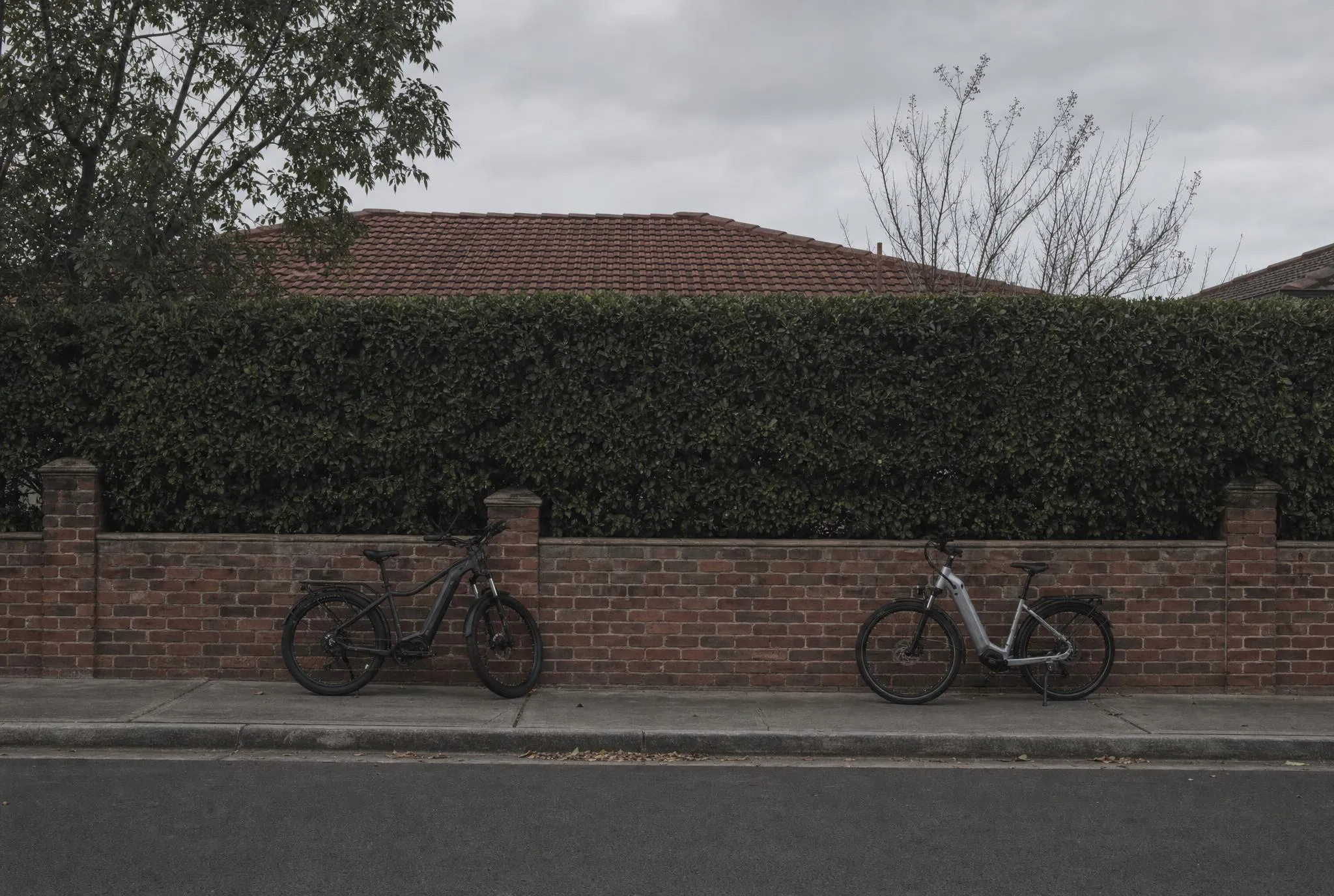
Are e-bikes legal in Victoria?
Yes, if your e-bike is a bicycle: built to be pedalled and within the power standard. No age limit and no licence, but you must wear a helmet, use lights at night, and mostly can't ride on footpaths from 13.
- What counts as an e-bike
- A bike built to be pedalled, with a motor up to 200 watts; or a pedal-assist bike that meets the Commonwealth power-assisted pedal cycle standard. A build you can't pedal, or a stronger motor that isn't a compliant pedal-assist cycle, isn't one 1
- Footpaths
- Under 13, yes. From 13, only in set cases, like riding alongside and supervising a child under 13. Keep left and give way to people on foot 1
- Your top speed
- No e-bike speed limit. You keep to the speed limit for the road you're on 1
- Minimum age
- None to ride. The age-13 rule only decides who can use a footpath 1
- Helmet
- Required, for you and any passenger, unless a doctor's certificate or religious headdress exempts you. The fine is half the e-scooter one 1
- Lights at night
- Required. A white front light and a red rear light, each visible 200 metres, plus a red rear reflector, whenever you ride at night or in poor visibility 1
- Licence & rego
- Neither. A 2022 order under the Road Safety Act declares a compliant e-bike not to be a motor vehicle, and only motor vehicles need registration and a licence 5
An e-bike is legal to ride in Victoria if it is the right kind of e-bike. The law treats a compliant one as a bicycle, so ordinary bike rules apply. 1 You need no licence to ride it, and there is no minimum age.
That is a very different picture from the e-scooter. An e-scooter rider has to be 16, is capped at 20 km/h, and may not touch a footpath. An e-bike has none of those limits. In law it is a bicycle, and the e-scooter rules don’t reach it. 1
What counts as a legal e-bike in Victoria?
A pedal bike with an electric motor. There are two ways a bike qualifies. 1
Dictionary — definition bicycle A pedal e-bike is a bicycle Road Safety Road Rules 2017 (Vic) 1
bicycle means a vehicle with 2 or more wheels that is built to be propelled partly or wholly by human power through a belt, chain or gears (whether or not it has an auxiliary motor), and— (a) includes a pedicab, penny-farthing and tricycle; and (b) includes a power-assisted pedal cycle within the meaning of vehicle standards, as amended from time to time, determined under section 7 of the Motor Vehicle Standards Act 1989 of the Commonwealth; but (c) does not include an electric personal transporter, an electric scooter, a scooter, wheelchair, wheeled recreational device, wheeled toy, or any vehicle with an auxiliary motor capable of generating a power output over 200 watts (whether or not the motor is operating), other than a vehicle referred to in paragraph (b); […] Notes 1 … The definition of power-assisted pedal cycle includes pedalecs within the meaning of that Standard.
The first way is a motor of no more than 200 watts, on a bike you can still pedal. The second is a “power-assisted pedal cycle”, which Victoria defines by pointing to the Commonwealth vehicle standard. Victoria spells it “pedalec”. 1
That Commonwealth standard now covers a pedal-assist bike of up to 250 watts. The help fades above 6 km/h. It stops at 25 km/h, or as soon as you stop pedalling above 6 km/h. Victoria writes only the 200-watt figure into its own law. 4
Definitions — EPAC The Commonwealth pedal-assist standard Vehicle Standard (Australian Design Rule – Definitions and Vehicle Categories) 2005 (Cth) 4
ELECTRICALLY POWER-ASSISTED CYCLE (EPAC) - means an electrically-powered pedal cycle with a maximum continuous rated power of 250W, of which the output is: progressively reduced as the cycle’s travel speed increases above 6 km/h; and cut off, where: the cycle reaches a speed of 25 km/h; or the cyclist is not pedalling and the travel speed exceeds 6km/h.
Because the bike is built to be pedalled with a helper motor inside those limits, the law counts it as a bicycle, and you ride it under bicycle rules. 1
Do you need a licence or registration for an e-bike in Victoria?
No, and Victoria says so directly. A 2022 order made under the Road Safety Act declares two kinds of e-bike not to be motor vehicles. That covers the whole Act. One is a bicycle whose motor is 200 watts or less. The other is a pedal-assist cycle that meets the Commonwealth standard. 5 The Act’s registration and licence rules apply only to motor vehicles, so neither applies to a compliant e-bike. 2
Order in Council, cl 5(a)–(b) A compliant e-bike is declared not a motor vehicle Order in Council declaring certain motor vehicles not to be motor vehicles (Vic) 5
5. Declaration The Lieutenant-Governor, as the Governor’s deputy, with the advice of the Executive Council, under section 3(2)(b) of the Road Safety Act 1986, declares that the following motor vehicles are not motor vehicles for the purposes of that Act: (a) a bicycle, within the meaning of the Road Safety Road Rules 2017, if it is fitted with one or more auxiliary motors that has or have a combined maximum ungoverned continuous rated power output of 200 watts or less; and (b) an electrically power-assisted cycle (EPAC) within the meaning of the Vehicle Standard (Australian Design Rule – Definitions and Vehicle Categories) 2005 made under section 12 of the Road Vehicle Standards Act 2018 of the Commonwealth; […]
s 3(1) — definitions bicycle and motor vehicle A declared vehicle is not a motor vehicle Road Safety Act 1986 (Vic) 2
bicycle has the same meaning as in the Road Rules; […] motor vehicle means a vehicle that is used or intended to be used on a highway and that is built to be propelled by a motor that forms part of the vehicle but does not include— (a) a vehicle intended to be used on a railway or tramway; or (b) a motorised wheel-chair capable of a speed of not more than 10 kilometres per hour … ; or (c) a vehicle that is not a motor vehicle by virtue of a declaration under subsection (2)(b);
This is also where a bike can tip over into being illegal. Two things take it out of the bicycle class: a motor over 200 watts that is not a compliant pedal-assist cycle, or a build you can’t pedal at all. 1 The 2022 order doesn’t cover a bike like that. 5 If it is built to be propelled by its motor, it falls within the Act’s definition of a motor vehicle. 2
A motor vehicle has to be registered before it can be used on a road, and its driver has to be licensed. A build that fails the power standard is caught by both rules. Riding one in public means an unregistered motor vehicle with an unlicensed rider. 2
s 7 — offence if vehicle not registered An unregistered motor vehicle is an offence Road Safety Act 1986 (Vic) 2
7 Offence if vehicle or trailer not registered (1) A person must not— (a) use on a highway a motor vehicle or a trailer; or (b) own a motor vehicle or a trailer which is used on a highway— unless that motor vehicle or trailer is registered under this Part or exempted from registration under the regulations … (3) A person who contravenes subsection (1) or (2) is guilty of an offence and liable to a penalty not exceeding— (a) in the case of an individual— (i) 25 penalty units for a first offence; (ii) 50 penalty units for a second or subsequent offence; …
The maximum court fine for using an unregistered motor vehicle is $5,228 the first time. Driving it unlicensed can bring a fine of up to $12,546, or up to six months in prison. 2 3
s 18 — offence if driver not licensed An unlicensed driver is an offence Road Safety Act 1986 (Vic) 2
18 Offence if driver not licensed (1) A person must not drive a motor vehicle on a highway unless the person— (a) holds a driver licence or learner permit which authorises the person to drive that category of motor vehicle; or (b) holds a licence or permit issued in another State, a Territory or another country and is authorised by the regulations …; or (c) is otherwise authorised by the regulations … (1A) Unless subsection (2), (2A) or (3) applies, a person who commits an offence under subsection (1) is liable to a penalty not exceeding 60 penalty units or to imprisonment for not more than 6 months.
Where can you ride an e-bike in Victoria, and how fast?
On roads, bicycle paths and shared paths. But not on a freeway unless you’re on a path beside it or a sign allows it. Not where a “no bicycles” sign applies. And not across a pedestrian or children’s crossing. 1 2 Footpaths are the catch.
r 250 Footpaths: under-13s may, 13 and up restricted Road Safety Road Rules 2017 (Vic) 1
250 Riding on a footpath or shared path (1) The rider of a bicycle who is 13 years old or older must not ride on a footpath except in the circumstances specified under subrule (1A). 3 penalty units. (1A) … the circumstances … are— (a) … 13 years old or older and is accompanying and supervising a child under 13 years old who is riding a bicycle on the footpath; or (ab) … 18 years old or older and … carrying a child— (i) in a bicycle baby seat which is attached to the rider's bicycle; or (ii) on a single or two-wheeled bicycle attachment with pedals …; or (b) the rider of the bicycle is 13 years old or older and— (i) has a certificate signed by a registered medical practitioner; and (ii) the certificate states that the rider has a disability or medical condition which makes it undesirable, impracticable or inexpedient for the rider to ride on the road; and (iii) the rider is complying with the conditions (if any) stated on the certificate; and (iv) if the disability or medical condition is of a temporary nature, the certificate contains an expiry date and has not expired; and (v) the rider is carrying the certificate; and (vi) the rider produces the certificate when requested to do so by a police officer or authorised person; or (c) … accompanying and supervising a rider … under subrule (b); or (d) … a postal worker … in the course of their duties as a postal worker. (2) The rider of a bicycle riding on a footpath or shared path must— (a) keep to the left … unless it is impracticable …; and (b) give way to any pedestrian (except a person travelling on an electric personal transporter) on the footpath or shared path. 3 penalty units. […] (3) In this rule— footpath does not include a separated footpath.
A child under 13 can ride on a footpath. From 13 up, you can’t, apart from a few set cases. 1 They are:
- a rider 13 or older riding alongside and supervising a child under 13
- a rider 18 or older carrying a child in a bicycle baby seat, or on a bicycle attachment with pedals
- a rider 13 or older with a doctor’s certificate for a disability or medical condition, who carries it, follows any conditions on it and shows it to police when asked, and anyone 13 or older riding with and supervising them
- a postal worker on the job
On any path, keep left and give way to people on foot.
An e-scooter is banned from footpaths at every age. An e-bike is the opposite: allowed for young children, restricted for everyone from 13. 1
There is no speed cap written for an e-bike. You follow the ordinary limit for wherever you are riding, the same as any bicycle. 1 An e-scooter is held to 20 km/h where it’s allowed to ride. An e-bike is a bicycle, so no such number applies to it. 1
There is also no minimum age to ride. The age-13 line is about footpath use. It sets no floor on who may ride. An e-scooter rider must be 16. 1
Do you need a helmet on an e-bike in Victoria?
Yes. An approved bicycle helmet, fitted and fastened on your head, for you and anyone you carry. 1
r 256 Bicycle helmet — half the e-scooter fine Road Safety Road Rules 2017 (Vic) 1
256 Bicycle helmets (1) The rider of a bicycle or an electric scooter must wear an approved bicycle helmet securely fitted and fastened on the rider's head unless— (a) a registered medical practitioner has issued a certificate … under subrule (4) …; or (b) the rider is exempt … under subrule (7). Penalty: In the case of a bicycle, 5 penalty units; In the case of an electric scooter, 10 penalty units. (2) A passenger on a bicycle that is moving, or is stationary but not parked, must wear an approved bicycle helmet securely fitted and fastened on the passenger's head, unless— (a) the passenger is a paying passenger on a three or four-wheeled bicycle; or (b) a registered medical practitioner has issued a certificate to the passenger under subrule (4) and the passenger complies with subrule (6); or (c) the passenger is exempt from this rule under subrule (7). 5 penalty units. (3) The rider of a bicycle must not ride with a passenger … unless the passenger complies with subrule (2). 5 penalty units.
The same rule sets the e-scooter helmet fine at double. An e-bike rider without a helmet faces up to $1,046 in court. An e-scooter rider faces up to $2,091 for the same thing. 1 3 A doctor’s certificate, which you must carry and show police when asked, or a religious headdress that makes a helmet impracticable, can exempt you. 1
Do you need lights at night on an e-bike in Victoria?
Yes. Riding at night, or in weather that cuts visibility, the bike or you must show lights front and rear. 1
r 259 Lights and a reflector at night Road Safety Road Rules 2017 (Vic) 1
259 Riding at night The rider of a bicycle or an electric scooter must not ride at night, or in hazardous weather conditions causing reduced visibility, unless the bicycle, the electric scooter, or the rider, displays— (a) a flashing or steady white light that is clearly visible for at least 200 metres from the front of the bicycle or the electric scooter; and (b) a flashing or steady red light that is clearly visible for at least 200 metres from the rear of the bicycle or the electric scooter; and (c) a red reflector that is clearly visible for at least 50 metres from the rear of the bicycle or the electric scooter when light is projected onto it by a vehicle's headlight on low-beam. 5 penalty units. Note Low-beam and night are defined in the dictionary.
That means a white light at the front and a red light at the rear, each visible for 200 metres. You also need a red reflector at the back. Steady or flashing lights both count. 1
A second rule applies at any hour: the bike needs at least one working brake and a bell, horn or similar warning device. 1
r 258 Brake and bell, at any hour Road Safety Road Rules 2017 (Vic) 1
258 Equipment on a bicycle or an electric scooter A person must not ride a bicycle or an electric scooter that does not have— (a) at least one effective brake; and (b) a bell, horn, or similar warning device, in working order. 5 penalty units.
What happens if you’re stopped?
If police stop you on an e-bike in Victoria, the bicycle offences can apply. So can the motor-vehicle ones, if the bike isn’t compliant.
On the rider: no helmet carries a maximum court penalty of $1,046, and the same applies to a passenger. 1 3 Riding at night without the required lights and reflector carries up to $1,046, and so does riding a bike with no working brake and warning device. 1 3 If you are 13 or older and on a footpath outside the allowed cases, that is a separate offence, up to $627. 1 3
On the bike: the question is whether it is still a bicycle. A pedal e-bike inside the power limits is. A build with a motor over 200 watts that isn’t a compliant pedal-assist cycle, or one you can’t pedal, is a motor vehicle instead. 1 2 A motor vehicle has to be registered to be used on a road, and its driver has to be licensed. Riding one in public runs into both offences at once.
Those two are the expensive ones. Using an unregistered motor vehicle runs to a maximum of $5,228 the first time and $10,455 if it happens again. Driving it unlicensed runs to $12,546, or up to six months in prison. 2 3
The dollar figures here are the maximum penalties a court can impose. Each rule sets its fine as a number of penalty units. One penalty unit is $209.10 in Victoria for 2026–27, and the figures here are the units multiplied out and rounded to the nearest dollar. 3
What it costs to get it wrong
| Offence | Penalty | Source |
|---|---|---|
| No helmet, rider or passenger (r 256) | up to $1,046 in court | 1 |
| No lights or rear reflector when riding at night (r 259) | up to $1,046 in court | 1 |
| No working brake and warning device (r 258) | up to $1,046 in court | 1 |
| Riding on a footpath when you're 13 or older (r 250) | up to $627 in court | 1 |
| Using an unregistered motor vehicle, meaning a non-compliant build (Road Safety Act s 7) | up to $5,228 first time; $10,455 if it happens again | 2 |
| Driving a non-compliant build unlicensed (Road Safety Act s 18) | up to $12,546, or up to 6 months' prison | 2 |
Common questions
Are e-bikes legal in Victoria?
Yes, if it's a compliant one. A pedal e-bike that stays within the power standard counts as a bicycle, so ordinary bike rules apply. You need no licence and there's no minimum age, but you must wear a helmet, carry lights at night, and from 13 you can ride on footpaths only in a few set cases. 1
How many watts can an e-bike have in Victoria?
Up to 200 watts for an ordinary pedal e-bike. A bike can go higher only if it meets the Commonwealth pedal-assist standard, which allows up to 250 watts with help cutting out at 25 km/h. Victoria writes only the 200-watt figure into its own law. 1
Do you need a licence to ride an e-bike in Victoria?
No. A 2022 order declares a compliant e-bike not to be a motor vehicle, so the registration and licence rules don't apply to it. A build outside the order's limits isn't covered, and riding it on a road needs registration and a licence. 5
Can you ride an e-bike on the footpath in Victoria?
Children under 13 can. From 13 up you can't, apart from set cases, such as riding alongside and supervising a child under 13, carrying a young child, or holding a doctor's certificate. On a shared path, keep left and give way to people on foot. 1
Is there a minimum age to ride an e-bike in Victoria?
No. An e-scooter has a minimum age of 16, but an e-bike has no riding age. The age-13 rule decides footpath use only; it sets no riding age. 1
Do you need a helmet on an e-bike in Victoria?
Yes. An approved bicycle helmet, fitted and fastened, for you and any passenger. The maximum court fine is $1,046, which is half what an e-scooter rider faces for the same thing. A doctor's certificate, which you must carry and show police when asked, or a religious headdress that makes a helmet impracticable, can exempt you. 1
Do you need lights on an e-bike at night in Victoria?
Yes. Riding at night, or in weather that cuts visibility, the bike or the rider must show a white light at the front and a red light at the rear, each visible 200 metres, plus a red rear reflector. The lights can be steady or flashing. 1
Is a throttle e-bike legal in Victoria?
It can be. What matters is that the bike is still built to be pedalled and its motor is 200 watts or less, or that it is a compliant pedal-assist cycle. A build you can't pedal at all, or a stronger motor that isn't a compliant pedal-assist cycle, isn't a bicycle. It becomes a motor vehicle, which needs registration and a licence. 1
Every source on this page
The small numbered marks throughout this page point to this list — 1 means source 1 below.
- Road Safety Road Rules 2017 (Vic), Dictionary (bicycle), rr 20, 248, 250, 252, 256, 258, 259, 262C, 262F, 262G
- Road Safety Act 1986 (Vic), s 3(1) (bicycle; motor vehicle), s 7, s 18, s 68A
- Victorian Treasurer's notice — penalty unit value 2026–27 ($209.10)
- Vehicle Standard (Australian Design Rule – Definitions and Vehicle Categories) 2005 (Cth), Definitions — electrically power-assisted cycle (EPAC)
- Order in Council declaring certain motor vehicles not to be motor vehicles (Vic), Victoria Government Gazette No. S 331, 30 June 2022, cl 5(a)–(b), made under Road Safety Act 1986 s 3(2)(b); in operation 1 July 2022
© State of Victoria. Sourced from the Victorian Legislation website at 13 Oct 2026. For the latest information on Victorian legislation please go to https://www.legislation.vic.gov.au. Reproduced without changes. This is not an official version — authorised versions are published at legislation.vic.gov.au.
Sourced from the Federal Register of Legislation at 15 Oct 2026. For the latest information on Australian Government law please go to https://www.legislation.gov.au. Licensed under CC BY 4.0. Reproduced without changes. This is not an official version. Creative Commons Attribution 4.0 licence.
© State of Victoria. Sourced from gazette.vic.gov.au at 15 Oct 2026. Reproduced without changes. This is not an official version.
Other rules for Victoria
- Are e-scooters legal in Victoria? Legal, with conditions
- How high can a fence be in Victoria? Legal, with conditions
- Is it legal to record a conversation in Victoria? Legal, with conditions
- What are the pool fence rules in Victoria? Legal, with conditions
E-bikes rules elsewhere
- Australian Capital Territory Legal, with conditions
- New South Wales Legal, with conditions
- Northern Territory Legal, with conditions
- Queensland Legal, with conditions
- South Australia Legal, with conditions
- Tasmania Legal, with conditions
- Western Australia Legal, with conditions
Page history
Every change to this page
- 15 Oct 2026
- First published.