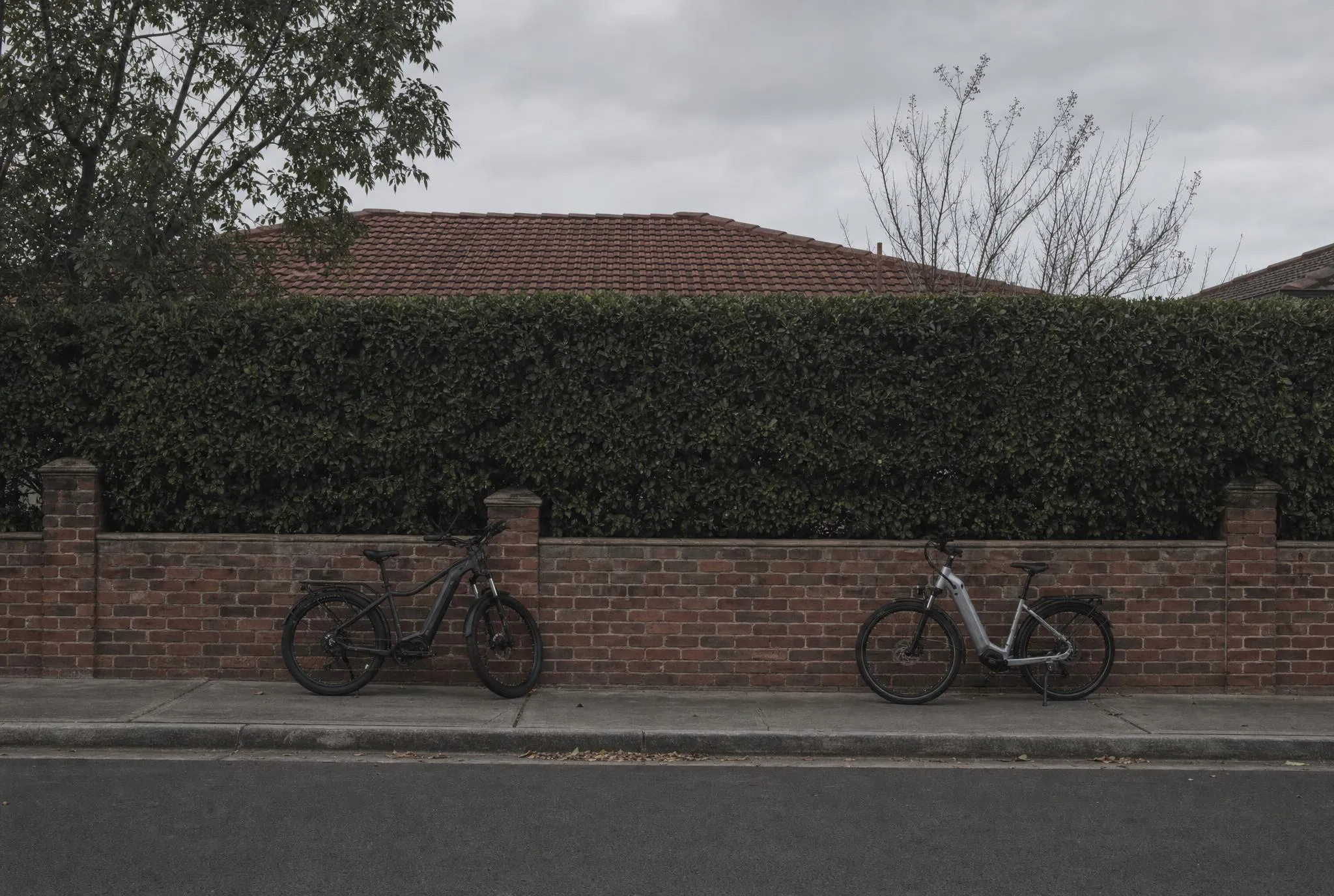
Are e-bikes legal in Queensland?
Yes, if your e-bike is a pedal-assist bike that meets the EN 15194 standard, so it counts as a bicycle. Riders usually must be 16 and hold a driver licence, plus a helmet and lights at night.
- What counts as an e-bike
- A pedal bike whose motor helps as you pedal and meets the EN 15194 safety standard, with a compliance label fitted. An over-standard motor, or a throttle that drives it past 6 km/h without pedalling, takes it outside the rules 1
- Footpaths
- Yes, unless a 'no bicycles' sign or marking applies. Keep left, give way to people on foot, and pass them at 12 km/h or less on a shared path 2
- Your top speed
- No blanket cap. You follow the ordinary limit for where you are. 12 km/h at crossings and on unsigned footpaths 2
- Minimum age
- Usually 16, with a driver licence, the same rule as e-scooters. A child of 12 or over can ride while a parent, grandparent, legal guardian or approved carer supervises them 1
- Helmet
- Required, for you and any passenger. Narrow exemptions: a current doctor's certificate, or a religious headdress that makes a helmet impractical 2
- Lights at night
- Riding after dark, you need a white front light, a red rear light and a red rear reflector 2
- Licence & rego
- A valid driver licence to ride, Queensland, interstate or overseas. No registration: a compliant e-bike is an exempt vehicle, so it carries no plates 1
An e-bike is legal to ride in Queensland if it is the right kind of e-bike. The law treats a compliant one as a bicycle, so ordinary bike rules apply. 1 What is different is who can ride it. Since 31 August 2026 most riders need to be at least 16 and hold a driver licence. 1
That licence rule is the same one Queensland put on e-scooters. Almost everything else is different, because in law an e-bike is a bicycle and an e-scooter is not. There is no device speed cap, and the test for a legal e-bike is a pedal-assist safety standard. 2
What counts as a legal e-bike in Queensland?
A pedal bike with an electric motor that helps you along while you pedal. Queensland’s name for it is an electrically power-assisted cycle, or EPAC. 1
Sch 4, definition electrically power-assisted cycle What makes an e-bike compliant Transport Operations (Road Use Management) Act 1995 (Qld) 1
electrically power-assisted cycle means a vehicle that— (a) has 2 or more wheels; and (b) is built to be propelled by human power through a belt, chain or gears; and (c) has 1 or more auxiliary electric motors; and (d) is 1 of the following types of vehicles— (i) a vehicle that—(A) complies with the EPAC standard in force when the vehicle was manufactured; and (B) has attached to it, in a permanent way, a label that indicates compliance with the EPAC standard; (ii) a vehicle to which a special circumstances permit applies; (iii) a vehicle that is verified as a legacy EPAC or special purpose EPAC as provided for under the EPAC verification rules.
So for a new e-bike, three things have to be true. The bike is built to be pedalled. It has one or more electric motors. And it meets the EPAC standard, with a label fitted that proves it. 1 Older bikes and permit bikes have their own routes, set out below.
That standard is a European one, EN 15194, named directly in Queensland’s road rules. 2 Queensland’s rules name the standard but do not restate its numbers. For comparison, Western Australia’s rules define a “pedalec” by the same EN 15194 standard and put it at 250 watts. 5
Because the bike is pedal-powered with a helper motor that meets the standard, the law counts it as a bicycle. It is not a motor vehicle. 1
Sch 4, definition bicycle A compliant e-bike is a bicycle Transport Operations (Road Use Management) Act 1995 (Qld) 1
bicycle— (a) means a vehicle with 2 or more wheels that is built to be propelled by human power through a belt, chain or gears, whether or not it has 1 or more auxiliary motors; and (b) includes the following— (i) a pedicab; (ii) a penny-farthing; (iii) a tricycle; (iv) an electrically power-assisted cycle; but (c) does not include the following— (i) a motorised mobility device; (ii) a wheelchair; (iii) a wheeled recreational device; (iv) a wheeled toy; (v) any vehicle with 1 or more auxiliary motors, other than an electrically power-assisted cycle.
That is why a compliant e-bike needs no registration and no number plate. Registration law applies to a “vehicle”, and a bicycle is a vehicle. But a bicycle is an “exempt vehicle”, so the duty to register does not reach it, and without registration there are no plates to display. 8
ss 4, 10 and Sch 1 item 13 Why a compliant e-bike needs no registration Transport Operations (Road Use Management—Vehicle Registration) Regulation 2021 (Qld) 8
10 … (1) A person must not use, or permit to be used, a vehicle on a road that is not a registered vehicle. Maximum penalty—80 penalty units. (2) However, subsection (1) does not apply if the vehicle is— (a) an exempt vehicle; […] 4 Meaning of exempt vehicle A vehicle mentioned in schedule 1 is an exempt vehicle. […] Schedule 1 Exempt vehicles […] 13 A vehicle that is not a motor vehicle, trailer or motorised mobility device.
Item 13 turns on the bike not being a motor vehicle. The Act’s own definition puts an e-bike outside that term. 1
Sch 4, definition motor vehicle An e-bike is not a motor vehicle Transport Operations (Road Use Management) Act 1995 (Qld) 1
motor vehicle means a vehicle propelled by a motor that forms part of the vehicle, and— (a) includes a trailer attached to the vehicle; but (b) does not include a low powered toy scooter, a motorised mobility device, a personal mobility device or an electrically power-assisted cycle.
A motor that is not a compliant EPAC takes the bike out of the bicycle definition altogether. 1
Older e-bikes have their own path. A bike made before 1 July 2026 can count as a “legacy” e-bike, but only once it has been verified as one under the department’s EPAC verification rules. To qualify it needs pedals and a motor no stronger than 250 watts. It can’t go faster than 6 km/h on motor power alone, and the assistance has to cut out at 25 km/h. 1 7
s 129D Legacy e-bikes: Queensland's own 250 W / 25 km/h limits Transport Operations (Road Use Management—Accreditation and Other Provisions) Regulation 2015 (Qld) 7
129D Prescribed characteristics and limitations for legacy EPACs (1) For section 122Q of the Act, definition legacy EPAC, paragraph (e), this section prescribes the characteristics and limitations for legacy EPACs. (2) A legacy EPAC must have pedals. (3) The total maximum continuous rated power of all auxiliary electric motors for a legacy EPAC must not be more than 250 watts. (4) When propelled only by auxiliary electric motor, a legacy EPAC must not be capable of exceeding a speed of 6km/h. (5) The propulsion assistance provided by an auxiliary electric motor must cut off once the legacy EPAC reaches a speed of 25km/h. (6) A legacy EPAC must not have a feature that allows a power or speed limitation mentioned in subsection (3), (4) or (5) to be bypassed, disengaged or overridden, unless the feature is for the purpose of setting a lower power or speed limitation.
A verified legacy e-bike counts as a bicycle, so the bike rules apply to it the same way. 1
What makes your e-bike illegal in Queensland?
A build that fails the EPAC test does not count as a bicycle at all. It becomes a prohibited bike. 1
s 6 A non-compliant e-bike is a "prohibited bike" Transport Operations (Road Use Management) Act 1995 (Qld) 1
6 What is a prohibited bike (1) Each of the following vehicles is a prohibited bike— (a) a noncompliant electrically power-assisted cycle; […] (2) However, none of the following vehicles is a prohibited bike— […] (b) an electrically power-assisted cycle; […] (4) In this section— noncompliant electrically power-assisted cycle means a vehicle that resembles an electrically power-assisted cycle but does not meet all elements of the definition of electrically power-assisted cycle under this Act.
A non-compliant EPAC is one that looks like an e-bike but misses any part of the definition. A motor stronger than the standard, no compliance label, or a throttle that drives the bike past 6 km/h without pedalling all fall here. 1
s 84B(1) Riding a prohibited bike is banned Transport Operations (Road Use Management) Act 1995 (Qld) 1
(1) A person must not ride a prohibited bike on a road, on a road-related area or in a public place. Maximum penalty—40 penalty units.
Riding a prohibited bike is banned on any road, bike path or public place. It is a $621 fine on the spot, and up to $6,908 if it goes to court. 3 There are two defences. One is riding at an organised competition or show held with the landowner’s consent. The other covers a vehicle the registration rules let you use without registration, for example under a permit. 1
Older e-bikes get some room. Say your bike was made before 1 July 2026. If it met the rules for a power-assisted bicycle back then, the law still treats it as a compliant e-bike for now. 1
s 245 Older e-bikes are treated as compliant for now Transport Operations (Road Use Management) Act 1995 (Qld) 1
245 Transition period for formerly compliant power-assisted bicycles and personal mobility devices […] (2) During the transitional period, a reference in an Act or regulation to an electrically power-assisted cycle is taken to include a vehicle that— (a) was manufactured before 1 July 2026; and (b) would have been a power-assisted bicycle as defined […] immediately before the e-mobility reforms. […] transitional period means the period starting on 1 July 2026 and ending on the day prescribed by regulation.
This transition ends on 28 February 2027, the day the regulations set. Until then, a pre-July-2026 e-bike is not a prohibited bike just because it misses the current standard. From 1 March 2027 it has to meet the standard and carry a compliance label, or be verified as a legacy e-bike, to stay legal. 1 7
s 177 The transition ends on 28 February 2027 Transport Operations (Road Use Management—Accreditation and Other Provisions) Regulation 2015 (Qld) 7
For the Act, section 245(3), definition transitional period, the day prescribed for the end of the transitional period is 28 February 2027.
Do you need a licence to ride an e-bike in Queensland?
Usually, yes. You have to be at least 16 and hold a driver licence. 1
s 78B(1) The age-and-licence rule Transport Operations (Road Use Management) Act 1995 (Qld) 1
78B Riding electrically power-assisted cycle or personal mobility device without valid licence prohibited (1) A person must not ride an electrically power-assisted cycle or personal mobility device on a road, on a road-related area or in a public place unless the person— (a) is at least 16 years; and (b) holds either— (i) a valid Queensland driver licence; or (ii) a valid non-Queensland driver licence. Maximum penalty—30 penalty units.
This started on 31 August 2026. Queensland accepts its own driver licence, or a licence from elsewhere. The Act’s term is a “valid non-Queensland driver licence”, which it defines as an interstate licence or a foreign one. So an overseas licence counts. A learner licence is also enough: the Act counts a learner, provisional, probationary or open licence alike. 1
The rule is not absolute. The law lets regulations set exemptions, and several are in force. 1
s 78B(1A)–(1C), (2) The 16-and-a-licence rule is not absolute Transport Operations (Road Use Management) Act 1995 (Qld) 1
78B … (1A) A regulation may prescribe the following— (a) the circumstances in which a child who is at least 12 years is exempt from complying with subsection (1) while the child is under adult supervision; […] (d) another circumstance in which a person is exempt from complying with subsection (1). (1B) A regulation made under subsection (1A) may prescribe the requirements, including any conditions, that must be complied with for the exemption to apply. (1C) Subsection (1) does not apply to a person if— (a) an exemption prescribed under subsection (1A) applies to the person; and (b) the person complies with the requirements […] prescribed for the exemption under subsection (1B). […] (2) In this section— adult supervision, in relation to a child, means supervision by— (a) the child’s parent or grandparent; or (b) the child’s legal guardian; or (c) another person prescribed by regulation who is responsible for the child. […]
A child who is at least 12 can ride without a licence while a parent, grandparent, legal guardian or approved carer supervises them. That person has to stay close enough to watch the child, talk to them and give instructions straight away. 7 A child under 12 has no supervised exemption. A medical exemption covers a person aged 16 or over. It applies if they can’t hold or obtain a driver licence only because of a medical condition or a physical or mental incapacity. They must hold a medical exemption certificate, carry it while riding, and follow any conditions on it. 7 And riders of any age, children included, are exempt from the age-and-licence rule at a mountain bike trail, a private recreational cycling facility or a rail trail. 7
There is also a transitional defence. Until 29 November 2026 you do not break the licence rule if you had a reasonable excuse for not holding a licence. 1
s 247 A reasonable-excuse defence runs until 29 Nov 2026 Transport Operations (Road Use Management) Act 1995 (Qld) 1
247 Requirement to hold valid licence under s 78B (1) This section applies for the period starting on the commencement and ending on 29 November 2026. (2) A person does not contravene section 78B(1)(b) if the person has a reasonable excuse.
The defence is narrow and it has a hard end. It covers the licence requirement only, not the minimum age. It turns on your having had a reasonable excuse, and from 30 November 2026 it is gone. 1
Outside those exemptions, the rule holds. Someone who has never held a licence can’t legally ride an e-bike on roads or public paths. The one softener is the reasonable-excuse defence, and it ends on 29 November 2026. 1
One more rule reaches parents. If the rider is a child under 16, a parent can share the blame. Say the child breaks the age-and-licence rule, or rides a non-compliant “prohibited bike”. The law then treats the parent as having committed the same offence. The parent faces the same penalty. 1
s 78D(1)–(3), (8) A parent shares liability for a child under 16 Transport Operations (Road Use Management) Act 1995 (Qld) 1
78D Liability of parent—offence committed by child against parent liability provision (1) If a child under 16 years commits an offence against a parent liability provision, a parent of the child is taken to have also committed an offence against the provision and is liable to the same penalty. (2) However, it is a defence for the parent to prove that— (a) the parent did not know, and could not reasonably have been expected to know, of the child’s conduct constituting the offence against the parent liability provision; or (b) the parent took all reasonable steps to ensure the child did not engage in the conduct constituting the offence against the parent liability provision. (3) In deciding whether things done or omitted to be done by the parent constitute reasonable steps for subsection (2)(b), a court must have regard to whether the parent was in a position to influence the child’s conduct in relation to the offence. […] (8) In this section— […] parent liability provision means— (a) section 78B; or (b) section 84B.
A parent is not caught automatically. It is a defence to show you did not know, and could not reasonably have known, what the child was doing. It is also a defence to show you took all reasonable steps to stop it. A court weighs whether you were in a position to influence the child. And the child stays liable for their own offence, on top of the parent’s. 1
Where can you ride an e-bike in Queensland, and how fast?
You can ride on the road, and on footpaths and shared paths. On a path, keep left and give way to people on foot. 2 A local law can change that keep-left and give-way rule on a footpath in a particular area. 2 You also can’t ride on a footpath or road where a “no bicycles” sign or marking applies. 2
s 252(1) You can't ride where a "no bicycles" sign applies Transport Operations (Road Use Management—Road Rules) Regulation 2009 (Qld) 2
The rider of a bicycle must not ride on a length of road or footpath to which a no bicycles sign, or a no bicycles road marking, applies. Maximum penalty—20 penalty units.
A compliant e-bike has no speed cap of its own. You follow the ordinary limit for wherever you are riding, the same as any bicycle. 2
s 24D(1) 12 km/h at crossings and on unsigned footpaths Transport Operations (Road Use Management—Road Rules) Regulation 2009 (Qld) 2
24D … (1) The speed limit applying to the rider of an electrically power-assisted cycle is— (a) for a rider riding across a road using a crossing on the road—12km/h; or (b) for a rider riding on a length of bicycle path, footpath, separated footpath or shared path to which a path speed limit sign or speed limit path marking applies—the speed limit applying under section 24B; or […] (c) for a rider riding on a length of footpath, other than a separated footpath, to which no path speed limit sign or speed limit path marking applies—12km/h.
Two spots carry a number. Crossing a road at a crossing, the limit is 12 km/h. On a footpath with no path-speed sign, it is also 12 km/h. 2 And on a shared path you drop to 12 km/h or less whenever you pass someone on foot. 2
This is where an e-bike parts ways with an e-scooter. Queensland caps an e-scooter at 25 km/h wherever it goes. A compliant e-bike has no such blanket cap. 2
Do you need a helmet on an e-bike in Queensland?
Yes. An approved bicycle or motorbike helmet, fitted and fastened on your head. The same goes for anyone you carry. 2 There are narrow exemptions: a current doctor’s certificate on medical grounds, or a religious headdress that makes a helmet impractical. 2 The on-the-spot fine is $518. 3
Do you need lights on an e-bike at night in Queensland?
Yes, and it is the same rule as any bicycle. Ride after dark, or in weather that cuts visibility, and the bike needs lights. A white light at the front, a red light at the rear, and a red reflector at the back. 2
s 259 Lights and a reflector are required at night Transport Operations (Road Use Management—Road Rules) Regulation 2009 (Qld) 2
259 Riding bicycles or personal mobility devices at night The rider of a bicycle or a personal mobility device must not ride at night, or in hazardous weather conditions causing reduced visibility, unless the bicycle, personal mobility device or rider displays— (a) a flashing or steady white light that is clearly visible for at least 200m from the front of the bicycle or device; and (b) a flashing or steady red light that is clearly visible for at least 200m from the rear of the bicycle or device; and (c) a red reflector that is clearly visible for at least 50m from the rear of the bicycle or device when light is projected onto it by a vehicle’s headlight on low-beam. Maximum penalty—20 penalty units.
The two lights can be steady or flashing, and they have to show from 200 m away. The reflector has to be visible from 50 m in a car’s headlights. Ride without them and it is a $172 fine on the spot, up to $3,454 in court. 3
Can you ride an e-bike after drinking in Queensland?
No, not over the limit. An e-bike is a bicycle, and Queensland’s drink and drug rules reach bicycle riders. 1
s 79(2AAA), (2AAB), (7A) Drink and drug riding reaches bicycles Transport Operations (Road Use Management) Act 1995 (Qld) 1
79 … (2AAA) […] A person who is 16 years or older and who rides a bicycle or personal mobility device on a road, on a road-related area or in a public place while the person is over the middle alcohol limit but is not over the high alcohol limit is guilty of an offence. Maximum penalty—28 penalty units. (2AAB) […] A person who is 16 years or older and who rides a bicycle or personal mobility device on a road, on a road-related area or in a public place while the person is over the general alcohol limit but is not over the middle alcohol limit is guilty of an offence. Maximum penalty—20 penalty units. […] (7A) […] A person who, while under the influence of liquor or a drug, rides or is in charge of a bicycle or personal mobility device on a road, on a road-related area or in a public place, or attempts to put in motion a bicycle or personal mobility device on a road, on a road-related area or in a public place, is guilty of an offence. Maximum penalty—40 penalty units or 9 months imprisonment.
The limit is 0.05, whatever kind of driver licence you hold. Ride at 0.05 or more but under 0.10 and it is a $518 fine on the spot, up to $3,454 in court. From 0.10 to under 0.15 it is $863 on the spot, up to $4,835.60 in court. 1 3 Ride under the influence of alcohol or a drug and the court maximum is $6,908 or nine months in prison. At 0.15 or more the law treats you as under the influence. 1 The over-the-limit offences start at 16. The under-the-influence offence sets no age floor. 1
What happens if you’re stopped?
If a police officer stops you on an e-bike in Queensland, two things get checked: you, and the bike.
First, you. As a rule you have to be 16 and hold a driver licence, unless an exemption covers you. Ride without meeting that, and with no exemption, and it is a $518 fine on the spot, with a court maximum of $5,181. 1 3
Then the bike. If it fails the EPAC test it is a prohibited bike, and that is a separate offence. It runs to $621 on the spot, or up to $6,908 in court, and it applies on any road, path or public place. 1 3 An officer can require you to put the bike on an approved testing device. Refusing, without a reasonable excuse, is its own offence: $1,036 on the spot, up to $10,362 in court. 1 3 Riding a bike that carries a compliance label when it is not a compliant EPAC is another offence: $518 on the spot, up to $5,181 in court. It is a defence if you bought the bike from a retailer and either the label was already on it, or you fitted the label following the retailer’s or maker’s instructions. 1 3
If police in a police vehicle direct you to stop, you must stop as soon as it is reasonably practicable. Failing to stop carries a minimum of $8,635 or 50 days in jail, and up to $34,540 or three years. At night it rises to $51,810 or five years. 9
Police can also seize a bike they reasonably suspect is a prohibited bike. 9
ss 123C, 123F Police can seize a prohibited bike Police Powers and Responsibilities Act 2000 (Qld) 9
123C Seizure of prohibited bike on road, on road-related area or in public place (1) This section applies if a police officer reasonably suspects that— (a) a vehicle is a prohibited bike; and (b) the vehicle is being, or has been, ridden on a road, on a road-related area or in a public place. […] (2) The police officer may seize the vehicle. […] 123F […] (f) that if no valid release application is made within the release application period, the vehicle will be forfeited to the State and may be destroyed or otherwise disposed of.
After a seizure the officer gives or publishes a notice within seven days. The owner has 30 days from the day of the seizure to apply to get the bike back, and the police commissioner can extend that by up to 30 days. The owner has to show a ground the Act sets, such as the bike being registered, or not a prohibited bike after all. If no valid application is made in time, the bike is forfeited to the State and may be destroyed. 9
If the rider is a child under 16, a parent can be drawn in. Say the child breaks the age-and-licence rule, or is on a prohibited bike. The parent is then taken to have committed the same offence. They are liable to the same penalty. A parent can answer it by proving they did not know, and could not reasonably have known, or that they took all reasonable steps to stop it. 1
The everyday rules carry their own fines. No helmet is $518, for you or a passenger. Riding at night without lights is $172. Passing someone on foot on a shared path faster than 12 km/h is $518 as well. 2 3 Holding a phone, or resting it on your body, while you ride is $1,295 on the spot, up to $3,454 in court. You can use it once you’ve stopped on a path. 2 3
Most offences carry two numbers. One is the on-the-spot fine written on the ticket. The other is the higher maximum a court can set. Riding under the influence and failing to stop for police have no on-the-spot fine; they go to court. 1 3 9
What it costs to get it wrong
| Offence | Penalty | Source |
|---|---|---|
| Riding under 16, or without a driver licence (s 78B) | $518 on the spot; up to $5,181 in court | 3 |
| Parent of a child under 16 who breaks the s 78B or s 84B rule (s 78D) | The same penalty as the child's offence; defence if you didn't know or took all reasonable steps | 1 |
| Riding a prohibited bike (a non-compliant e-bike) in public (s 84B) | $621 on the spot; up to $6,908 in court | 3 |
| Riding at 0.05 to under 0.10 (s 79(2AAB)) | $518 on the spot; up to $3,454 in court | 3 |
| Riding at 0.10 to under 0.15 (s 79(2AAA)) | $863 on the spot; up to $4,835.60 in court | 3 |
| Riding under the influence of alcohol or a drug (s 79(7A)) | Up to $6,908 or 9 months in court | 1 |
| Refusing to let police test the bike (s 34A) | $1,036 on the spot; up to $10,362 in court | 3 |
| Riding with a compliance label on a non-compliant bike (s 84C) | $518 on the spot; up to $5,181 in court | 3 |
| Holding or resting a mobile phone on you while riding (s 300) | $1,295 on the spot; up to $3,454 in court | 3 |
| No helmet, rider or passenger (s 256) | $518 on the spot; up to $3,454 in court | 3 |
| Passing someone on foot on a shared path over 12 km/h (s 250A) | $518 on the spot; up to $6,908 in court | 3 |
| Not keeping left or giving way on a footpath (s 250) | $172 on the spot; up to $3,454 in court | 3 |
| Riding at night without lights (s 259) | $172 on the spot; up to $3,454 in court | 3 |
Common questions
Are e-bikes legal in Queensland?
Yes, if it's a compliant one. A pedal-assist e-bike that meets the EN 15194 standard and carries a compliance label counts as a bicycle. You then usually have to be 16 and hold a driver licence, and you must wear a helmet. 1
Do you need a licence to ride an e-bike in Queensland?
Usually, yes. Since 31 August 2026 you must be at least 16 and hold a valid driver licence, a Queensland, interstate or overseas one. A learner licence is enough. There are exemptions: a supervised child aged 12 or over, a medical exemption, and riding at a mountain bike trail, private cycling facility or rail trail. A reasonable-excuse defence also runs until 29 November 2026. The same rules cover e-scooters. 7
Can a 12-year-old ride an e-bike in Queensland?
On roads and paths, only while a parent, grandparent, legal guardian or approved carer supervises them closely. A child under 12 has no supervised exemption. Riders of any age, including children, are exempt from the age-and-licence rule at a signed mountain bike trail, a private recreational cycling facility or a signed rail trail. 7
How many watts can an e-bike have in Queensland?
For a new e-bike, Queensland's road rules point to the EN 15194 standard without restating its figures. For older "legacy" e-bikes Queensland sets them itself: a motor no more than 250 watts, and assistance cutting out at 25 km/h. 7
Is a throttle e-bike legal in Queensland?
Only within limits. A throttle that can drive the bike faster than 6 km/h without pedalling takes an older "legacy" e-bike outside Queensland's limits. A new e-bike must meet the EN 15194 standard. A bike that fails its test is a "prohibited bike": $621 on the spot, up to $6,908 in court. 1
Can you ride an e-bike on the footpath in Queensland?
Yes, unless a "no bicycles" sign or marking applies. Keep left, give way to people on foot, and drop to 12 km/h or less when you pass a pedestrian on a shared path. 2
How fast can you ride an e-bike in Queensland?
There's no blanket speed cap on a compliant e-bike, unlike an e-scooter. You follow the ordinary limit for where you are. The exceptions are 12 km/h at a crossing and 12 km/h on a footpath with no path-speed sign. 2
Do you need a helmet on an e-bike in Queensland?
Yes. An approved bicycle or motorbike helmet, fitted and fastened, for you and any passenger. The on-the-spot fine is $518. There are narrow exemptions, including a current doctor's certificate or a religious headdress that makes a helmet impractical. 2
Every source on this page
The small numbered marks throughout this page point to this list — 1 means source 1 below.
- Transport Operations (Road Use Management) Act 1995 (Qld), Sch 4 (bicycle, electrically power-assisted cycle, motor vehicle, Queensland driver licence), ss 6, 34A, 78B, 78D, 79, 84B, 84C, 122Q, 245, 247
- Transport Operations (Road Use Management—Road Rules) Regulation 2009 (Qld), ss 19, 24C, 24D, 250, 250A, 252, 256, 259, 300, 353B
- State Penalties Enforcement Regulation 2014 (Qld), Sch 1
- Penalties and Sentences Regulation 2025 (Qld), s 4 — penalty unit $172.70
- Road Traffic (Administration) Regulations 2014 (WA), reg 4 (power assisted pedal cycle — 250 W pedalec / 200 W, EN 15194)
- Transport and Other Legislation (Managing E-mobility Use and Protecting Our Communities) Amendment Act 2026 (Qld), s 45 (inserts TORUM Act ss 245–247)
- Transport Operations (Road Use Management—Accreditation and Other Provisions) Regulation 2015 (Qld), pt 5A ss 129A–129C (s 78B exemptions), s 129D (legacy EPAC limits) (ins SL 2026 No 119); s 177 (end of transition) (ins 2026 Act No 13 s 50A)
- Transport Operations (Road Use Management—Vehicle Registration) Regulation 2021 (Qld), ss 4, 10, Sch 1 item 13 (exempt vehicles)
- Police Powers and Responsibilities Act 2000 (Qld), ch 4A, ss 123A, 123C, 123F, 123FA, 123G, 123P, 123Q (seizure of prohibited bikes); s 754
Sourced from the Queensland Legislation website at 15 Oct 2026. For the latest information on Queensland Government legislation please go to https://www.legislation.qld.gov.au © State of Queensland. Licensed under CC BY 4.0. Reproduced without changes. This is not an official version. Creative Commons Attribution 4.0 licence.
Sourced from the Queensland Legislation website at 12 Oct 2026. For the latest information on Queensland Government legislation please go to https://www.legislation.qld.gov.au © State of Queensland. Licensed under CC BY 4.0. Reproduced without changes. This is not an official version. Creative Commons Attribution 4.0 licence.
Sourced from the Western Australian Legislation website at 14 Oct 2026. For the latest information on Western Australian legislation, visit www.legislation.wa.gov.au. © State of Western Australia. Licensed under CC BY 4.0. Reproduced without changes. This is not an official version and its use is not endorsed by the State. Creative Commons Attribution 4.0 licence.
Other rules for Queensland
- Are e-scooters legal in Queensland? Legal, with conditions
- How high can a fence be in Queensland? Legal, with conditions
- Is it legal to record a conversation in Queensland? Legal, with conditions
- What are the pool fence rules in Queensland? Legal, with conditions
E-bikes rules elsewhere
- Australian Capital Territory Legal, with conditions
- New South Wales Legal, with conditions
- Northern Territory Legal, with conditions
- South Australia Legal, with conditions
- Tasmania Legal, with conditions
- Victoria Legal, with conditions
- Western Australia Legal, with conditions
Page history
Every change to this page
- 15 Oct 2026
- First published.