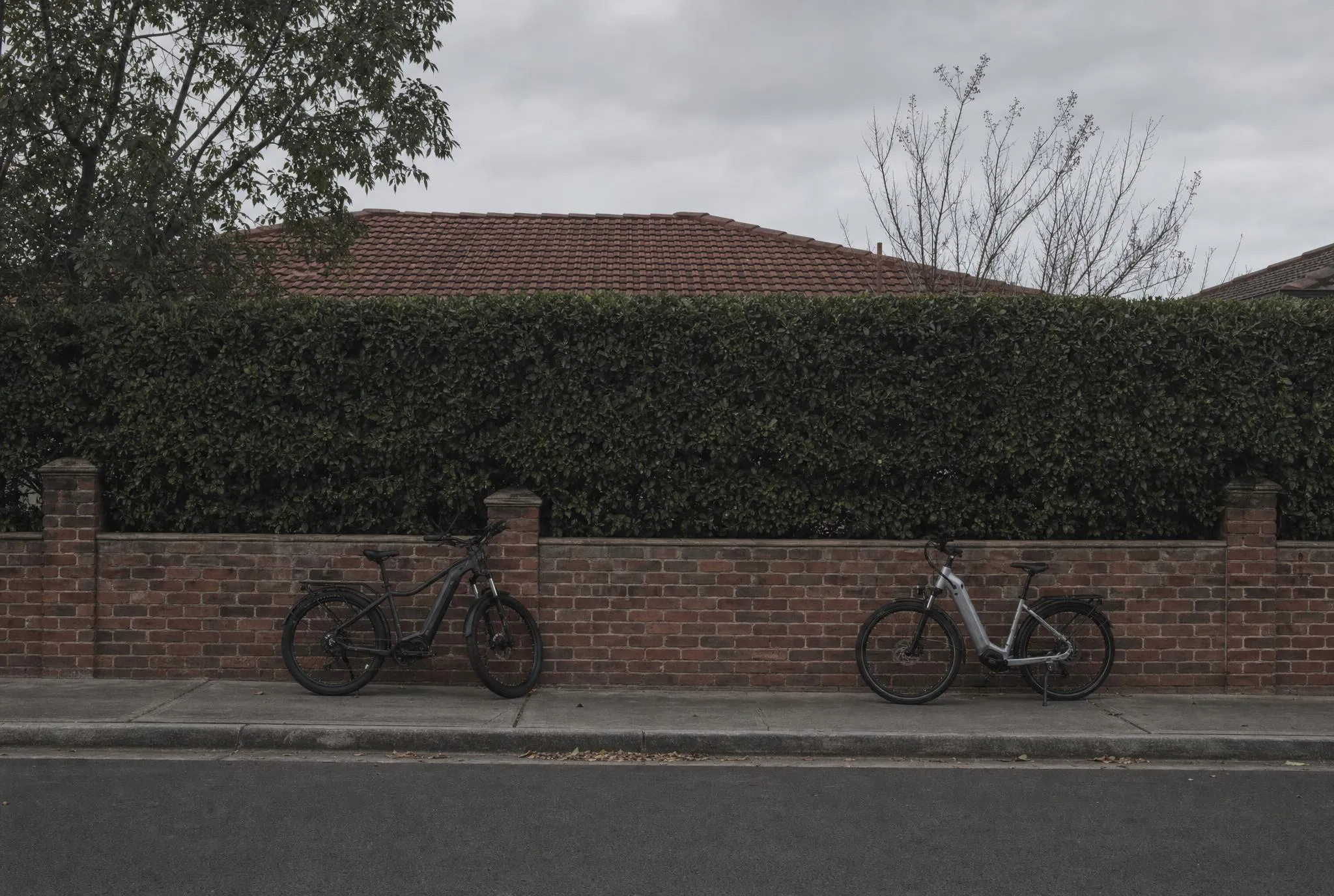
Are e-bikes legal in the ACT?
Yes, if your e-bike is a bicycle: built to be pedalled and within the power standard. No licence, rego or minimum age. Wear a helmet and use lights at night. Footpaths are open unless a no-bicycles sign applies.
- What counts as an e-bike
- A bike built to be pedalled, with a motor up to 200 watts; or a pedal-assist bike that meets the Commonwealth power-assisted pedal cycle standard. A stronger motor that isn't a compliant pedal-assist cycle, or a build you can't pedal, isn't one 1
- Footpaths
- Yes, at any age, unless a 'no bicycles' sign applies. Keep left and give way to people on foot. Slow to 10 km/h approaching or on a crossing 2
- Your top speed
- No limit set for e-bikes. You follow the ordinary limit for the road or path, except 10 km/h at a crossing 2
- Minimum age
- None. There is no riding age and no child-supervision rule for a bicycle 2
- Helmet
- Required. An approved bicycle helmet, fitted and fastened, for you and any passenger 2
- Licence & rego
- Neither. The registration rules say they don't apply to a bicycle, and a bicycle rider is exempt from holding a licence 3
- Lights at night
- Required. A white front light and a red rear light, each visible 200 metres, plus a red rear reflector, at night or in poor visibility 2
An e-bike is legal to ride in the ACT if it is the right kind of e-bike. The law treats a compliant one as a bicycle, so ordinary bike rules apply. 1 You need no licence to ride it, and there is no minimum age.
That is a different picture from the e-scooter. Both are allowed on ACT footpaths. But an e-scooter is capped at 15 km/h on a footpath and 25 km/h elsewhere. And a child under 12 may ride one only with an adult. 2 An e-bike has none of those limits. In law it is a bicycle, and the e-scooter rules don’t reach it. 1
What counts as a legal e-bike in the ACT?
A pedal bike with an electric motor. There are two ways a bike qualifies. 1
dictionary — bicycle A pedal e-bike is a bicycle Road Transport (General) Act 1999 (ACT) 1
bicycle means a vehicle with 2 or more wheels that is built to be propelled by human power through a belt, chain or gears (whether or not it has an auxiliary motor) and— (a) includes a pedicab, penny-farthing and tricycle; and (b) includes a power-assisted pedal cycle within the meaning of the national road vehicle standards determined under the Road Vehicle Standards Act 2018 (Cwlth), section 12; but (c) does not include— (i) a wheelchair, wheeled recreational device or wheeled toy; or (ii) a vehicle (other than a vehicle mentioned in paragraph (b)) with an electric motor capable of generating a power output over 200W (whether or not the motor is operating); or (iii) a vehicle that has an internal combustion engine; or (iv) a personal mobility device.
The first way is a motor of no more than 200 watts, on a bike you can still pedal. The second is a “power-assisted pedal cycle”, which the ACT defines by pointing to the Commonwealth vehicle standard. 1
That Commonwealth standard covers a pedal-assist bike with a motor of up to 250 watts, whose help fades above 6 km/h and cuts out at 25 km/h. 6 The ACT writes only the 200-watt figure into its own law and leaves the rest to the Commonwealth standard. 1
Because the bike is built to be pedalled with a helper motor inside those limits, the law counts it as a bicycle. 1 That is why it needs no registration and no number plate, and why you ride it under bicycle rules.
Do you need a licence or registration for an e-bike in the ACT?
No, and each rule is short. The registration rules say in terms that they do not apply to a bicycle. 3
s 20 Registration doesn't reach a bicycle Road Transport (Vehicle Registration) Regulation 2000 (ACT) 3
20 Bicycles with electric motors The registration provisions do not apply to a registrable vehicle that is a bicycle. Note A bicycle does not include any vehicle— (a) with an electric motor capable of generating a power output over 200W, other than a vehicle that is a power-assisted pedal cycle within the meaning of the national road vehicle standards determined under the Road Vehicle Standards Act 2018 (Cwlth), s 12; or (b) that has an internal combustion engine. (See Road Transport (General) Act 1999, dict, def bicycle.)
The licence rule exempts a bicycle rider in terms. Anyone riding a bicycle doesn’t need to hold a driver licence, and the same regulation says what “bicycle” covers. 8
s 99(2)(b) A bicycle rider needs no licence Road Transport (Driver Licensing) Regulation 2000 (ACT) 8
99 Other exemptions from requirement to hold driver licence […] (2) For the Act, section 31 (1) (b), a person is exempt from holding an Australian driver licence while driving, on a road or road related area— (a) a motor vehicle weighing not more than 250kg when unladen that is built or used only for cutting grass or for purposes incidental to cutting grass; or (b) a bicycle; or […] Note A bicycle does not include any vehicle— (a) with an electric motor capable of generating a power output over 200W, other than a vehicle that is a power-assisted pedal cycle within the meaning of the national road vehicle standards determined under the Road Vehicle Standards Act 2018 (Cwlth), s 12; or (b) that has an internal combustion engine. (See Road Transport (General) Act 1999, dict, def bicycle.)
This is also where a bike can tip over into being illegal. Two things take it out of the bicycle class: a motor over 200 watts that is not a compliant pedal-assist cycle, or a build you can’t pedal at all. 1 What is left is a bike built to be propelled by a motor. In the ACT that is a motor vehicle. 1
dictionary — motor vehicle What a motor vehicle is Road Transport (General) Act 1999 (ACT) 1
motor vehicle means a vehicle built to be propelled by a motor that forms part of the vehicle, but does not include a personal mobility device.
A motor vehicle has to be registered to be used on a road. 9 Its driver has to be licensed. 4
s 18 Using an unregistered vehicle is an offence Road Transport (Vehicle Registration) Act 1999 (ACT) 9
18 Prohibition on using unregistered registrable vehicles or vehicles with suspended registration (1) A person must not use, or permit or allow a person to use, an unregistered registrable vehicle, or a vehicle with suspended registration, on a road or road related area. Maximum penalty: 20 penalty units. (2) Subsection (1) does not apply to the use of an unregistered registrable vehicle on a road or road related area if— (a) the vehicle is of a kind prescribed by a regulation mentioned in section 17 (Regulations may exclude vehicles and people from Act) as a vehicle exempt from this Act; or (b) the use is otherwise permitted under this Act. […]
dictionary — registrable vehicle A motor vehicle is a registrable vehicle Road Transport (Vehicle Registration) Act 1999 (ACT) 9
registrable vehicle means— (a) any motor vehicle except a light rail vehicle; or (b) any trailer; or (c) any other vehicle prescribed under the regulations for this definition.
The registration rules switch off for a bicycle, but not for a build that falls outside the bicycle definition. 3
s 8 Unregistered use of a pt 2.2 vehicle is permitted Road Transport (Vehicle Registration) Regulation 2000 (ACT) 3
8 Application of Act, s 18 to pt 2.2 vehicles For the Act, section 18 (2) (b), the use of an unregistered vehicle mentioned in part 2.2 (Vehicles not subject to registration provisions) on a road or road related area is permitted under this regulation.
Riding a non-compliant build means an unlicensed rider on an unregistered motor vehicle. The fines for both are set out under “What happens if you’re stopped in Canberra?” below.
Where can you ride an e-bike in the ACT, and how fast?
On the road, on shared paths and bicycle paths, and on footpaths, except where a “no bicycles” sign applies or on the walking side of a separated footpath. 2
s 250 Footpaths: keep left, give way Road Transport (Road Rules) Regulation 2017 (ACT) 2
250 Riding on footpath or shared path (1) The rider of a bicycle riding on a footpath or shared path must— (a) keep to the left of the footpath or shared path unless it is impracticable to do so; and (b) give way to any pedestrian on the footpath or shared path. Maximum penalty: 20 penalty units. (2) In this section: footpath does not include a separated footpath.
On any path, keep left and give way to people on foot. One speed rule applies on foot crossings: slow to 10 km/h as you approach one and while you ride across. 2
s 248A 10 km/h approaching or on a crossing Road Transport (Road Rules) Regulation 2017 (ACT) 2
248A Riding across road on crossing (1) A bicycle rider commits an offence if, when approaching a crossing, the rider— (a) travels faster than 10km/h; or (b) fails to look for approaching traffic and prepare to stop. Maximum penalty: 20 penalty units. […] (3) A bicycle rider commits an offence if, when riding on a crossing, the rider— (a) travels faster than 10km/h; or (b) fails to give way to a pedestrian on the crossing; or (c) fails to keep to the left of an oncoming bicycle or pedestrian. Maximum penalty: 20 penalty units.
Away from a crossing there is no speed cap written for an e-bike. You follow the ordinary limit for wherever you are riding, the same as any bicycle. 2 An e-scooter is held to 15 km/h on a footpath and 25 km/h elsewhere. An e-bike is a bicycle, so no such number applies to it. 2
There is also no minimum age to ride, and no rule that a child must be supervised. An e-scooter rider under 12 needs an adult with them; a bicycle rider does not. 2
Do you need a helmet on an e-bike in the ACT?
Yes. An approved bicycle helmet, fitted and fastened on your head, for you and anyone you carry. 2
s 256 Bicycle helmet, rider and passenger Road Transport (Road Rules) Regulation 2017 (ACT) 2
256 Bicycle helmet (1) The rider of a bicycle must wear an approved bicycle helmet securely fitted and fastened on the rider's head. Maximum penalty: 20 penalty units. (2) A passenger on a bicycle that is moving, or is stationary but not parked, must wear an approved bicycle helmet securely fitted and fastened on the passenger's head, unless the passenger is a paying passenger on a three-wheeled or four-wheeled bicycle. Maximum penalty: 20 penalty units. (3) The rider of a bicycle must not ride with a passenger on the bicycle unless the passenger complies with subsection (2). Maximum penalty: 20 penalty units. (4) This section does not apply if— (a) the person required to wear the helmet is a member of a religious group; and (b) the person is wearing a type of headdress customarily worn by members of the group; and (c) the wearing of the headdress makes it impractical for the person to wear an approved bicycle helmet.
Riding without one is a $218 fine on the spot, and so is carrying a passenger who isn’t wearing one. The rule has two narrow exceptions: religious headdress, and a paying passenger on a three- or four-wheeled bicycle. 5
Do you need lights at night on an e-bike in the ACT?
Yes. Riding at night, or in weather that cuts visibility, the bike or you must show lights front and rear. 2
s 259 Lights and a reflector at night Road Transport (Road Rules) Regulation 2017 (ACT) 2
259 Riding at night The rider of a bicycle must not ride at night, or in hazardous weather conditions causing reduced visibility, unless the bicycle, or the rider, displays— (a) a flashing or steady white light that is clearly visible for at least 200m from the front of the bicycle; and (b) a flashing or steady red light that is clearly visible for at least 200m from the rear of the bicycle; and (c) a red reflector that is clearly visible for at least 50m from the rear of the bicycle when light is projected onto it by a vehicle's headlight on low-beam. Maximum penalty: 20 penalty units.
That means a white light at the front and a red light at the rear, each visible for 200 metres. You also need a red reflector at the back, visible for 50 metres. Steady or flashing lights both count. 2
A second rule applies at any hour: the bike needs at least one working brake and a bell, horn or similar warning device. 2
s 258 Brake and warning device Road Transport (Road Rules) Regulation 2017 (ACT) 2
258 Equipment on bicycle A person must not ride a bicycle that does not have— (a) at least 1 effective brake; and (b) a bell, horn, or similar warning device, in working order. Maximum penalty: 20 penalty units.
What happens if you’re stopped in Canberra?
If police stop you on an e-bike in the ACT, the bicycle offences can apply. So can the motor-vehicle ones, if the bike isn’t compliant.
On the rider, the fines are flat. Riding without a helmet is $218 on the spot, and so is carrying a passenger without one. 5 Riding at night without the front light, the rear light or the reflector is $218 for each one you’re missing. Riding without a working brake or warning device is $218 too. 5 Not keeping left or not giving way on a path is $218, and so is going faster than 10 km/h at a crossing. 5 None of these carry demerit points. Each one is set in the law at 20 penalty units. A penalty unit is $160 in the ACT, so if a court deals with the matter rather than you paying on the spot, the maximum is $3,200. 7
On the bike, the question is whether it is still a bicycle. A pedal e-bike inside the power limits is. A build with a motor over 200 watts that isn’t a compliant pedal-assist cycle, or one you can’t pedal, is a motor vehicle instead. 1 A motor vehicle has to be registered to be used on a road. 9 Its driver has to be licensed. 4 Riding one in public runs into both at once. Riding it without the right licence is $750 on the spot, or up to $3,200 in court. For someone who hasn’t held a licence in the past five years, a repeat offence can bring up to $8,000, six months in prison, or both, plus an automatic three-year disqualification. 4 5 Using an unregistered motor vehicle is $750 on the spot, or up to $3,200 in court. 9 5
Those court figures are unit conversions too: the $3,200 is 20 penalty units and the $8,000 repeat maximum is 50, at $160 a unit. 7
What it costs to get it wrong
| Offence | Penalty | Source |
|---|---|---|
| No helmet, rider or passenger (s 256) | $218 on the spot (court maximum 20 penalty units = $3,200) | 5 |
| No front light, rear light or reflector when riding at night (s 259) | $218 on the spot for each | 5 |
| No working brake or warning device (s 258) | $218 on the spot for each | 5 |
| Not keeping left or not giving way on a footpath or shared path (s 250) | $218 on the spot | 5 |
| Faster than 10 km/h approaching or on a crossing (s 248A) | $218 on the spot | 5 |
| Riding a non-compliant build without a licence for it (Driver Licensing Act s 31) | $750 on the spot; court maximum $3,200. If you haven't held any licence in the past 5 years, a repeat offence is up to $8,000, 6 months' prison or both | 4 |
| Using an unregistered motor vehicle, meaning a non-compliant build (Vehicle Registration Act s 18) | $750 on the spot (court maximum 20 penalty units = $3,200) | 9 |
Common questions
Are e-bikes legal in the ACT?
Yes, if it's a compliant one. A pedal e-bike that stays within the power standard counts as a bicycle, so ordinary bike rules apply. You need no licence and there's no minimum age, but you must wear a helmet and carry lights at night. 1
How many watts can an e-bike have in the ACT?
Up to 200 watts for an ordinary pedal e-bike. A bike can go higher only if it counts as a power-assisted pedal cycle under the Commonwealth vehicle standard, which covers a pedal-assist bike of up to 250 watts that cuts out at 25 km/h. The ACT writes only the 200-watt figure into its own law. 1
Do you need a licence or registration for an e-bike in the ACT?
No. A compliant e-bike is a bicycle. The registration rules say they don't apply to a bicycle, and the licence rules exempt anyone riding one. A build that fails the power standard isn't a bicycle, so neither exemption covers it. 3
Can you ride an e-bike on the footpath in the ACT?
Yes, at any age, unless a 'no bicycles' sign applies. Keep left and give way to people on foot. Slow to 10 km/h when you approach or ride across a crossing. There's no footpath speed cap otherwise, unlike an e-scooter, which is held to 15 km/h on a footpath. 2
Is there a minimum age to ride an e-bike in the ACT?
No. A bicycle has no riding age and no child-supervision rule in the ACT. An e-scooter is different: a child under 12 can only ride one with an adult supervising. 2
Do you need a helmet on an e-bike in the ACT?
Yes. An approved bicycle helmet, fitted and fastened, for you and any passenger. Riding without one costs $218 on the spot. The rule has two narrow exceptions: religious headdress, and a paying passenger on a three- or four-wheeled bicycle. 2
Do you need lights on an e-bike at night in the ACT?
Yes. Riding at night, or in weather that cuts visibility, the bike or you must show a white light at the front and a red light at the rear, each visible 200 metres, plus a red rear reflector. The lights can be steady or flashing. 2
Is a throttle e-bike legal in the ACT?
It can be. What matters is that the bike is still built to be pedalled and its motor is 200 watts or less, or that it's a compliant pedal-assist cycle. A build you can't pedal, or a stronger motor that isn't a compliant pedal-assist cycle, isn't a bicycle. It is then a motor vehicle, which needs registration and a licence. 1
Every source on this page
The small numbered marks throughout this page point to this list — 1 means source 1 below.
- Road Transport (General) Act 1999 (ACT), dictionary — bicycle; motor vehicle
- Road Transport (Road Rules) Regulation 2017 (ACT), ss 20, 244FB, 244HB, 248A, 249, 250, 252, 256, 258, 259
- Road Transport (Vehicle Registration) Regulation 2000 (ACT), ss 8, 20
- Road Transport (Driver Licensing) Act 1999 (ACT), s 31
- Road Transport (Offences) Regulation 2005 (ACT), Sch 1 pts 1.8, 1.16, 1.18
- Vehicle Standard (Australian Design Rule – Definitions and Vehicle Categories) 2005 (Cth), Definitions — electrically power-assisted cycle (EPAC)
- Legislation Act 2001 (ACT), s 133 (penalty unit $160)
- Road Transport (Driver Licensing) Regulation 2000 (ACT), s 99(2)(b)
- Road Transport (Vehicle Registration) Act 1999 (ACT), s 18; dictionary — registrable vehicle
© Australian Capital Territory. Sourced from the ACT Legislation Register at 15 Oct 2026. For current law please go to https://www.legislation.act.gov.au. Licensed under CC BY 4.0. Reproduced without changes. This is not an official version. Creative Commons Attribution 4.0 licence.
© Australian Capital Territory. Sourced from the ACT Legislation Register at 13 Oct 2026. For current law please go to https://www.legislation.act.gov.au. Licensed under CC BY 4.0. Reproduced without changes. This is not an official version. Creative Commons Attribution 4.0 licence.
Sourced from the Federal Register of Legislation at 15 Oct 2026. For the latest information on Australian Government law please go to https://www.legislation.gov.au. Licensed under CC BY 4.0. Reproduced without changes. This is not an official version. Creative Commons Attribution 4.0 licence.
Other rules for Australian Capital Territory
- Are e-scooters legal in the ACT? Legal, with conditions
- How high can a fence be in the ACT? Legal, with conditions
- Is it legal to record a conversation in the Australian Capital Territory? Legal, with conditions
- What are the pool fence rules in the ACT? Legal, with conditions
E-bikes rules elsewhere
- New South Wales Legal, with conditions
- Northern Territory Legal, with conditions
- Queensland Legal, with conditions
- South Australia Legal, with conditions
- Tasmania Legal, with conditions
- Victoria Legal, with conditions
- Western Australia Legal, with conditions
Page history
Every change to this page
- 15 Oct 2026
- First published.