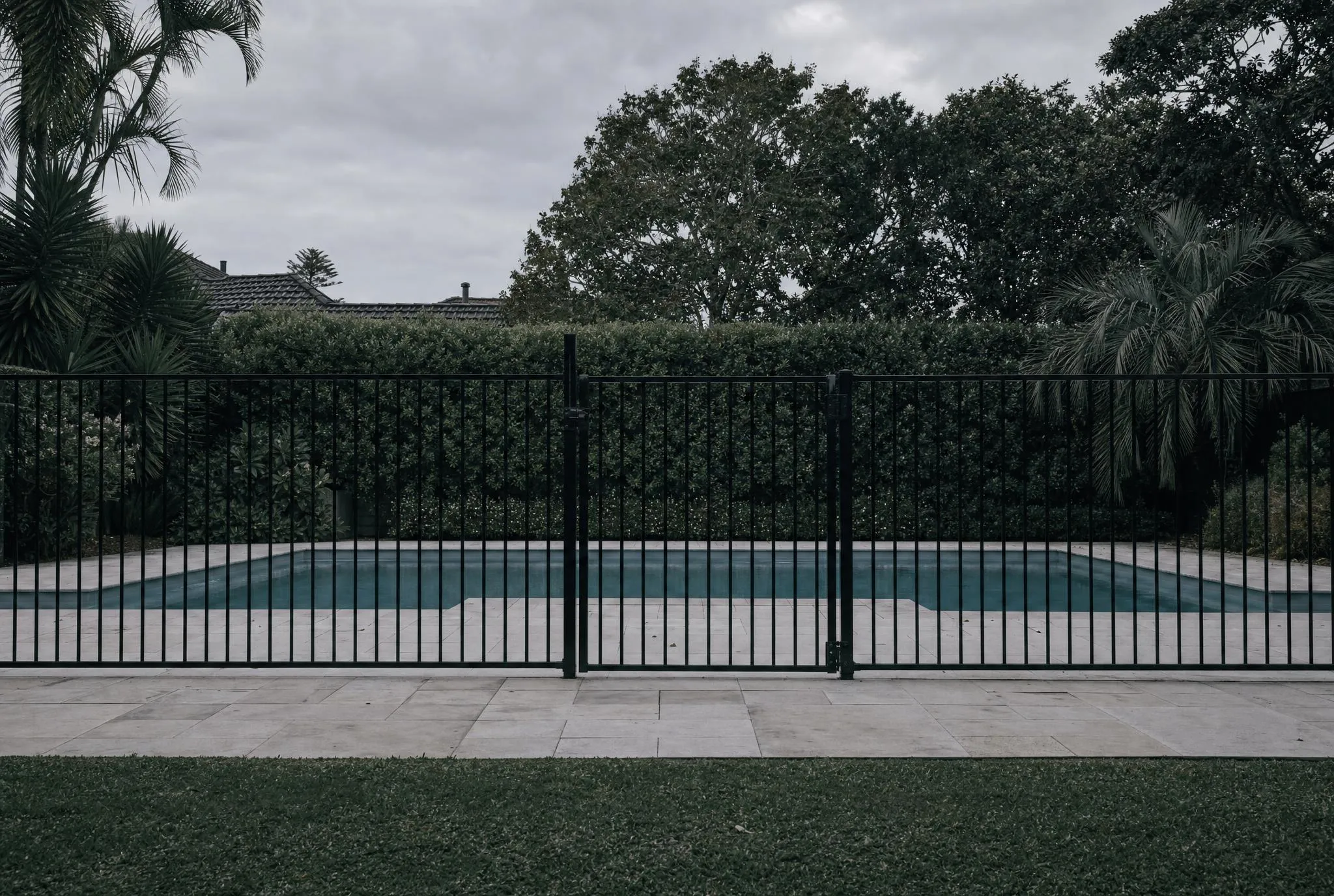
What are the pool fence rules in Queensland?
Every regulated Queensland pool needs a barrier that meets the pool safety standard, and it goes on a state register. Pool safety certificates are built into selling and leasing. Court maximums reach $28,495 per offence.
- Barrier required when
- Any regulated pool at a home, unit block, moveable-dwelling park or residential park. In law the "pool" includes its barriers 1
- Height & standard
- The pool safety standard is a Queensland Development Code part called MP 3.4. It applies the Australian Standard with Queensland's own changes, including a 1.2 m minimum for a boundary fence used as a barrier 2
- How often it's checked
- Licensed inspectors issue pool safety certificates. They last 2 years, or 1 year for shared pools. The state building commission runs the register, not your council 1
- Selling or leasing
- Before settlement the seller hands over a certificate, or a no-certificate notice. The buyer then has 90 days to get one. Leasing a home with a private pool needs a certificate first 1
- Fines
- Most pool-safety offences carry a court maximum of $28,495.50 (165 penalty units) 1
- Boundary pools
- A pool owner can build or upgrade a boundary fence as the pool barrier on 14 days' notice, and pays for the pool-compliance part of the cost 1
- Gates
- Everyone who opens a pool gate has to close it securely. Owners, occupiers and visitors each carry their own duty 1
Queensland has the most certificate-driven pool system in the country. There’s a pool safety standard, licensed inspectors, a register kept by the Queensland Building and Construction Commission, and certificates built straight into selling and leasing. 1
Which pools need a barrier in Queensland?
Any regulated pool — a pool on land with a home, a unit building, a moveable-dwelling park or a residential park. In law the pool includes its barriers, so the fence isn’t a separate thing bolted onto a pool; it is part of what the rules call the pool. 1
The standard it has to meet is a part of the Queensland Development Code, MP 3.4. That name is worth remembering because a certifier will use it, but the practical measurements come from the Australian Standard it applies. 1
The duty is continuous. Not just build it right — keep every barrier in good condition, for as long as the pool exists. 1
s 232(1) The core duty: comply, and keep the barrier good Building Act 1975 (Qld) 1
The owner of a regulated pool must ensure— (a) the pool complies with the pool safety standard for the pool; and (b) all barriers for the pool are kept in good condition. Maximum penalty—165 penalty units.
How high does a pool fence need to be in Queensland?
The base measurements come from the Australian Standard, and Queensland layers its own changes on top. Those changes are what matter if you want your boundary fence to double as the pool barrier. A boundary fence doubling as a pool barrier can be as low as 1.2 m, but only with the climb-free strip on the outside. At 1.8 m or more you get more freedom about where that zone sits. 2
Sch 1, items 6–7 Boundary fences as barriers: 1.2 m minimum Queensland Development Code MP 3.4 — Swimming pool barriers 2
6. The non-climbable zone must be located, for a fence, including a boundary fence: (a) less than 1800 millimetres in height - on the outside of the fence (i.e. the side facing away from the pool area); and (b) 1800 millimetres or more in height - on either the outside or the inside of the fence. 7. A boundary fence may be less than 1800 millimetres in height, but not less than 1200 millimetres in height, provided the non-climbable zone is located on the outside of the fence (i.e. the side facing away from the pool area).
MP 3.4 states a few other things in its own words. Pool gates must not open towards the pool. A certifier-approved temporary fence can stand in for up to 3 months at a time. And in the right conditions, a deep, wide body of water can form part of the barrier. 2
Who issues pool safety certificates in Queensland?
Licensed pool safety inspectors, licensed by the Building and Construction Commission, which also keeps the register. Your council has a narrower role here. A certificate lasts two years, or one year for a shared pool. 1
s 246AL Certificates: 2 years (1 year for shared pools) Building Act 1975 (Qld) 1
(1) A pool safety certificate for a regulated pool expires at the end of the relevant period unless it is sooner cancelled under section 246AF. (2) In this section—relevant period means— (a) for a pool that is a shared pool—1 year after the pool safety certificate is given; or (b) otherwise—2 years after the pool safety certificate is given.
What do you need to sell or lease a house with a pool in Queensland?
This is where Queensland is strictest. When you sell, the buyer gets either a current certificate or a formal no-certificate notice before settlement, and the state building commission gets a copy. 1
s 246ATF Selling: certificate or notice, before settlement Building Act 1975 (Qld) 1
An owner of regulated premises who is proposing to sell the premises must, before settlement under a contract of sale for the premises— (a) if a pool safety certificate is in effect for a relevant regulated pool for the premises—give to the purchaser of the premises under the contract a copy of the pool safety certificate; and (b) if a pool safety certificate is not in effect for a relevant regulated pool that is not a shared pool—give a notice in the approved form to each of the following— (i) the purchaser; (ii) the QBCC commissioner […] Maximum penalty—165 penalty units.
If you buy without a certificate, the clock starts on you instead. You get 90 days from settlement to arrange one. 1
s 246ATJ(1)–(2) Buying without a certificate: 90 days to fix it Building Act 1975 (Qld) 1
(1) This section applies to a person who purchases regulated premises if, at settlement under the contract of sale for the premises, a pool safety certificate is not in effect for a relevant regulated pool for the premises that is not a shared pool. (2) The person must ensure there is a pool safety certificate in effect for the pool within— (a) generally—90 days after the day of settlement (the usual period) […] Maximum penalty—165 penalty units.
Leasing works differently. A private pool needs a certificate in effect before the lease is signed. Shared pools have to display their certificate near the gate. 1
Can a pool barrier sit on the boundary in Queensland?
Queensland gives pool owners a right most other states don’t. You can build or upgrade the boundary fence as your pool barrier without your neighbour agreeing, on 14 days’ written notice. The result has to comply and still work as an adequate dividing fence. 1
s 245XB(3) Pool barriers on the boundary: 14 days' notice Building Act 1975 (Qld) 1
Also, the pool owner may construct part of the pool barrier along the common boundary without the adjoining owner having agreed to the carrying out of the fencing work if— (a) the pool barrier will, when complete, comply with the pool safety standard; and (b) the part of the pool barrier along the common boundary will, when complete, be a sufficient dividing fence; and (c) the pool owner gives the adjoining owner a notice of proposed fencing work at least 14 days before the proposed fencing work is carried out.
The money follows the purpose. The pool-compliance part of the cost is the pool owner’s alone. Anything beyond that splits half each. Disputes go to QCAT. 1
s 245XH(2) Boundary-barrier costs: pool-safety part is the pool owner's Building Act 1975 (Qld) 1
If the dividing fence forms part of a barrier for a regulated pool on only 1 parcel of adjoining land— (a) to the extent the work is attributable to a pool owner complying with section 232(1), the cost of carrying out the work is to be borne solely by the pool owner; and (b) to the extent the work is not attributable to a pool owner complying with section 232(1), the cost of carrying out the work is to be borne equally by the pool owner and adjoining owner.
Who has to keep the pool gate closed in Queensland?
Everyone. The Act puts a personal duty on any person who opens a pool gate, on top of the standing duties for owners of shared pools and occupiers of homes. 1
What happens when someone complains about your pool?
Queensland’s council role is triggered rather than routine, and once it triggers it has more teeth than people expect.
After an immersion incident, a complaint, or a report from a pool safety inspector, the council must inspect, and it can enter the property to do it. It can also cancel a pool safety certificate it finds was wrongly held. So a certificate on your file is not a shield if the barrier isn’t right. 1
Selling is the other trigger, and the obligation moves. Hand over a current certificate before settlement, or a formal no-certificate notice with a copy to the state building commission. If the buyer takes the pool without a certificate, the clock passes to them: 90 days from settlement to get one. That is a real negotiating point rather than a formality. 1
Leasing is stricter than selling. A private pool needs a certificate in effect before the lease is signed. There’s no equivalent of the buyer’s 90 days. 1
Behind all of it sits a court maximum of $28,495.50. That covers a non-compliant pool, a barrier in poor condition, a gate left open, and breaches of the sale and lease rules. 1
What it costs to get it wrong
| Offence | Penalty | Source |
|---|---|---|
| Pool not complying with the pool safety standard, or barriers not kept in good condition | Court maximum $28,495.50 (165 penalty units at $172.70) | 1 |
| Selling without giving a certificate or notice; leasing without a certificate; buyer not certifying within 90 days | Court maximum $28,495.50 each | 1 |
| Leaving a pool gate or door open (any person) | Court maximum $28,495.50 | 1 |
Common questions
How high does a pool fence need to be in Queensland?
At least 1.2 m. The heights sit in Queensland's pool safety standard, called MP 3.4, rather than in the Act. MP 3.4 spells out the boundary-fence case: a boundary fence doubling as the pool barrier can go as low as 1.2 m, but only if the strip that has to stay clear of anything climbable is on the outside. At 1.8 m or more you get more freedom about where that strip sits. 2
Do I need a pool safety certificate to sell my house in Queensland?
Yes, or the alternative to one. Before settlement you have to give the buyer either a current pool safety certificate or a formal no-certificate notice, with a copy to the state building commission. If the buyer takes the pool without a certificate, they get 90 days to arrange one. The duty changes hands at settlement. 1
Do I need a pool safety certificate to rent out my house in Queensland?
Yes. For a private pool, a certificate has to be in effect before you sign the lease. For a shared pool, such as one in a unit complex, a copy of the certificate has to be on display near the pool gate or the main entrance. 1
How long does a pool safety certificate last in Queensland?
Two years for a private pool, and one year for a shared pool such as one in a unit complex, unless it gets cancelled earlier. 1
Who inspects pool fences in Queensland?
Licensed pool safety inspectors, licensed by the state building commission, which also runs the pool register. Your council doesn't inspect as a matter of routine, but it does have real power when something happens. After an immersion incident, a complaint or a report from an inspector, the council has to inspect, and it can enter the property to do so. It can also cancel a pool safety certificate that shouldn't have been issued. 1
Can my neighbour's pool fence be our boundary fence in Queensland?
Yes, and there's a whole set of rules for it. A pool owner can build or upgrade the boundary fence as their pool barrier on 14 days' written notice, as long as the result will comply and still be an adequate dividing fence. The pool-safety part of the cost is theirs, not yours. Disputes go to QCAT, the state tribunal for everyday disputes. 1
What's the fine for an non-compliant pool fence in Queensland?
The court maximum for the main offences is 165 penalty units, which comes to $28,495.50 at the current penalty-unit value of $172.70. Those offences are a non-compliant pool, a barrier in poor condition, a gate left open, and breaches of the sale and lease rules. 1
Does a temporary fence count during pool works in Queensland?
Yes, within limits. MP 3.4 lets a certifier-approved temporary fence stand in for the permanent barrier for up to 3 months at a time. 2
Every source on this page
The small numbered marks throughout this page point to this list — 1 means source 1 below.
- Building Act 1975 (Qld), ch 8 — ss 231A–231D, 232, 234, 245T–245U, 245X–245XX, 246ADA–246AF, 246AK–246AL, 246ATF–246ATJ, 246AW
- Queensland Development Code MP 3.4 — Swimming pool barriers, Sch 1 modifications (published 18 July 2012)
- Building Regulation 2021 (Qld), Sch 1, item 1(1)(b); Schs 5, 7
- Penalties and Sentences Regulation 2025 (Qld), s 4 — penalty unit $172.70
Sourced from the Queensland Legislation website at 28 Aug 2026. For the latest information on Queensland Government legislation please go to https://www.legislation.qld.gov.au © State of Queensland. Licensed under CC BY 4.0. Reproduced without changes. This is not an official version. Creative Commons Attribution 4.0 licence.
© State of Queensland. Sourced from housing.qld.gov.au at 28 Aug 2026. Reproduced without changes. This is not an official version.
Other rules for Queensland
- Are e-bikes legal in Queensland? Legal, with conditions
- Are e-scooters legal in Queensland? Legal, with conditions
- How high can a fence be in Queensland? Legal, with conditions
- Is it legal to record a conversation in Queensland? Legal, with conditions
Pool fences rules elsewhere
- Australian Capital Territory Legal, with conditions
- New South Wales Legal, with conditions
- Northern Territory Legal, with conditions
- South Australia Legal, with conditions
- Tasmania Legal, with conditions
- Victoria Legal, with conditions
- Western Australia Legal, with conditions
Page history
Every change to this page
- 28 Aug 2026
- First published. Current to the Queensland Building Act as at 1 February 2026 and the pool safety standard MP 3.4.