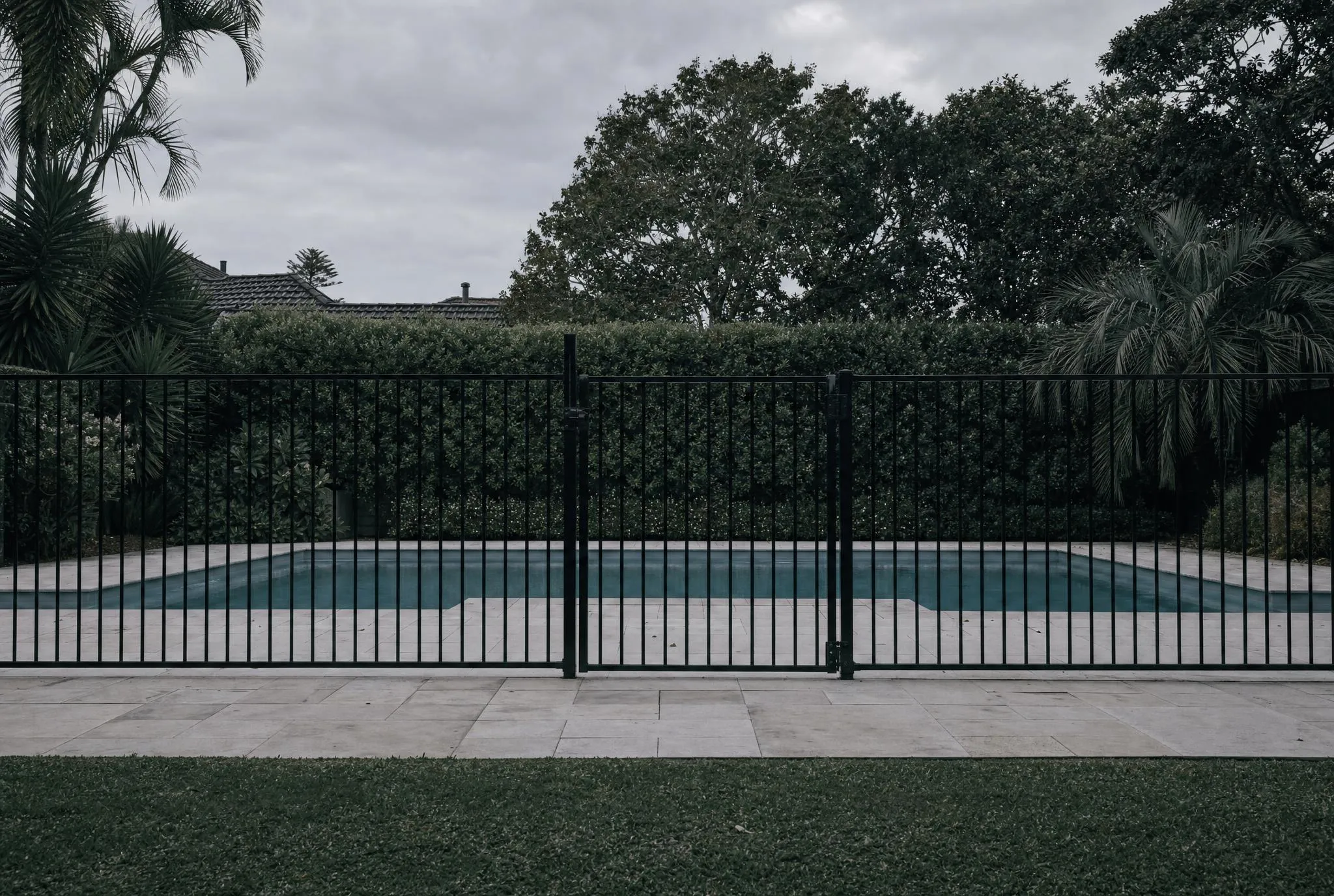
What are the pool fence rules in the NT?
Every NT pool deeper than 30 cm needs a purpose-built barrier — a boundary fence alone never counts — and the Registrar-General cannot transfer title over a house with an uncertified pool. Leases carry the same lock.
- Barrier required when
- Any pool or spa holding water more than 30 cm deep, at homes, units and caravan parks. Different rules cover hotels, short-term lets and non-residential complexes 1
- Height & standard
- AS 1926.1-1993 and AS 1926.2-1995, with NT changes. The one figure NT states itself is for chainmesh: 1.2 m for fine mesh, 1.7 m for coarser mesh 2
- How often it's checked
- A new pool on an ordinary block must hold a compliance certificate at all times. A pre-2003 pool can wait until the property is sold or leased 1
- Selling or leasing
- You cannot transfer the title or sign a lease without certification, or an acknowledgment. A buyer who takes on an uncertified pool gets 3 months to sort it out 1
- Fines
- Most duties carry 10 penalty units, which is $1,940. An uncertified pool on unit-complex common property runs to 100 units, or $19,400 1
- Old pools
- A pre-2003 pool may be able to use the lower Community Safety Standard. Even then, your boundary fence on its own is never enough 1
- Big blocks
- On premises of 1.8 hectares or more you never have to certify the pool. It depends on the size of the block, not the age of the pool 1
The Northern Territory sets no height limit at all for ordinary fences. Pool fences are the opposite. There’s a whole Act about them, every pool needs its own barrier, and you can’t transfer your property’s title until the pool complies. 1
Which pools need a barrier in the NT?
Any pool or spa that holds water more than 30 cm deep and is used for swimming, wading or paddling. That covers houses, units and caravan parks. Hotels, short-term holiday lets and non-residential complexes are covered by different rules. 1
s 6(1)–(2) Which pools are covered Swimming Pool Safety Act 2004 (NT) 1
(1) A swimming pool is an excavation, structure or vessel (including a spa bath outside a building and a spa pool) that: (a) is capable of being filled with water to a depth of 300 millimetres or more at the deepest point of the swimming pool; and (b) is used, or is designed, manufactured or adapted to be used, solely or principally for swimming, wading, paddling or another human aquatic activity. (2) A swimming pool does not include any of the following structures: (a) a spa bath within a building; (b) a structure within a bathroom that is within a building; (c) a structure within a building to which all points of entry consist of doors, gates or windows that are self-closing and self-latching; (d) a structure that is exempted by the Regulations from the application of this Act.
Plenty of things can count as part of the barrier — walls, windows, even a lockable lid on a spa. One thing is ruled out by name: anything made wholly of hedge or vegetation. 1
That matters if you have a mature garden. A thick hedge can be taller and harder to push through than a pool fence, and it still does not count for a single metre of the barrier.
s 7(1), (3) What counts as a barrier — hedges never do Swimming Pool Safety Act 2004 (NT) 1
(1) A swimming pool barrier is a fence, wall or similar structure intended to form a barrier to a swimming pool and includes a gate or door set in the fence, wall or structure. […] (3) A swimming pool barrier does not include a fence, wall or structure that consists, or part of which consists, solely of a hedge or vegetation.
What standard does an NT pool fence have to meet?
Most pools follow the modified Australian Standard. The barrier has to go all the way around the pool. It has to separate the pool from your house and from every neighbouring property. And it has to meet two technical standards, AS 1926.1-1993 and AS 1926.2-1995, with the changes NT law makes to them. 1
s 10(1)(a) The main standard: surround, separate, comply Swimming Pool Safety Act 2004 (NT) 1
The modified Australian Standard for a swimming pool is that: (a) the swimming pool must be enclosed by a swimming pool barrier that: (i) surrounds the swimming pool; (ii) separates the swimming pool from a residential building at the premises where the swimming pool is situated and from all areas of land or buildings adjoining the premises; and (iii) is designed, constructed, sited and maintained in a manner consistent with the standards prescribed by the Regulations […]
The working number is 1.2 m. Most of the detail sits inside those standards, which are sold rather than published. Chainmesh is the exception. The NT wrote its own clause for that one, so here are the actual figures. 2
reg 5(2) NT's own figures: chainmesh 1.2 m / 1.7 m Swimming Pool Safety Regulations 2004 (NT) 2
The Australian Standards are modified by omitting Clause 2.3.2 of AS 1926.1–1993 and substituting the following: "2.3.2 Chainmesh — A fence that uses chainmesh with apertures not greater than 13 mm must include a strainer wire or a rail at the top and the bottom of the fence and must have an effective fencing height of not less than 1.2 m. A fence that uses chainmesh with apertures greater than 13 mm but less than 100 mm must include a strainer wire or a rail at the top and the bottom of the fence and must have an effective fencing height of not less than 1.7 m."
Pools built before 2003 may be able to use the lower Community Safety Standard instead. That one asks whether the barrier realistically keeps young children out, rather than setting exact dimensions. It still has a floor written into it. 1
s 11(2) A boundary fence alone never counts Swimming Pool Safety Act 2004 (NT) 1
If a swimming pool is at premises where access to the swimming pool is prevented only by a perimeter boundary, the swimming pool does not comply with the Community Safety Standard.
Block size changes things too. On premises of 1.8 hectares or more you never have to get the pool certified, whatever age it is. 1
What happens when you sell or lease a house with a pool in the NT?
This is how the Territory actually enforces the rules, and it isn’t inspections. It’s the sale. The Registrar-General cannot process the transfer. 1
s 24(2) The title lock: no transfer without the paperwork Swimming Pool Safety Act 2004 (NT) 1
The Registrar-General must not, under Part 6 of the Land Title Act 2000, transfer a fee simple interest in small premises at which there is a swimming pool unless there is: (a) in respect of a new swimming pool — a compliance certificate; or (b) in respect of an existing swimming pool — one of the following: (i) a compliance certificate or provisional compliance certificate; (ii) an acknowledgment notice together with a purchaser's declaration; (iii) a provisional acknowledgment notice or temporary acknowledgment notice.
There is a way through for a buyer. If you buy a pre-2003 pool that hasn’t been certified, the provisional pathway gives you 3 months from transfer to finish the certification, and you can apply in writing for longer. Leases work the same way. 1
s 29(1) The lease lock Swimming Pool Safety Act 2004 (NT) 1
A landlord must not enter into a tenancy agreement in relation to small premises at which there is a swimming pool unless the swimming pool is certified or notified and there is no contravention of section 31 or 32 (as applicable). Maximum penalty: 10 penalty units.
What should you sort out before you sell?
The Territory enforces this at the Land Titles Office rather than at your fence, which makes it the hardest regime in the country to put off.
The Registrar-General cannot process the transfer. Not “will fine you later” — the transaction does not complete. That applies to an ordinary block with a pool unless there is a compliance certificate for a new pool, or a certificate or acknowledgment for a pre-2003 one. Leasing works the same way. 1
There is a way through for a buyer, and it is worth knowing before you negotiate. Take on an uncertified pre-2003 pool through the provisional pathway and you get 3 months from transfer to finish the certification, extendable if you ask in writing. That is a real allocation of risk between buyer and seller, not a formality. 1
Two things decide whether any of this reaches you. Block size: on premises of 1.8 hectares or more, certification is never compulsory whatever the pool’s age. And 1 January 2003: pools older than that may use the lower Community Safety Standard, though even that has a floor, and your boundary fence alone never satisfies it. 1
What do you have to keep doing after that in the NT?
If your pool was built from 2003 onwards and sits on an ordinary block, you need to hold a compliance certificate at all times. Everyone has to keep the gates shut. 1
Pools on unit-complex common property run to their own deadlines, and they carry the Act’s biggest penalty at 100 penalty units. Fines here are set in penalty units, and the Territory picks the dollar value each year. 1
What it costs to get it wrong
| Offence | Penalty | Source |
|---|---|---|
| New pool on an ordinary (small-premises) block without a compliance certificate | 10 penalty units ($1,940) | 1 |
| Gates, doors or windows giving pool access not kept securely closed (owner and occupier) | 10 penalty units ($1,940) | 1 |
| Entering a residential lease over premises with an uncertified pool | 10 penalty units ($1,940), and 5 more ($970) for not remedying it promptly after | 1 |
| Common-property (unit-complex) pool not certified or notified in time | 100 penalty units ($19,400) | 1 |
Common questions
How high does a pool fence need to be in the NT?
At least 1.2 m. The NT writes that figure down itself for chainmesh, which needs at least 1.2 m for fine mesh with holes 13 mm or smaller, and 1.7 m for coarser mesh. Either way you need top and bottom rails, or strainer wires. For everything else the measurements sit inside AS 1926.1-1993 and AS 1926.2-1995 as NT law changes them, and they land on the same 1.2 m. 2
Can I sell my house with an uncertified pool in the NT?
Usually not, and this is the rule the NT is known for. There is a way through, called the provisional pathway, which lets a buyer take on an uncertified pool and finish the certification afterwards. The Registrar-General must not transfer the title of an ordinary block with a pool on it unless there is a compliance certificate for a new pool, or a certificate or acknowledgment for a pre-2003 one. If a buyer takes on an uncertified pool through the provisional pathway, they get 3 months to finish it, and can ask for longer. 1
Can I rent out a house with an uncertified pool in the NT?
No. The same rule covers renting. A landlord must not sign a tenancy for an ordinary block with a pool that has not been certified or notified, and has to put it right quickly if it happens anyway. 1
My pool was built before 2003 — do the rules apply in the NT?
Yes, but you get an easier path. A pre-2003 pool on an ordinary block can stay uncertified until the property is sold or leased, and it may qualify under the lower Community Safety Standard instead of the full modified Australian Standard. One thing is never enough on its own, though, and that is your ordinary boundary fence. 1
Does my block's boundary fence count as the pool fence in the NT?
On its own, never. The Act says a pool protected only by the boundary fence fails even the lower standard. You need a proper barrier around the pool itself. A compliant dividing barrier can form part of that, as long as you give your neighbour notice. 1
Does a spa need a fence in the NT?
Yes. Spas are covered, including outdoor spa baths, and the lid can legally form part of the barrier. A spa bath inside the house is not covered. 1
Can a hedge be a pool fence in the NT?
No, and the Act says so directly. A barrier made even partly of hedge or vegetation alone does not count as a swimming pool barrier. 1
What if my property is a big rural block in the NT?
Premises of 1.8 hectares or more are the exception: certification is never compulsory there, whatever the pool's age. The line is drawn by size, not remoteness — and it's about certification, not about whether fencing a pool is a good idea. 1
Every source on this page
The small numbered marks throughout this page point to this list — 1 means source 1 below.
- Swimming Pool Safety Act 2004 (NT), ss 3–4, 6–12, 23–24, 29–30, 33 (as in force 13 September 2025)
- Swimming Pool Safety Regulations 2004 (NT), regs 3–6, 20; Sch 2 (as in force 13 September 2025)
- Penalty Units Regulations 2010 (NT), reg 2 — penalty unit $194
Reproduced from the Northern Territory Legislation website at 28 Aug 2026 with the permission of the Northern Territory. This is not an official version of Northern Territory legislation. For current law please go to https://legislation.nt.gov.au.
Reproduced from the Northern Territory Legislation website at 1 Sept 2026 with the permission of the Northern Territory. This is not an official version of Northern Territory legislation. For current law please go to https://legislation.nt.gov.au.
Other rules for Northern Territory
- Are e-bikes legal in the Northern Territory? Legal, with conditions
- Are e-scooters legal in the Northern Territory? Illegal
- How high can a fence be in the NT? Legal, with conditions
- Is it legal to record a conversation in the Northern Territory? Legal, with conditions
Pool fences rules elsewhere
- Australian Capital Territory Legal, with conditions
- New South Wales Legal, with conditions
- Queensland Legal, with conditions
- South Australia Legal, with conditions
- Tasmania Legal, with conditions
- Victoria Legal, with conditions
- Western Australia Legal, with conditions
Page history
Every change to this page
- 28 Aug 2026
- First published. Current to the NT Swimming Pool Safety Act and Regulations as at 13 September 2025.