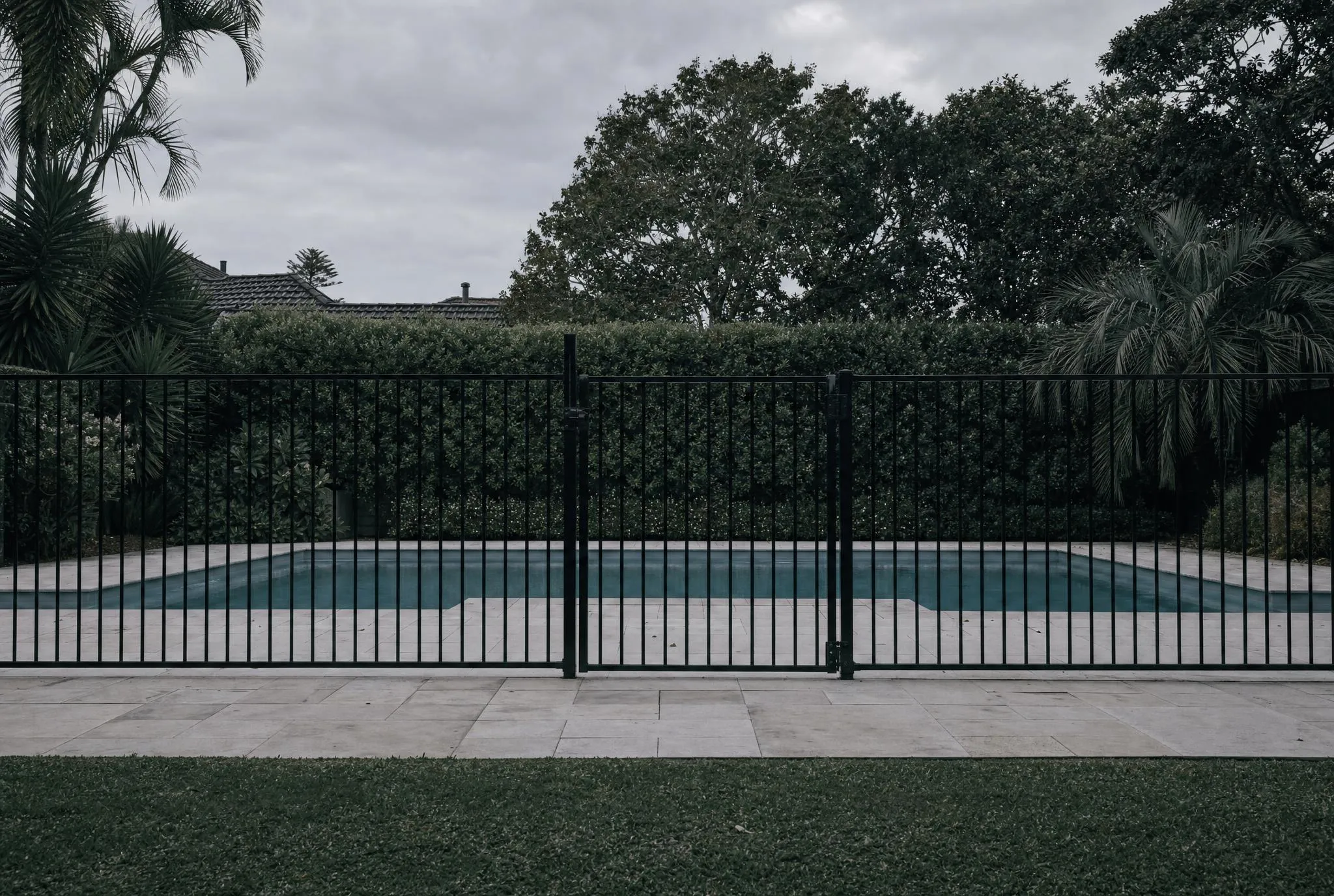
What are the pool fence rules in Victoria?
Every Victorian pool or spa more than 30 cm deep needs a compliant barrier, has to be registered with your council, and needs a fresh compliance certificate every 4 years. Fines reach $10,455 for barrier failures.
- Barrier required when
- Any pool or spa at a home or residential building that can hold more than 30 cm of water. Relocatable and inflatable ones count 1
- Height & standard
- At least 1.2 m. Pools from before April 1991 get an extra option, a solid paling fence at 1.5 m. Newer ones follow the barrier standard that applied when they were built 1
- How often it's checked
- A compliance certificate from an inspector or building surveyor, lodged with your council every 4 years, dated no more than 30 days before lodgement 1
- Selling or leasing
- Nothing here is triggered by a sale or a lease. The register and the 4-yearly certificate cycle apply whoever owns the pool 1
- Fines
- $418 on-the-spot fines for most breaches. Court maximums reach $10,455 for barrier failures 1
- Relocatable pools
- An inflatable or relocatable pool that stays up 3 or more days must be registered within 4 days of going up 1
- Who's on the hook
- The owner has to have the barrier and maintain it. The occupier, a tenant for example, has to keep it working and the gate closed. And anyone who opens the gate has to close it 1
Victoria’s pool system has three moving parts: a barrier, a council register, and a certificate you renew every 4 years. The duties are spread across the owner, the occupier, and anyone at all who opens the gate. 1
Which pools need a fence in Victoria?
Any pool or spa at a home or residential building that can hold more than 30 cm of water. The rules name relocatable and inflatable pools directly. 1
reg 147A Which pools these rules cover Building Regulations 2018 (Vic) 1
This Part applies to land on which a swimming pool or spa is located if the swimming pool or spa— (a) is appurtenant to a Class 1, 2, 3 or 10 building or a Class 4 part of a building; and (b) is capable of containing water to a depth of greater than 300 mm.
What does the pool barrier need to be in Victoria?
At least 1.2 m for most pools. 1
Pools built or permitted before 8 April 1991 get a choice the newer ones don’t. Any of three things will do. A fence and gate built to the Australian Standard AS 1926.1. A building wall with compliant doors and windows. Or a solid paling fence at least 1.5 m high. 1
That last option is why so many older Victorian pools sit behind an ordinary timber boundary fence. It is legal — provided the fence really is solid, really is 1.5 m, and the pool predates the cut-off.
regs 147B–147C Pre-1991 pools: the three permitted barrier types Building Regulations 2018 (Vic) 1
147B Application of Division — This Division applies to a swimming pool or spa that was constructed, or for which a building permit was granted, before 8 April 1991. […] 147C Requirement for barriers — The owner of the land on which a swimming pool or spa is located must ensure that one or more of the following barriers are in place to restrict access to the part of the land on which the swimming pool or spa is located— (a) a wall of a building […] (b) a fence and gate complying with AS 1926.1—1993 Swimming pool safety Part 1: Fencing for swimming pools, published 26 July 1993 as in force or as issued from time to time; (c) a paling or imperforate fence if— (i) it is at least 1.5 m in height measured above the ground level on the approach side; and (ii) any door or gate in the fence complies with regulation 147D. Penalty: 50 penalty units.
Every newer pool is measured against the “applicable barrier standard”, meaning the barrier rules in force when that pool was built, or when its barrier was last rebuilt. 1
reg 5(1) Newer pools: the standard from when they were built Building Regulations 2018 (Vic) 1
applicable barrier standard, in relation to a swimming pool or spa barrier, means— (a) the requirements of the Act and these Regulations with which the barrier must comply (the barrier requirements) in force at the date of construction of the swimming pool or spa; or (b) if after the date of construction of the swimming pool or spa, building work is carried out on the whole or part of the barrier resulting in the whole or part of the barrier having to comply with any subsequent barrier requirements— (i) the subsequent barrier requirements in force at the date of the issue of any building permit for the building work […]
In practice that has meant a barrier built to the Australian Standard AS 1926.1, applied through the conditions on your permit. So there is no single Victorian number that fits every pool: yours is set by whichever version of the standard was current when your pool was built, or when the barrier was last rebuilt. If you don’t know which that is, the permit paperwork for the pool will tell you, and your council holds a copy.
The gate rules are the exception — the regulation states those itself, for every pool. Self-closing, self-latching, and the opening mechanism at least 1.5 m up. 1
Whose job is the pool fence in Victoria?
Everyone’s, and the rules split it up on purpose. The owner has to have a compliant barrier and maintain it. The occupier, a tenant for example, has to keep it working and the gate closed. And any person who opens the gate has to close it behind them. Each duty carries its own 50-penalty-unit maximum. 1
regs 147F–147H Everyone has a duty: owner, occupier, gate-opener Building Regulations 2018 (Vic) 1
147F […] The owner of the land […] must take all reasonable steps to ensure that a barrier restricting access to the swimming pool or spa is properly maintained. Penalty: 50 penalty units. 147G An occupier of the land […] must take all reasonable steps to ensure that a barrier restricting access to the swimming pool or spa is operating effectively. Penalty: 50 penalty units. 147H(1) An occupier […] must take all reasonable steps to ensure that any gate or door forming part of a barrier […] remains closed except when a person is entering or leaving […] Penalty: 50 penalty units. (2) A person who opens a gate or door forming part of a barrier […] must ensure that the gate or door is closed immediately after entering or leaving […] Penalty: 50 penalty units.
How do you register a pool in Victoria?
Every pool and spa has to be registered with your council. For a new pool that’s within 30 days of getting the occupancy permit, and you lodge the compliance certificate at the same time. Inflatable and relocatable pools that stay up 3 or more days have to be registered by the 4th day. 1
reg 147M(2) New pools: register within 30 days Building Regulations 2018 (Vic) 1
The owner of the land on which the swimming pool or spa is located must— (a) apply to the relevant council for registration of the swimming pool or spa within 30 days after the date on which the owner receives the occupancy permit or certificate of final inspection for the swimming pool or spa; and (b) lodge the certificate of pool and spa barrier compliance issued by the relevant building surveyor under regulation 147Y with the relevant council at the time of applying for registration of the swimming pool or spa. Penalty: 10 penalty units.
The one-off deadline for pools that already existed was 1 November 2020. That’s long gone, so an older pool that still isn’t registered is already in breach. It isn’t waiting on a future date. 1
Then comes the cycle. Every 4 years you need a fresh certificate of pool and spa barrier compliance. A building surveyor issues it, or a pool inspector you hire yourself, and it has to be dated within 30 days of when you lodge it. The council writes back with your next due date. 1
reg 147V(2), (4)(b) The 4-year certificate cycle Building Regulations 2018 (Vic) 1
(2) A certificate of pool and spa barrier compliance lodged by an owner with a relevant council in accordance with subregulation (1) must be dated not more than 30 days before the date it is lodged. […] (4) Following lodgement of a certificate of pool and spa barrier compliance with the relevant council by an owner […] the relevant council must give a notice in writing to the owner of— […] (b) the date by which the next certificate of pool and spa barrier compliance is required to be lodged with the relevant council which must be 4 years after the previous certificate was lodged with the relevant council.
Councils can push a due date back 6 months at a time if you have a reasonable excuse, a booked inspection, or rectification work under way. 1
What are the fines for pool-fence breaches in Victoria?
There are two tracks. On the on-the-spot track, the municipal building surveyor can issue a flat $418.20 infringement notice for having no compliant barrier, or for the registration and certificate offences. 1
The prosecution track is much bigger, at up to $10,455 for barrier failures and around $2,091 for the paperwork ones. There’s a quirk here worth knowing. The maintenance, operation and gate-closed duties aren’t on the infringement list at all, so they go to prosecution or nowhere. 1 3
What happens if you miss the four-year certificate?
In Victoria this is a paperwork cycle rather than an inspection round, and it has a quirk worth knowing.
Your council sends the notice and tracks the cycle, so the due date isn’t something you have to remember unaided. If you can’t make it, councils can extend a due date six months at a time for a reasonable excuse, a booked inspection, or rectification work already under way. 1
Now the quirk. Registration and certificate offences can be dealt with by a flat $418.20 on-the-spot fine. The maintenance, operation and gate-closed duties can’t be — they aren’t on the infringement list at all. So the paperwork failures get a modest ticket, while the duties that actually keep a child out of the water go to prosecution or nowhere, with a $10,455 maximum. 1
The duties are also split three ways, which matters if you rent. The owner has to have the barrier and maintain it. The occupier has to keep it working and the gate shut. And anyone who opens the gate has to close it. A tenant carries real obligations here, not just the landlord. 1
What it costs to get it wrong
| Offence | Penalty | Source |
|---|---|---|
| No compliant barrier in place (owner's duty) | $418.20 on the spot; court maximum $10,455 (50 penalty units at $209.10) | 1 |
| Barrier not maintained, not operating, or gate not kept closed | Court-only — up to $10,455 (these duties have no on-the-spot option) | 1 |
| Registration and certificate offences (late registration, missing 4-yearly certificate, unpaid lodgement fees) | $418.20 on the spot; court maximum $2,091 | 1 |
Common questions
How high does a pool fence need to be in Victoria?
At least 1.2 m for most pools, which is the figure the AS 1926 standards carry. Victoria adds an option for older ones. For pools built or permitted before 8 April 1991 the rules name three choices themselves: an AS 1926.1-compliant fence and gate, a building wall with compliant doors and windows, or a solid paling fence at least 1.5 m high. Newer pools follow the barrier standard in force when they were built. 1
Do I need to register my pool in Victoria?
Yes, with your council. For a new pool you have 30 days from getting the occupancy permit or final-inspection certificate, and you lodge the barrier compliance certificate at the same time. Pools that existed before November 2020 should already be registered. That deadline has gone, so an older pool that still isn't registered is already in breach. 1
Do inflatable or portable pools need a fence in Victoria?
Yes, if it can hold more than 30 cm of water. The rules name relocatable pools and spas directly. One that stays up for 3 or more days also has to be registered with your council by the 4th day. 1
How often does a pool fence need to be inspected in Victoria?
Every 4 years. You hire an inspector or building surveyor and lodge their certificate of barrier compliance with your council. It has to be dated no more than 30 days before you lodge it. Your council's notice tells you when each cycle is due. 1
Do I need a pool compliance certificate to sell my house in Victoria?
Victoria's pool rules aren't triggered by a sale. The register and the 4-yearly certificate cycle stay with the property either way. A buyer will usually want to know where the pool sits in its cycle, so keep your council's latest notice handy. 1
What's the fine for a non-compliant pool fence in Victoria?
The municipal building surveyor can issue a $418.20 on-the-spot fine if you have no compliant barrier, and prosecution can reach $10,455. There's a quirk worth knowing: the maintenance and gate-closed duties can't be handled by an on-the-spot fine at all. They go straight to prosecution, with the same $10,455 maximum. 1
Is my tenant responsible for the pool gate in Victoria?
Partly, yes. The rules split the duties three ways. The owner has to have a compliant barrier and keep it maintained. The occupier has to keep it working properly and keep the gate closed. And anyone who opens the gate has to close it behind them. Each duty carries its own 50-penalty-unit maximum. 1
Who checks pool fences in Victoria?
Three kinds of people can issue the compliance certificate: the relevant building surveyor, a swimming pool and spa inspector you hire yourself, or the municipal building surveyor. Councils keep the register and send out the cycle notices. The state regulator for building matters is now the Building and Plumbing Commission. 1
Every source on this page
The small numbered marks throughout this page point to this list — 1 means source 1 below.
- Building Regulations 2018 (Vic), Part 9A (regs 147A–147ZM); regs 276–278; Sch 3, item 8 (Authorised Version 030)
- Building Act 1993 (Vic), ss 216D, 254–255 (Authorised Version 149)
- Victorian Treasurer's notice — penalty unit value 2026–27 ($209.10)
© State of Victoria. Sourced from the Victorian Legislation website at 3 Sept 2026. For the latest information on Victorian legislation please go to https://www.legislation.vic.gov.au. Reproduced without changes. This is not an official version — authorised versions are published at legislation.vic.gov.au.
Other rules for Victoria
- Are e-bikes legal in Victoria? Legal, with conditions
- Are e-scooters legal in Victoria? Legal, with conditions
- How high can a fence be in Victoria? Legal, with conditions
- Is it legal to record a conversation in Victoria? Legal, with conditions
Pool fences rules elsewhere
- Australian Capital Territory Legal, with conditions
- New South Wales Legal, with conditions
- Northern Territory Legal, with conditions
- Queensland Legal, with conditions
- South Australia Legal, with conditions
- Tasmania Legal, with conditions
- Western Australia Legal, with conditions
Page history
Every change to this page
- 3 Sept 2026
- Re-checked against Victoria's 1 September 2026 consolidations: Building Regulations 2018 version 031 and Building Act 1993 version 150, replacing versions 030 and 149. Every provision quoted on this page is present in the new version unchanged, so no wording here changed — only the version the page points at.
- 28 Aug 2026
- First published. Current to the Victorian Building Regulations as at 1 July 2026.