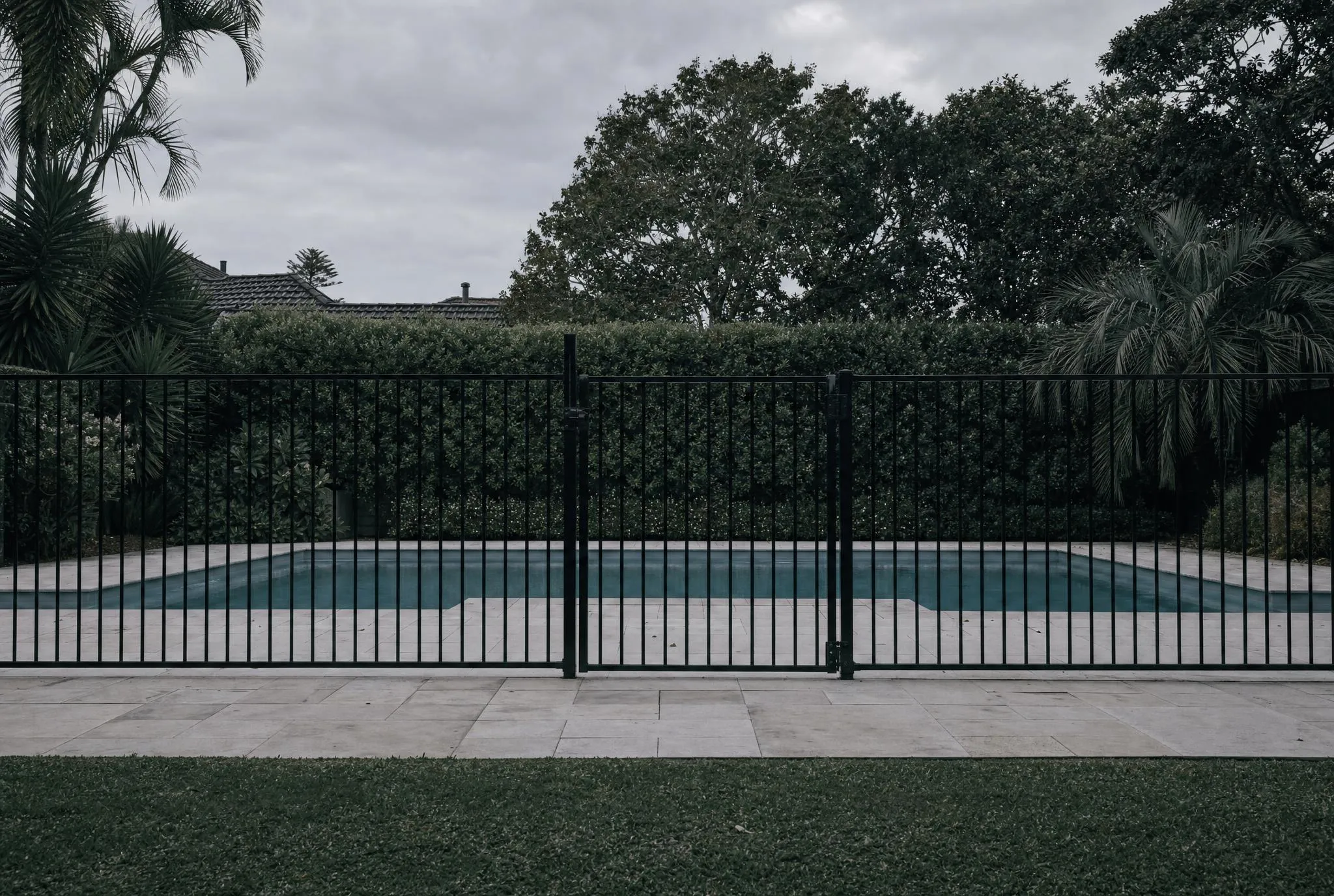
What are the pool fence rules in NSW?
Every NSW pool more than 30 cm deep needs a child-resistant barrier and has to be registered. You can demand an inspection when you sell or lease. The pool owner pays for the fence, not the neighbour.
- Barrier required when
- Any pool or spa that can hold more than 30 cm of water, at a home, moveable dwelling or tourist accommodation. Indoor pools are covered too 1
- Height & standard
- At least 1.2 m. The Act itself gives no figure, so it comes from the Building Code. Three narrow exemptions for older pools use AS 1926.1—2007 instead 2
- How often it's checked
- Councils run inspection programs, and a certificate of compliance lasts 3 years; you can request an inspection at any time 1
- Selling or leasing
- Selling: a valid compliance certificate (or an occupation certificate plus registration, or a certificate of non-compliance) must be attached to the contract — leave it out and the buyer can pull out within 14 days. Leasing: you can demand a council inspection, due in 10 business days 6
- Fines
- $550 on the spot for an unfenced pool (court maximum $5,500); $220 for an unregistered pool 2
- Who pays
- Barrier work on a shared boundary is the pool owner's cost. This beats the usual half-each fence rule 1
- Old pools
- Pre-1990, small-lot, large-property and waterfront pools swap "surround the pool" for "restrict access from the house". The exemption ends for good once any barrier is built 1
NSW pool law comes down to one blunt duty, a set of technical standards, and a money rule that catches neighbours out. The height everyone asks about isn’t in the Act at all — it sits in the Building Code, which the Act points to. 1
Which pools need a fence in NSW?
Any pool or spa that can hold more than 30 cm of water and is used mainly for swimming, wading or paddling. That covers homes, moveable dwellings and tourist accommodation. Indoor pools are included, though their duty is about restricting access rather than fencing the pool in. 1
The duty is continuous, which is the part people underestimate. It isn’t a box you tick when the pool goes in. The barrier has to be there and working every day the pool exists, and a gate propped open on a hot afternoon breaches it just as a missing fence would. 1
s 7(1) The core duty: a child-resistant barrier, at all times Swimming Pools Act 1992 (NSW) 1
The owner of the premises on which a swimming pool is situated must ensure that the swimming pool is at all times surrounded by a child-resistant barrier— (a) that separates the swimming pool from any residential building situated on the premises and from any place (whether public or private) adjoining the premises, and (b) that is designed, constructed, installed and maintained in accordance with the standards prescribed by the regulations. Maximum penalty—50 penalty units.
There is one real alternative, and only for spas. A spa can use a lockable child-resistant cover instead of a barrier, kept locked whenever the spa isn’t in use. 1
Be clear about the trade. You are swapping a fence you build once for a lid someone has to lock every single time. If that isn’t realistic in your household, fence it.
How high does a pool fence need to be in NSW?
At least 1.2 m. That is the number your certifier will work to, and it is the one to plan around.
The number isn’t in the Swimming Pools Act or its Regulation at all. Both point at the Building Code of Australia, and that is where the 1.2 m sits. 2
cl 5(1) The standard: the Building Code — not a number in the Act Swimming Pools Regulation 2018 (NSW) 2
For the purposes of sections 7 (1) (b) and 12 (d) of the Act, the prescribed standards in accordance with which a child-resistant barrier surrounding a swimming pool is to be designed, constructed, installed and maintained are the requirements set out in the Building Code of Australia.
Why 1.2 m, then? Because it is the figure every Australian state that writes the number into its own law uses for the same family of standards. South Australia sets 1.2 m for older pools, the Northern Territory for fine chainmesh, and Western Australia and Queensland both use it where a boundary fence doubles as the pool barrier.
Treat 1.2 m as your working minimum and have your certifier confirm it against the edition that applies to your pool. Height is not the only thing the standard covers either: gate latches, the gap under the fence and what sits climbable nearby all get checked too. 2
Is my old pool exempt in NSW?
There are three exemptions. Pools built before August 1990. Older pools on small lots under 230 m². And pre-2010 pools on large properties of 2 hectares or more, or on waterfront land.
None of them removes the duty to have a barrier. What they do is let the barrier skip separating the pool from your own house. The condition is that every door and window opening onto it is restricted to the AS 1926.1—2007 standard. 1
s 8(1)–(2), (4) The old-pool exemption — and its permanent off-switch Swimming Pools Act 1992 (NSW) 1
(1) This section applies to the following swimming pools— (a) swimming pools the construction or installation of which commenced before 1 August 1990, (b) swimming pools the construction or installation of which commenced before 1 July 2010 and that are situated on premises having an area of less than 230 square metres. (2) The child-resistant barrier surrounding the swimming pool is not required to separate the swimming pool from any residential building situated on the premises so long as the means of access to the swimming pool from the building are at all times restricted in accordance with the standards prescribed by the regulations. […] (4) This section ceases to apply in respect of a swimming pool if a barrier is erected on the premises (between the swimming pool and a residential building) as a barrier to direct access to the swimming pool from any residential building situated on the premises.
There’s an off-switch, too. The exemption ends for good the moment any barrier goes up between the house and the pool. Once fenced, always fenced. 1
Do you have to register a pool in NSW?
Yes. Every pool has to be on the NSW Register of Swimming Pools. Doing it yourself online is free, and your council can charge at most $10. 1
s 30B(1) Registration is compulsory Swimming Pools Act 1992 (NSW) 1
The owner of the premises on which a swimming pool is situated must ensure that any information prescribed by the regulations in relation to the swimming pool (the registration information) is entered on the Register. Maximum penalty—20 penalty units.
Councils run their own inspection programs, and they inspect at least every three years at tourist accommodation and multi-dwelling premises. A certificate of compliance lasts three years. When a sale or lease is on, the Act lets you demand an inspection, and the regulation gives the council 10 business days. 1
ss 22C(3), 22D(6) Sale or lease: inspection on demand, 3-year certificates Swimming Pools Act 1992 (NSW) 1
22C […] (3) A local authority must carry out an inspection under this section, and must carry out that inspection within a reasonable time, if the request to the local authority is in writing and states that the inspection is required to enable the sale or lease of the premises or part of the premises on which the swimming pool is situated. […] 22D […] (6) A certificate of compliance remains valid for a period of 3 years from the date on which it is issued but ceases to be valid if a direction is issued under section 23 in respect of the swimming pool to which the certificate relates.
What do you need to sell a house with a pool in NSW?
Selling is where it gets serious. A different law handles this, the conveyancing rules rather than the Swimming Pools Act. If there’s a pool on the land, one of three documents has to be attached to the contract of sale. A valid certificate of compliance. An occupation certificate plus proof the pool is registered. Or a valid certificate of non-compliance. 6
reg 4(1); Sch 1 Pt 1 item 15 Selling: the pool certificate goes in the contract Conveyancing (Sale of Land) Regulation 2022 (NSW) 6
4 Documents that must be attached to contract (1) […] the documents listed in Schedule 1, Part 1 […] are prescribed […] Schedule 1, Part 1 — 15 (1) If the contract relates to land on which there is a swimming pool to which the Swimming Pools Act 1992 applies, 1 of the following for the swimming pool— (a) a valid certificate of compliance issued under that Act, section 22D, (b) a relevant occupation certificate within the meaning of that Act and evidence that the swimming pool is registered under the Act, Part 3A, (c) a valid certificate of non-compliance issued under the Swimming Pools Regulation 2018 following an inspection under the Swimming Pools Act 1992, section 22C. (2) This item does not apply if— (a) the contract relates to a lot in a strata scheme or in a community scheme and that strata or community scheme comprises more than 2 lots, or (b) the contract is an off the plan contract.
That third option is easy to miss. A pool that doesn’t comply can still be sold, as long as the buyer is told so in the contract. Two kinds of contract are left out: off-the-plan contracts, and lots in a strata or community scheme of more than two lots.
If you leave the document out, it’s the buyer who gets the remedy, not the council. They can pull out of the contract within 14 days of it being made. 6
regs 21(1)(a), 22(1)(a)(i) Leave it out and the buyer can walk — for 14 days Conveyancing (Sale of Land) Regulation 2022 (NSW) 6
21 Purchaser may rescind contract or option (1) For the Act, section 52A(6), the purchaser under a contract for the sale of land may rescind the contract— (a) for the vendor's failure to attach the prescribed documents to the contract […] 22 Method of rescinding contract or option (1) […] a purchaser may rescind a contract or option under section 21 by written notice served on the vendor— (a) for a contract— (i) if the purchaser's right to rescind arises from the vendor's failure to attach the prescribed documents or a disclosure statement—within 14 days after the contract is made, unless the contract has been completed […]
Who pays for a pool fence on a boundary in NSW?
The pool owner. The Act says so directly. It beats the Dividing Fences Act’s usual half-each rule for the part of the work that’s about pool compliance. 1
s 33(1)–(2) Boundary-fence costs: the pool owner pays Swimming Pools Act 1992 (NSW) 1
(1) The expenses of constructing, altering, repairing, replacing or maintaining a dividing fence are, to the extent to which they are attributable to work done for the purpose of complying with the requirements of this Act in respect of a swimming pool, to be borne— (a) by the owner of the premises on which the swimming pool is situated, or (b) if swimming pools are situated on more than one of the premises bounded by the dividing fence—by the owners of each of those premises in appropriate proportions. (2) This section prevails over any provision of the Dividing Fences Act 1991 to the contrary.
Do you need council approval to build a pool fence in NSW?
Usually not. In residential areas you can build a pool fence without a development application, on one condition: it has to comply with the Swimming Pools Act. Get the safety part right and the planning part looks after itself. 3
What happens if your pool isn’t compliant?
There are a few ways this comes to light: a council inspection program, a complaint, or the moment you sell or lease. Each one starts a clock.
Selling is the sharp end. If the pool document isn’t attached to the contract, the buyer can walk away within 14 days of it being made. That’s the buyer’s remedy, not the council’s, and it doesn’t need anybody to have inspected anything. The quiet mercy is the third option: a certificate of non-compliance also satisfies the rule, so a pool that doesn’t comply can still be sold as long as the buyer is told. 6
If the council does inspect and you fail, the certificate isn’t the end of it. A rectification direction under the Act cuts an existing certificate of compliance short, so a three-year certificate can stop being valid the moment a direction lands. 1
The money is smaller than people expect and that’s the trap. $550 on the spot for an unfenced pool, $220 for not registering. Those are recoverable amounts. The bigger problems are the $5,500 court maximum, and the sale falling over. 2
One thing worth doing early: register the pool. It’s free online, a council can charge at most $10, and it’s the cheapest item on this page. 1
What it costs to get it wrong
| Offence | Penalty | Source |
|---|---|---|
| Pool without a compliant child-resistant barrier (outdoor, moveable-dwelling or indoor-access duties) | $550 on the spot; court maximum $5,500 (50 penalty units at $110) | 2 |
| Failing to register the pool on the NSW Register | $220 on the spot; court maximum $2,200 | 2 |
| No warning notice (CPR sign) near the pool | $110 on the spot; court maximum $550 | 2 |
Common questions
How high does a pool fence need to be in NSW?
At least 1.2 m. That is what your certifier will work to, so plan around it. The Act itself gives no figure on purpose: it requires the barrier to meet the standard set out in the rules, which for new pools is the Building Code of Australia, and the three exemptions for older pools use AS 1926.1—2007. Height is not the only thing those standards cover either. Gate latches, the gap under the fence and anything climbable nearby all get checked. 2
Is a pre-1990 pool exempt from pool fencing in NSW?
Not in the way people assume. The pre-1990 exemption doesn't remove the duty to have a barrier. It lets the barrier skip separating the pool from your own house, as long as every door and window that opens onto the pool is restricted to the AS 1926.1—2007 standard. The exemption also ends for good the moment any barrier goes up between the house and the pool. 1
Do I need to register my swimming pool in NSW?
Yes. Every pool has to be on the NSW Register of Swimming Pools, and it's a $220 on-the-spot fine if it isn't. Registering it yourself online is free, and a council can charge at most $10 to do it for you. 1
How long does a pool compliance certificate last in NSW?
Three years, unless the council issues a rectification direction first, which is a formal order to fix something, which ends it early. 1
Do I need a pool compliance certificate to sell my house in NSW?
Yes, in nearly every case. One of three pool documents has to be attached to the contract itself: a valid certificate of compliance, an occupation certificate plus proof the pool is registered, or a valid certificate of non-compliance. Off-the-plan contracts are the exception, as are lots in a strata or community scheme of more than two lots. If the document is missing, the buyer can pull out of the contract within 14 days of it being made. 6
What happens if you sell a house in NSW without a pool certificate?
The buyer gets a way out. Failing to attach the prescribed documents lets the purchaser rescind by written notice within 14 days after the contract is made, unless it has already completed. Note the third option, though: a certificate of NON-compliance also satisfies the rule, so a pool that doesn't yet comply can still be sold — the buyer just has to be told. 6
Who pays for a pool fence on a boundary in NSW?
The pool owner — in so many words. Where boundary-fence work is done to satisfy pool-safety requirements, the Swimming Pools Act puts that cost on the pool owner and expressly overrides the Dividing Fences Act's usual half-each rule. If both neighbours have pools, they share in appropriate proportions. 1
Can a spa have a lockable cover instead of a fence in NSW?
Yes — a spa pool doesn't need a surrounding barrier if access to the water is restricted by a lockable child-resistant cover, lid or grille of substantial construction, kept locked when the spa isn't in use. 1
Do I need council approval to build a pool fence in NSW?
Usually no — in residential zones, you can build a pool-barrier fence with no development application, on one condition: the fence complies with the Swimming Pools Act. The planning shortcut depends entirely on the safety compliance. 3
Every source on this page
The small numbered marks throughout this page point to this list — 1 means source 1 below.
- Swimming Pools Act 1992 (NSW), ss 3–10, 14, 20, 22B–22D, 30B, 33
- Swimming Pools Regulation 2018 (NSW), cll 3–9, 17, 24–25; Sch 1
- State Environmental Planning Policy (Exempt and Complying Development Codes) 2008 (NSW), cll 2.34A–2.34B
- Dividing Fences Act 1991 (NSW), s 7
- Crimes (Sentencing Procedure) Act 1999 (NSW), s 17 — penalty unit $110
- Conveyancing (Sale of Land) Regulation 2022 (NSW), regs 4, 21–22; Sch 1 Pt 1 item 15
Sourced from the New South Wales Legislation website at 28 Aug 2026. For the latest information on New South Wales Government legislation please go to https://www.legislation.nsw.gov.au. © State of New South Wales. Licensed under CC BY 4.0. Reproduced without changes. This is not an official version. Creative Commons Attribution 4.0 licence.
Sourced from the New South Wales Legislation website at 29 Aug 2026. For the latest information on New South Wales Government legislation please go to https://www.legislation.nsw.gov.au. © State of New South Wales. Licensed under CC BY 4.0. Reproduced without changes. This is not an official version. Creative Commons Attribution 4.0 licence.
Other rules for New South Wales
- Are e-bikes legal in NSW? Legal, with conditions
- Are e-scooters legal in NSW? Illegal
- How high can a fence be in NSW? Legal, with conditions
- Is it legal to record a conversation in New South Wales? Legal, with conditions
Pool fences rules elsewhere
- Australian Capital Territory Legal, with conditions
- Northern Territory Legal, with conditions
- Queensland Legal, with conditions
- South Australia Legal, with conditions
- Tasmania Legal, with conditions
- Victoria Legal, with conditions
- Western Australia Legal, with conditions
Page history
Every change to this page
- 29 Aug 2026
- Added what you have to attach to a contract when selling a house with a pool, and what happens if you leave it out. The buyer can pull out within 14 days.
- 28 Aug 2026
- First published. Current to the NSW Swimming Pools Act as at 14 August 2026, with its Regulation and the planning rules for pool fences.