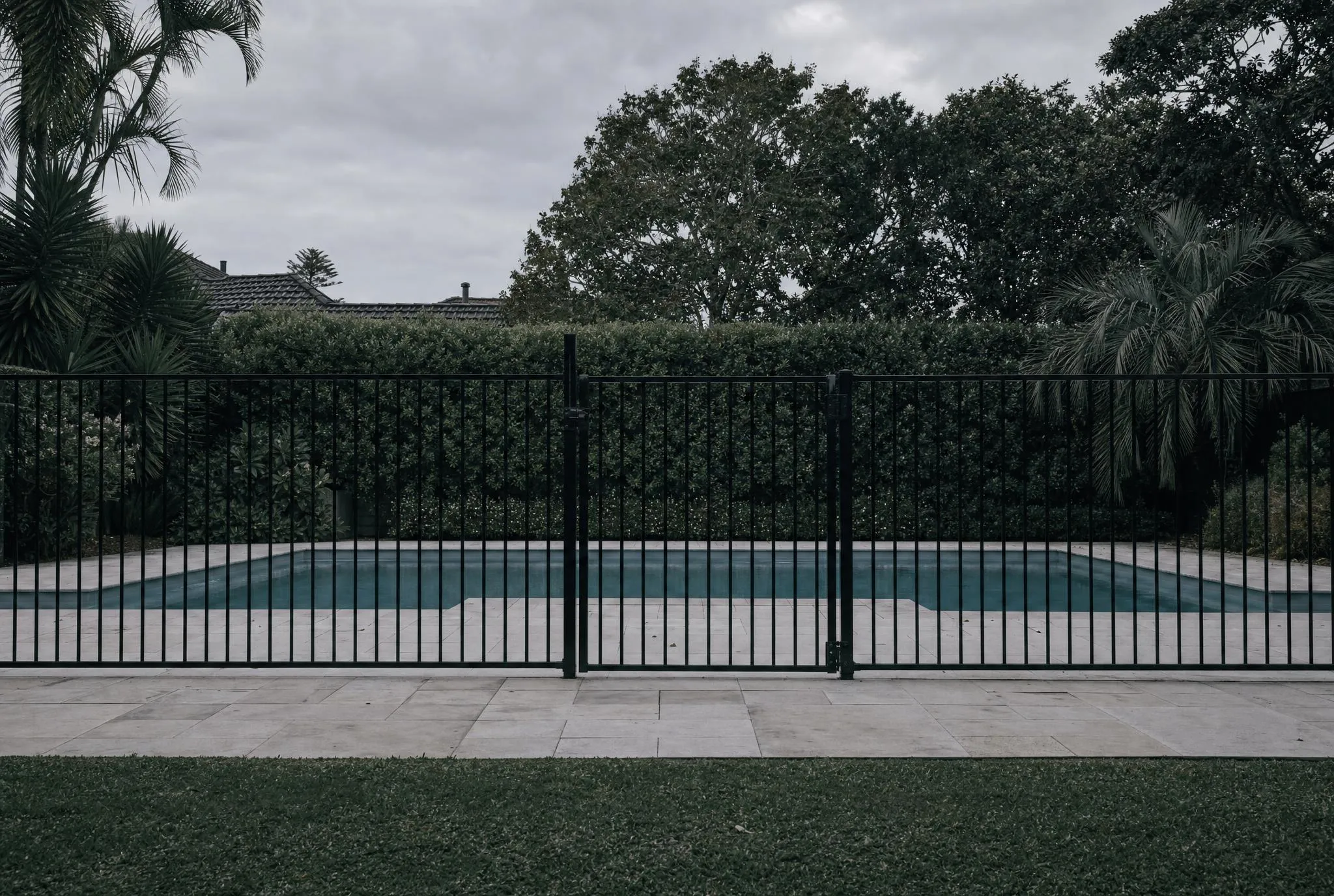
What are the pool fence rules in Tasmania?
Every Tasmanian pool needs an access barrier, and you are not allowed to build one yourself. It has to be designed, built by a licensed builder and checked by a building surveyor.
- Barrier required when
- Any pool or spa more than 30 cm deep, including temporary and inflatable ones. You can't even set those up until the barrier is there 1
- Height & standard
- Tasmanian law gives no figure. The barrier follows the National Construction Code and AS 1926 Parts 1 and 2. In practice that means 1.2 m, the figure other states write into their own laws 1
- How often it's checked
- Always "notifiable work". You have to hire a building surveyor before work starts. They sign off the plan and inspect the result. No self-built pool fences 2
- Selling or leasing
- Selling or leasing changes nothing. The duty stays with the pool 1
- Fines
- Skip the surveyor and you face up to 100 penalty units: $21,300 for a person, $106,500 for a company 2
- Portable pools
- A relocatable pool up to 9 m² of water surface is the easy tier, but only once the barrier is already up. A pool cover is not a barrier 1
Tasmania does this differently from every other state. There is no pool safety Act, and neither the Building Act, the Building Regulations nor the state planning scheme mentions pool barriers. The whole system sits in one document, and it works by treating every pool barrier as professional building work. 1
Which pools need a barrier in Tasmania?
Any pool or spa more than 30 cm deep. Everything that matters is carried by the definitions in one document, the Director’s Determination — including what counts as a compliant barrier at all. 1
item 3.1.8 The rule: every pool, a barrier, builder-built Director's Determination — Categories of Building and Demolition Work (Version 1.4, made under the Building Act 2016 s 20) 1
3.1.8 Swimming Pool Access Barrier and associated Swimming Pool or Spa Pool — Unlimited — Any swimming pool or a spa pool must be protected by a Swimming Pool Access Barrier constructed by a licensed builder. This category includes: Construction of Swimming Pool Access Barrier for existing pools, temporary pools, and replacement of existing access barriers. Construction of Swimming Pools/Spas.
How high does a pool fence need to be in Tasmania?
No Tasmanian document gives one. Ordinary fences get clear thresholds in the same Determination, at 1.2 m, 2.1 m and 3 m. Pool barriers get none. Instead the barrier has to meet the National Construction Code and AS 1926 Parts 1 and 2, and the measurements sit inside those standards. Standards Australia sells them, so they aren’t reproduced here. 1
There is a practical answer, though. The number you’ll be quoted is 1.2 m. Other states work to the same AS 1926 standard, and where they write the figure into their own law, it’s 1.2 m. South Australia sets that as the minimum barrier height for older pools. The Northern Territory sets it for fine chainmesh. Western Australia and Queensland both use it for a boundary fence doing double duty as the pool barrier. Tasmania just doesn’t restate it.
Plan around 1.2 m, and let your building surveyor confirm it against the current edition. They’re the one who signs it off. There’s also a real gap worth knowing about: the Determination never says which edition of the standard applies. 1
Who builds and checks pool fences in Tasmania?
Professionals, every time. A pool barrier is always notifiable building work, which is the tier where an owner isn’t allowed to do it themselves. Three people are involved and none of them are optional. A designer designs it. A licensed builder builds it. And a building surveyor, who you hire yourself before work starts, signs it off and inspects it. 2
ss 94–95 Designer, builder, surveyor: hired before you start Building Act 2016 (Tas) 2
94 Notifiable building work must be— (a) designed by a designer; and (b) performed in accordance with this Act by a licensed builder who is licensed to perform the building work; and (c) inspected in accordance with this Act by a building surveyor. 95 The owner of the premises where notifiable building work is proposed to be performed must engage a building surveyor in respect of the work before the notifiable building work commences. Penalty: In the case of— (a) a natural person, a fine not exceeding 100 penalty units; or (b) a body corporate, a fine not exceeding 500 penalty units.
s 96 Before work: notice + likely-compliance certificate Building Act 2016 (Tas) 2
A person must not perform notifiable building work unless he or she ensures that— (a) a notice of work has been given under section 97 to the building surveyor engaged in respect of the work; and (b) the building surveyor engaged in respect of the work has issued a certificate of likely compliance (notifiable building work) in respect of the work; and (c) the work to be performed is the same as, or not materially different from, the work specified in that certificate of likely compliance (notifiable building work); and (d) the work is to be performed by, or under the supervision of, the responsible person for the work. Penalty: Fine not exceeding 100 penalty units.
You don’t need a council permit, because pool barriers sit below the permit tier. The surveyor chain takes its place, and skipping it costs up to 100 penalty units, or 500 for a company. 2 At the penalty-unit value that applies from 1 July 2026, which is $213, that’s up to $21,300 for a person and $106,500 for a company. 4
What happens if you skip the surveyor?
Tasmania has no pool inspectors knocking on doors, so the enforcement point is the building surveyor you were supposed to hire.
You have to engage one before the work starts. They issue a certificate of likely compliance, and they inspect. Skipping that is not a paperwork oversight: it carries up to 100 penalty units, which is $21,300 for a person and $106,500 for a company at the value that applies from 1 July 2026. 2 4
The order matters as much as the people. For a relocatable pool, the barrier has to exist before the pool goes up, and a pool cover doesn’t count as a barrier. Putting the pool up first and sorting the fence out later is the sequence the rules specifically close off. 1
And because there is no certificate system and no sale trigger, nothing ever forces a check. The duty just runs with the pool, whoever owns it. For a buyer that means a Tasmanian pool may never have been looked at by anyone, and no document will tell you either way. 1
Do inflatable and portable pools need a fence in Tasmania?
Yes, and the order you do things in matters. A relocatable pool can only go up after the barrier exists. A pool cover doesn’t count. 1
item 1.3.11 Portable pools: barrier first — a cover doesn't count Director's Determination — Categories of Building and Demolition Work (Version 1.4, made under the Building Act 2016 s 20) 1
1.3.11 A relocatable (temporary) swimming pool — Maximum water surface area 9m² — May only be erected if a Swimming Pool Access Barrier has already been installed as Notifiable Building Work — Work must comply with Standard Limitations […] — Excludes pools less than 300mm deep — A pool cover is not a legally compliant Swimming Pool Access Barrier — Notify Council? No.
The Building Regulations separately treat a temporary pool and its barrier as a “temporary structure”. That’s a labelling question. It changes which machinery applies to the pool. It doesn’t change whether you need a barrier. 3
What happens when you sell a house with a pool in Tasmania?
Nothing extra. Selling or leasing triggers nothing here. There’s no certificate system and no duty to upgrade before settlement. The barrier obligation simply stays with the pool, whoever owns it. 1
What it costs to get it wrong
Common questions
How high does a pool fence need to be in Tasmania?
No Tasmanian law gives one. Not the Building Act, not the Building Regulations, and not the planning scheme. The barrier has to meet the National Construction Code and AS 1926 Parts 1 and 2, and the measurements sit inside those standards, which Standards Australia sells. In practice the number you will be quoted is 1.2 m: other states work to the same standard, and where they write the figure into their own law it is 1.2 m. Plan around that and let your building surveyor confirm it against the current edition. 1
Can I build my own pool fence in Tasmania?
No, and this is the rule that sets Tasmania apart. A pool barrier is always professional work. A designer designs it, a licensed builder builds it, and a building surveyor you hire before work starts inspects it. You can build your own garden fence in Tasmania. You cannot build your own pool barrier. 2
Do inflatable or portable pools need a fence in Tasmania?
Yes, and the order matters. A relocatable pool up to 9 m² of water surface and more than 30 cm deep can only go up once a compliant barrier is already installed. The rules also say directly that a pool cover does not count as a barrier. 1
Do I need council approval for a pool fence in Tasmania?
Not a council permit. Pool barriers sit at the "notifiable" tier, just below permit work. Before work starts the surveyor issues a certificate of likely compliance, which is a document saying the plan should meet the rules. You still get oversight, though. The building surveyor steps in instead: you hire them, they issue a certificate of likely compliance, and they inspect. None of that can be skipped. 2
Do I need a pool inspection or certificate to sell my house in Tasmania?
Selling or leasing triggers nothing. Tasmania has no certificate-on-sale system like Queensland's. The duty just continues with the pool. 1
What's the fine for pool-fence breaches in Tasmania?
The stated maximums are 100 penalty units for a person (500 for a company) for skipping the surveyor or the pre-work certificate. Tasmania's penalty-unit dollar value is indexed each year — the value from 1 July 2026 is $213, so a 100-unit fine is up to $21,300 and a company's 500-unit maximum is $106,500. 2
Does a spa need a fence in Tasmania?
Yes. The definition names spa pools directly, and "any swimming pool or a spa pool" has to be protected by a compliant access barrier. 1
Is there a Tasmanian pool safety Act?
No. Tasmania has never passed one, and neither the Building Act, the Building Regulations nor the state planning scheme mentions pool barriers. The whole system rests on one document, the Director of Building Control's Determination, which makes every pool barrier professional building work. 1
Every source on this page
The small numbered marks throughout this page point to this list — 1 means source 1 below.
- Director's Determination — Categories of Building and Demolition Work (Version 1.4, made under the Building Act 2016 s 20), Terms and definitions; items 1.3.11, 3.1.8 (in effect from 12 April 2021)
- Building Act 2016 (Tas), ss 4(1), 93–96
- Building Regulations 2016 (Tas), regs 4(1)(da), 81
- Department of Justice (Tas) — Penalty units indexed amounts, Penalty unit value from 1 July 2026
© State of Tasmania. Sourced from cbos.tas.gov.au at 28 Aug 2026. Reproduced without changes. This is not an official version.
Sourced from the Tasmanian Legislation website at 28 Aug 2026. For the latest information on Tasmanian Government legislation please go to www.legislation.tas.gov.au. Licensed under CC BY 4.0. Reproduced without changes. This is not an official version. Creative Commons Attribution 4.0 licence.
Other rules for Tasmania
- Are e-bikes legal in Tasmania? Legal, with conditions
- Are e-scooters legal in Tasmania? Legal, with conditions
- How high can a fence be in Tasmania? Legal, with conditions
- Is it legal to record a conversation in Tasmania? Legal, with conditions
Pool fences rules elsewhere
- Australian Capital Territory Legal, with conditions
- New South Wales Legal, with conditions
- Northern Territory Legal, with conditions
- Queensland Legal, with conditions
- South Australia Legal, with conditions
- Victoria Legal, with conditions
- Western Australia Legal, with conditions
Page history
Every change to this page
- 29 Aug 2026
- Updated the fines to Tasmania's penalty-unit value of $213, which applied from 1 July 2026, replacing $205. Maximum fines are now shown in dollars.
- 28 Aug 2026
- First published. Current to Tasmania's Director of Building Control determination and the Building Act.