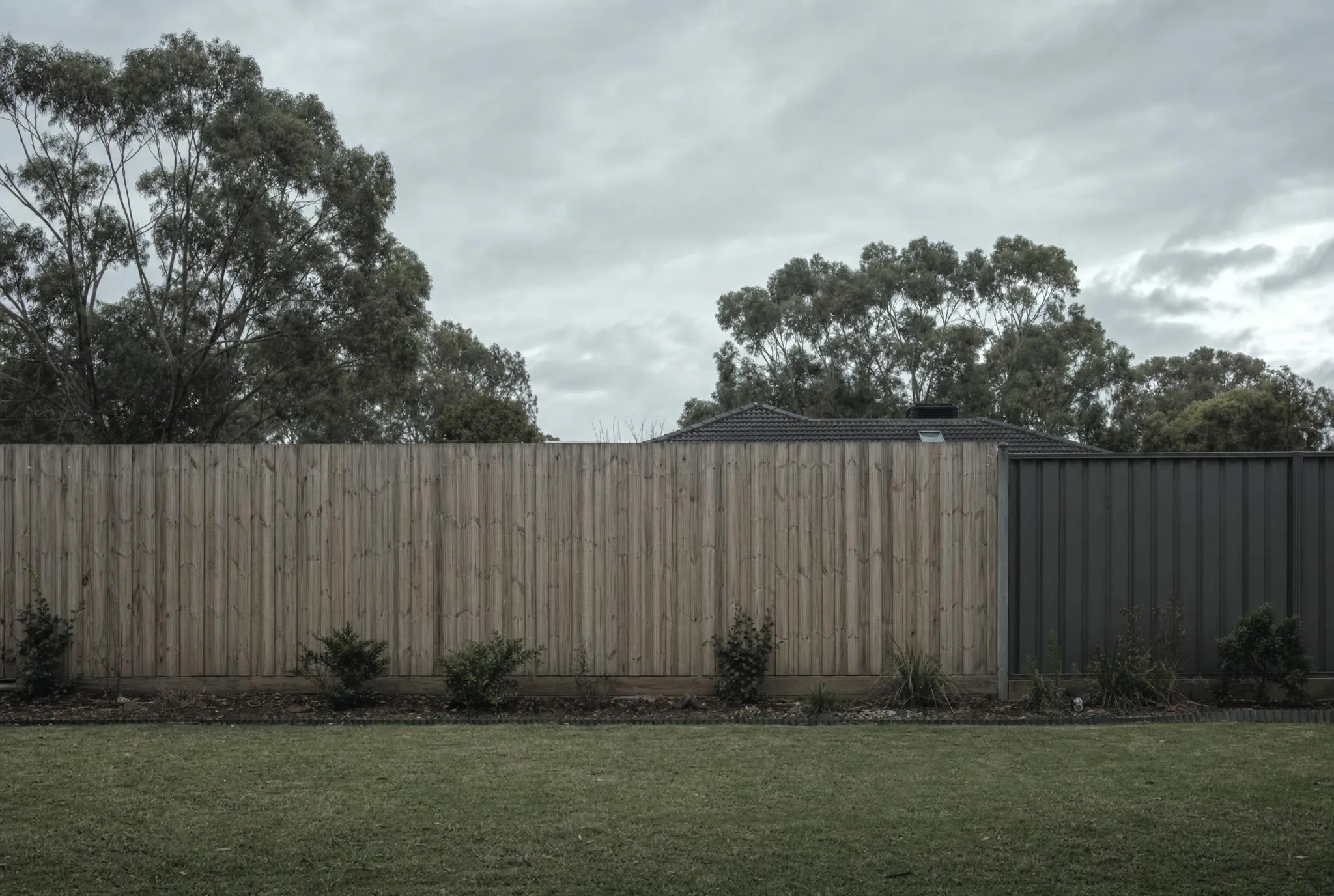
How high can a fence be in Tasmania?
Most Tasmanian boundary fences can reach 2.1 m with no approvals, though brick stops at 1.2 m. Near the street it's 1.2 m solid, or 1.8 m see-through. Two separate rulebooks apply: building and planning.
- Without approval
- Boundary fences to 2.1 m. Brick or concrete stops at 1.2 m, chain link goes to 3 m. The fence has to clear BOTH the building and planning rulebooks 1
- Front fences
- Within 4.5 m of the street: 1.2 m solid, or 1.8 m if the part above 1.2 m is at least 30% see-through 3
- Approval needed when
- Above the caps there's no hard ceiling. The fence becomes "notifiable work", so it needs a designer, a licensed builder and a building surveyor 1
- Who pays (dividing)
- Owners share the cost of a "sufficient fence", as agreed or awarded. It's defined as stock-proof, or whatever you agree. Never a height 4
- Pool fences
- At least 1.2 m — a minimum, not a maximum like the rest of this page. A licensed builder always has to build it; see our Tasmanian pool fence page 1
- Rural fences
- In the Rural and Agriculture zones, fences are planning-exempt with no height condition at all 3
- The 1.8 m myth
- Tasmania's famous "1.8 m limit" is a hedge rule. A neighbour can demand a LIVE fence be trimmed to 1.8 m. It caps no built fence 4
Tasmania answers “how high can my fence be” three different ways, because there are three different questions hiding in it. Do you need approval? Does the planning scheme allow it? And how much will your neighbour chip in? Three laws, three sets of numbers. 1
The 1.8 m you have probably seen quoted is none of those. It comes from the planning scheme’s rules about fences along a street boundary, which is a different question again — covered further down.
How high can you build a fence in Tasmania without approval?
Start with building control. A fence is a “structure”, structures are “buildings”, and building work is permit-tier by default, unless it falls into a lighter category. 2
The Director of Building Control sets those categories, and the fence thresholds are exact. 2.1 m for a normal fence. Only 1.2 m for brick or concrete. And 3 m for chain link. All of that is “low-risk work” you can build yourself with no council involvement at all. 1
Table 1.3, items 1.3.6–1.3.8 The low-risk fence thresholds: 1.2 / 2.1 / 3.0 m Director's Determination — Categories of Building and Demolition Work (Version 1.4, made under the Building Act 2016 s 20) 1
1.3.6 Fence or wall of masonry or concrete — Maximum height 1.2m — [Notify council?] No. 1.3.7 Fence or wall (other than masonry or concrete) — Maximum height 2.1m — No. 1.3.8 Chain link fence — Maximum height 3.0m — No.
Above those thresholds there’s no height cap at all. What changes is who has to be involved: the fence becomes what the law calls “notifiable work”. A designer designs it, a licensed builder builds it, and a building surveyor inspects it. In Tasmania that surveyor is a private practitioner you hire, not the council. 2
s 94 Above the thresholds: no cap — a team instead Building Act 2016 (Tas) 2
Notifiable building work must be— (a) designed by a designer; and (b) performed in accordance with this Act by a licensed builder who is licensed to perform the building work; and (c) inspected in accordance with this Act by a building surveyor.
Here’s the catch, and it’s the thing to remember about Tasmania. Planning is a second, separate rulebook. A fence that clears the building thresholds still has to fit the planning exemptions below, and the two use different numbers. It’s 2.1 m under the building rules, but 1.8 m under the planning rules next to public land. A fence can pass one and fail the other, so check both. 3
How high can a front fence be in Tasmania?
The planning scheme’s exemption for street-front fences works like this. Within 4.5 m of the street, 1.2 m if solid, or up to 1.8 m if everything above 1.2 m is at least 30% see-through. 3
cll 4.0.1, 4.6.3(a) Planning: street fences 1.2 m solid / 1.8 m open Tasmanian Planning Scheme — State Planning Provisions (Version 16.1) 3
4.0.1 Use or development listed in Tables 4.1 – 4.6 is exempt from requiring a permit provided it meets the corresponding requirements. […] 4.6.3 fences within 4.5m of a frontage — Fences (including free-standing walls) within 4.5m of a frontage, if located in: (a) the General Residential Zone, Inner Residential Zone, Low Density Residential Zone, Village Zone, Urban Mixed Use Zone, Local Business Zone, General Business Zone, Central Business Zone, Commercial Zone or any particular purpose zone, and if not more than a height of: (i) 1.2m above existing ground level if the fence is solid; or (ii) 1.8m above existing ground level, if the fence has openings above the height of 1.2m which provide a uniform transparency of at least 30% (excluding any posts or uprights) […]
Away from the street the planning exemption rises to 2.1 m, or 1.8 m where the boundary adjoins public land. And in the Rural and Agriculture zones, fences are planning-exempt with no height condition at all. 3
cll 4.6.4(b), 4.6.6 Planning: 2.1 m boundaries; rural fences uncapped Tasmanian Planning Scheme — State Planning Provisions (Version 16.1) 3
4.6.4 fences not within 4.5m of a frontage — Fences not within 4.5m of a frontage, if located in: […] (b) any other zone and it is (i) not more than a height of 1.8m above existing ground level if adjoining public land; or (ii) not more than a height of 2.1m above existing ground level if not adjoining public land, unless the Local Historic Heritage Code applies and requires a permit for the use or development. […] 4.6.6 fences in the Rural Zone or Agriculture Zone — Fences within the Rural Zone or Agriculture Zone, unless the Local Historic Heritage Code applies and requires a permit for the use or development.
Two things override all of these. A heritage-listed place can need a permit whatever the height, and each council’s Local Provisions Schedule can vary the scheme for particular areas. Worth a check if your block is unusual. 3
Is there a 1.8 m fence limit in Tasmania?
Not the way it’s usually quoted. Tasmania’s most mis-cited fence rule is section 48 of the Boundary Fences Act 1908, and it’s about hedges. A neighbour can serve notice requiring a live boundary fence to be kept trimmed to 1.8 m. It sets no limit on any built fence. 4
s 48(1)(a) The famous 1.8 m: a hedge rule, not a cap Boundary Fences Act 1908 (Tas) 4
The occupier of any land may, by notice in writing under his hand, require the occupier of any adjoining land— (a) to cut and keep cut any live boundary fence to a distance of not more than one metre from the boundary line of such adjoining lands or to a height of 1.8 metres, or both […]
Who pays for a dividing fence in Tasmania?
The 1908 Act defines a “sufficient fence” by what it does, not by how tall it is. Stock-proof in the country, or “the description and quality agreed or awarded” in town. 4
Neighbours share the cost of that basic fence, in whatever proportions are agreed or awarded. In a very Tasmanian touch, the Act applies the same machinery to rabbit-proof fences. 4
s 8(1) Sharing the cost of a basic fence Boundary Fences Act 1908 (Tas) 4
Subject to the provisions of this Act, the owners of adjoining lands not divided by a sufficient fence or a rabbit-proof fence shall be liable to join in or contribute to the erection of a sufficient fence or a rabbit-proof fence, as the case may be, between such lands in such proportion as may be— (a) agreed upon; or (b) awarded under the provisions of this Act.
You start by giving your neighbour a form called a notice to fence. Agreement first, and the Act’s award machinery if you can’t reach one. 4
What happens if you and your neighbour disagree?
Tasmania’s neighbour law is the oldest on this page, and it shows.
First, you write to your neighbour. The form is called a notice to fence. You fill it in and give it to them, setting out the fence you want. From there the 1908 Act takes over: you try to agree, and if you can’t, the Act has its own process for deciding it for you. 4
What gets decided is the cost of an ordinary fence. Tasmania defines that by what the fence has to do, not by how tall it is. Stock-proof in the country, or whatever is agreed or decided in town. 4
If your neighbour quotes 1.8 m at you, check what they mean. That number comes from a rule about hedges. Section 48 lets a neighbour ask for a living boundary fence to be trimmed back to 1.8 m. It puts no limit on a built fence at all. 4
The expensive part of a Tasmanian fence isn’t the neighbour, though. Go over 2.1 m and you can’t build it yourself any more. You need a designer, a licensed builder, and a building surveyor you hire before anything starts. 2
What about pool fences in Tasmania?
A pool barrier is always professional work. Whatever its height, a licensed builder has to build it, under its own safety rules. None of the general fence numbers on this page apply to it. 1
Common questions
Is there a 1.8 m fence height limit in Tasmania?
Not for built fences. The 1.8 m figure you see quoted comes from a hedge rule. A neighbour can serve notice requiring a LIVE boundary fence, meaning a hedge, to be kept trimmed to 1.8 m. Built fences run on different numbers: 2.1 m without approvals for a normal boundary fence, and 1.2 m for brick. 4
How high can a colorbond fence be in Tasmania?
2.1 m as low-risk work. No council involvement, and an owner or competent person can build it. Above that it isn't banned. It moves up a tier, and then it needs a designer, a licensed builder and a building surveyor. 1
How high can a brick fence be in Tasmania without approval?
Only 1.2 m. Masonry and concrete fences have a much lower low-risk threshold than other materials, which get 2.1 m. Chain link runs the other way, at up to 3 m. 1
How high can a front fence be in Tasmania?
Within 4.5 m of the street it's 1.2 m if solid, or up to 1.8 m if everything above 1.2 m is at least 30% see-through. Heritage-listed places can need a permit anyway. 3
Can I build a 2 m fence in Tasmania?
On a side or rear boundary, yes. That sits under both the 2.1 m building threshold and the 2.1 m planning exemption, which drops to 1.8 m if the boundary adjoins public land like a reserve or laneway. At the street front, no. The solid cap there is 1.2 m. 3
Who pays for a boundary fence in Tasmania?
Adjoining owners share the cost of a "sufficient fence", as agreed, or as awarded under the Act if you can't agree. Tasmania defines sufficient by what the fence does, meaning stock-proof, or by agreement. Never by height. The process starts with a written notice to fence. The Act even covers rabbit-proof fences. 4
How high can a farm fence be in Tasmania?
In the Rural and Agriculture zones, fences are exempt from planning permits with no height condition at all. The building-work thresholds still apply, so over 2.1 m a non-masonry fence moves up into the professional tier. 3
What is the legal height of a pool fence in Tasmania?
A pool fence has a MINIMUM height, not a maximum: at least 1.2 m. That is the opposite of the fence rules on this page, which are ceilings. Pool barriers also have their own standard and their own approval path — see [pool fence rules in Tasmania](/pool-fences/tas/). 1
Every source on this page
The small numbered marks throughout this page point to this list — 1 means source 1 below.
- Director's Determination — Categories of Building and Demolition Work (Version 1.4, made under the Building Act 2016 s 20), Table 1.3, items 1.3.6–1.3.8; Category 3, item 3.1.4 (in effect from 12 April 2021)
- Building Act 2016 (Tas), ss 4(1), 20, 91–95, 128
- Tasmanian Planning Scheme — State Planning Provisions (Version 16.1), cll 4.0.1, 4.6.3–4.6.6 (effective 14 April 2026)
- Boundary Fences Act 1908 (Tas), ss 4, 8, 9, 48
© State of Tasmania. Sourced from cbos.tas.gov.au at 28 Aug 2026. Reproduced without changes. This is not an official version.
Sourced from the Tasmanian Legislation website at 28 Aug 2026. For the latest information on Tasmanian Government legislation please go to www.legislation.tas.gov.au. Licensed under CC BY 4.0. Reproduced without changes. This is not an official version. Creative Commons Attribution 4.0 licence.
© State of Tasmania. Sourced from stateplanning.tas.gov.au at 28 Aug 2026. Reproduced without changes. This is not an official version.
Other rules for Tasmania
- Are e-bikes legal in Tasmania? Legal, with conditions
- Are e-scooters legal in Tasmania? Legal, with conditions
- Is it legal to record a conversation in Tasmania? Legal, with conditions
- What are the pool fence rules in Tasmania? Legal, with conditions
Fence heights rules elsewhere
- Australian Capital Territory Legal, with conditions
- New South Wales Legal, with conditions
- Northern Territory Legal, with conditions
- Queensland Legal, with conditions
- South Australia Legal, with conditions
- Victoria Legal, with conditions
- Western Australia Varies by area
Page history
Every change to this page
- 28 Aug 2026
- First published. Current to the Tasmanian Building Act, the Boundary Fences Act and version 16.1 of the State Planning Provisions.