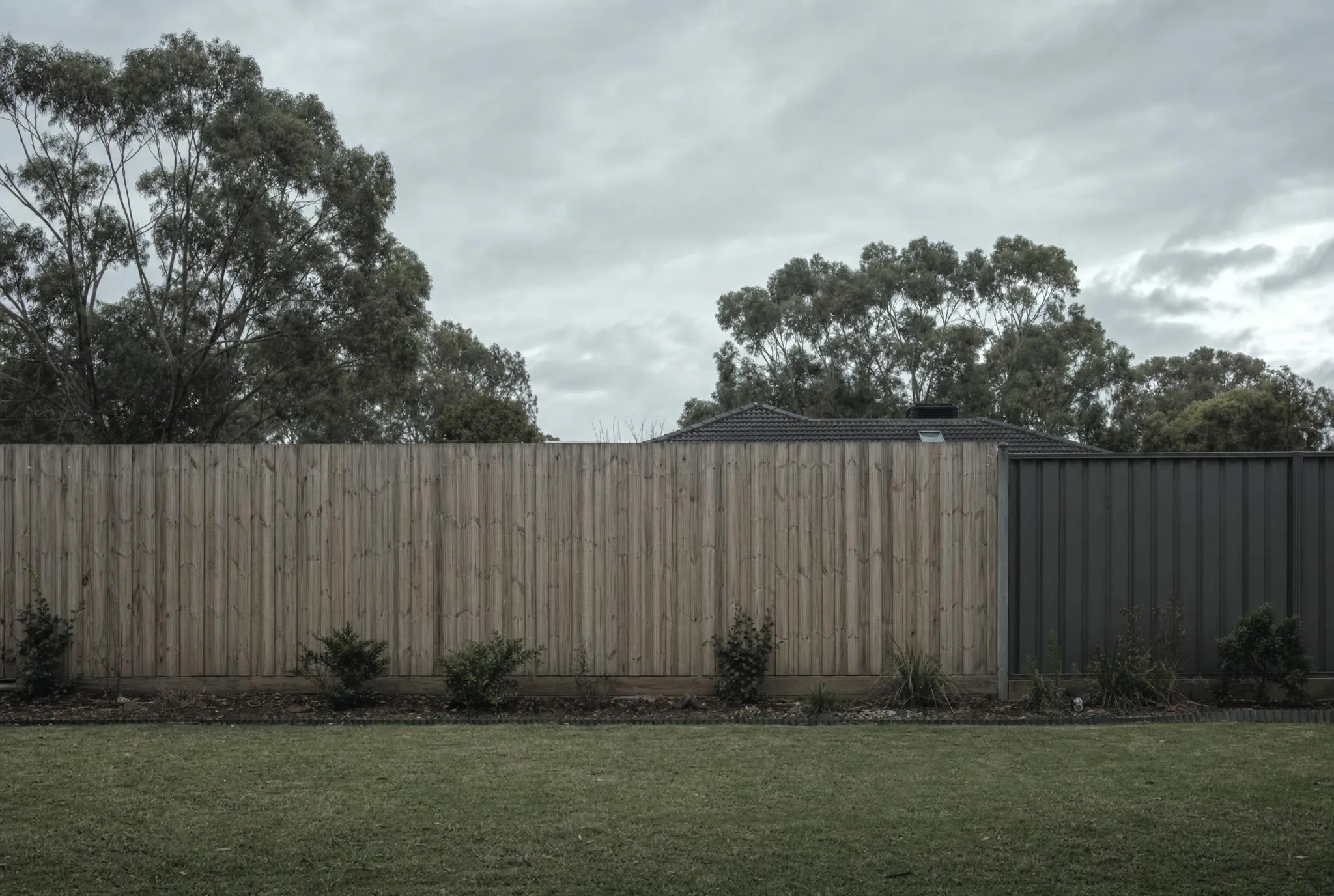
How high can a fence be in WA?
WA has no single fence-height number. Your council's fencing local law sets the standard, commonly 1.8 m. Without one, permit-free fences cap at 1.8 m, or 0.75 m for brick. Front fences have their own rules.
- Without approval
- A fence built to your council's fencing local law needs no permit. If your council has no fencing law, the cap is 1.8 m, or 0.75 m for masonry 1
- Front fences
- In the strip between your house and the street: 1.8 m maximum, and see-through above 1.2 m 4
- Approval needed when
- The fence doesn't fit the local law or the default caps. Building without a permit risks a $50,000 fine 2
- Who pays (dividing)
- Half each for a "sufficient fence", which your council's local law defines. Stirling says 1.8 m. With no local law, the Act falls back to a fence that keeps out cattle and sheep 3
- Pool fences
- At least 1.2 m, and 1.8 m on the pool side — a minimum, not a maximum like the rest of this page. See our WA pool fence page 1
- Your council
- Your council is the main rule-maker here. Its fencing local law sets the height, and most metro ones land on 1.8 m. Check yours, because it is the one that counts 5
WA does fences differently from the eastern states. There is no single state height number. Your council’s fencing local law is the main rulebook. The state sets fallback caps only for councils without one, and front fences follow a state design code. 1 So the first question is always which of those applies to your block.
How high can you build a fence in WA without a permit?
By default, all building work needs a building permit, and skipping a required one is an offence with a $50,000 maximum fine for a first offence. 2
Fences get an exemption, and it’s worth reading how it forks. A fence built in accordance with your council’s fencing local law needs no permit at all. The flat caps you’ve probably heard, 1.8 m or 0.75 m for masonry, only apply where your council has no fencing local law. 1
reg 41(3) → Sch 4, cl 2, item 4 The fence exemption: local law first, flat caps second Building Regulations 2012 (WA) 1
41(3) A building permit is not required for building work of a kind described in the Table in Schedule 4 clause 2. […] 4. Construction, erection, assembly or placement of a fence, screen or similar structure, other than a fall prevention barrier, if— (a) the fence, screen or similar structure is constructed in accordance with a local law made under the Local Government Act 1995 section 9.60 that applies to the construction of the fence, screen or similar structure in the district in which the fence, screen or similar structure is, or is to be, located; or (b) the fence, screen or similar structure is, or is to be, located in a district in which there is no local law of a type referred to in paragraph (a) and the fence, screen or similar structure— (i) if constructed of masonry — is no more than 0.75 m in height; and (ii) if constructed of a material other than masonry — is no more than 1.8 m in height; and (iii) is not located in wind region C or D as defined in AS 1170.2.
Most established councils do have one. Here’s what a real one looks like. The City of Stirling’s sets 1.8 m for a standard residential dividing fence. 5
Sch 1(a) What a real council fencing law says (Stirling) City of Stirling Fencing Local Law 2008 (example council fencing local law) 5
Each of the following is a 'sufficient fence' on a residential lot— (a) a fully enclosed timber fence built to manufacturer's specifications or in accordance with established construction techniques, the height of the fence to be 1800mm except with respect to the front setback area […]
Every council writes its own, there is no central register, and the numbers differ.
That makes WA the one state where the number you find on a national website is most likely to be wrong for you. The 1.8 m everyone quotes is the fallback that applies only if your council has no fencing local law — and most established councils have one. Start at your council’s website, not at state legislation, and if you cannot find a fencing local law then the state caps are yours.
How high can a front fence be in WA?
Front fences follow WA’s residential design code, the R-Codes. In the strip between your house and the street a fence can be at most 1.8 m, and everything above 1.2 m has to be see-through. 4
cl C3.6.7 Front fences: 1.8 m max, see-through above 1.2 m Residential Design Codes Volume 1 (WA planning code, version 3) 4
When provided, fences or walls within the primary street setback area are to be: i. a maximum height of 1.8m; and ii. visually permeable above 1.2m (refer Figure 3.6c); measured from natural ground level on the primary street side of the fence or wall.
“See-through” has an exact meaning here. Gaps of 50 mm or more making up at least a third of the surface, or narrower gaps making up half. 4
Appendix A1 What "see-through" means, precisely Residential Design Codes Volume 1 (WA planning code, version 3) 4
VISUALLY PERMEABLE - in reference to a wall, gate, door, screen or fence that the vertical surface, when viewed directly from the street or other public space, has: — continuous vertical or horizontal gaps of 50mm or greater width occupying not less than one third of the total surface area; — continuous vertical or horizontal gaps less than 50mm in width, occupying at least one half of the total surface area in aggregate; or — a surface offering equal or lesser obstruction to view.
Two things worth knowing. Near driveways and street corners the code cuts fences down to 0.75 m within 1.5 m of the intersection, so drivers can see. 4 And a solid or taller front fence isn’t automatically banned. It falls outside the standard tick-the-box rules, but a council can still approve it on its design merits. 4
These rules reach your block through your council’s planning scheme. The code applies because the scheme adopts it, and nearly all of them do. 6
s 32C(2) The front-fence rules apply through your council's scheme Planning and Development Act 2005 (WA) 6
Despite subsection (1), a planning code has effect only to the extent that it is incorporated, with or without modifications— (a) into a local planning scheme by a provision of the scheme under section 77(1)(b); or […]
Who pays for a dividing fence in WA?
Half each, for a “sufficient fence”. WA defines that term with a cascade. Your council’s local law comes first. Whatever you and your neighbour agree comes second. And if neither exists, the Act falls back to its 1961 wording: a fence “ordinarily capable of resisting the trespass of cattle and sheep”. 3
s 5 (definition of "sufficient fence") "Sufficient fence": local law first, cattle-proof fallback Dividing Fences Act 1961 (WA) 3
sufficient fence, in relation to a dividing fence or a boundary fence referred to in section 16, means— (a) any fence prescribed by a local law as a sufficient fence for the part of the local government district in which the dividing fence or boundary fence is, or is to be, erected; or (b) any fence of the description and quality agreed upon by the parties concerned which does not fail to comply with any local law referred to in paragraph (a), or where no such local law or agreement is made, means— (c) any substantial fence that is ordinarily capable of resisting the trespass of cattle and sheep; or (d) any fence determined to be a sufficient fence by the court pursuant to this Act;
s 7 Half each for a basic fence Dividing Fences Act 1961 (WA) 3
Subject to this Act the owners of adjoining lands not divided by a sufficient fence are liable to join in or contribute in equal proportions to the construction of a dividing fence between those lands.
The process starts with a written notice to your neighbour covering the boundary, the proposal and the kind of fence. 3
s 8 The notice that starts the process Dividing Fences Act 1961 (WA) 3
An owner of land desiring to compel the owner of adjoining land to join in or contribute to the construction of a dividing fence under this Act may give him a notice which shall— (a) specify the boundary to be fenced, or if on account of the physical features of the adjoining lands it is impracticable to construct a fence on the common boundary of those lands, the line upon which it is proposed to construct the fence; and (b) contain a proposal for fencing the common boundary or other line; and (c) specify the kind of fence proposed to be constructed.
Can’t agree after the notice? The Act sends the dispute to court. 3 In a council with a fencing local law, that law’s specification is the standard your neighbour has to help pay for. In Stirling that means an 1800 mm timber, sheet or masonry fence. 5
What happens if you and your neighbour disagree?
WA handles this differently from the eastern states, for the same reason that runs through the rest of this page: your council’s local law does the work.
First, you write to your neighbour. You give them a written notice covering where the boundary is, what you want built, and the kind of fence. If you can’t agree after that, the Act sends it to court. 3
But there may be less to argue about than you’d think. If your council has a fencing local law, that law already says what an ordinary fence is. In Stirling it’s an 1800 mm fence in timber, sheet or masonry, so the standard is set before anyone starts arguing. Where a council has no such law, you fall back to the Act’s 1961 wording about keeping cattle and sheep out, which is a much vaguer place to begin. 3 5
The sharper risk is the building side, and it has nothing to do with your neighbour. Building work that needed a permit and didn’t have one is an offence, with a court maximum of $50,000 for a first offence. Finishing the fence doesn’t make that go away. 2
What about pool fences and special fences in WA?
Pool barriers are excluded from the fence exemption by name. The Building Regulations leave out “a fall prevention barrier”, and pool safety runs under its own rules and standards. None of the numbers on this page apply to a pool fence. 1
Some councils also run licence schemes for unusual fences. Electrified and razor-wire fencing need a council licence under Stirling’s local law, for example. If your fence is anything other than an ordinary boundary fence, check the local law’s special-fence schedules. 5
What it costs to get it wrong
| Offence | Penalty | Source |
|---|---|---|
| Doing building work — including a fence — without a required building permit | Court maximum $50,000 for a first offence | 2 |
Common questions
How high can a fence be between neighbours in WA?
Whatever your council's fencing local law says. That's how WA works. Many metro councils set 1.8 m, the City of Stirling among them, but each council writes its own law, so check yours. Where a council has no fencing law, the permit-free defaults are 1.8 m, or 0.75 m for brick or stone. 3
Can I build a 2 m fence in WA?
Only if your council's fencing local law allows it. Outside a local law, a 2 m fence is over the permit-free cap, so it needs a building permit. 1
How high can a colorbond fence be in WA?
Whatever your council's fencing local law says, commonly 1.8 m. Where no local law exists, colorbond is permit-free up to 1.8 m, because it isn't masonry. 1
How high can a brick fence be in WA without a permit?
Watch this one. Where no council fencing law applies, the permit-free cap for masonry, meaning brick, stone or concrete, is only 0.75 m. That's much lower than the 1.8 m people expect. Above that you need a permit, or a local law that covers it. 1
How high can a front fence be in WA?
Up to 1.8 m in the strip between your house and the street, and it has to be see-through above 1.2 m, with gaps making up at least a third of the surface. A solid fence above 1.2 m at the front doesn't meet the standard design rules, though a council can still approve one on its merits. 4
Who pays for a boundary fence in WA?
Half each, for a "sufficient fence" as your council's local law defines it. Start with a written notice to your neighbour describing the fence and the boundary. If you can't agree, the Act sends the dispute to court. 3
What happens if I build a fence without a permit in WA?
If the fence needed a permit and didn't have one, that's an offence under the Building Act. The court maximum is $50,000 for a first offence. 2
What is the legal height of a pool fence in WA?
A pool fence has a MINIMUM height, not a maximum: at least 1.2 m, and 1.8 m on the pool side. That is the opposite of the fence rules on this page, which are ceilings. Pool barriers also have their own standard and their own approval path — see [pool fence rules in WA](/pool-fences/wa/). 1
Every source on this page
The small numbered marks throughout this page point to this list — 1 means source 1 below.
- Building Regulations 2012 (WA), reg 41(3); Sch 4, cl 2, item 4
- Building Act 2011 (WA), s 9
- Dividing Fences Act 1961 (WA), ss 5, 7, 8, 24
- Residential Design Codes Volume 1 (WA planning code, version 3), cll C4.1, C3.6.7; Appendix A1 (published 10 April 2026)
- City of Stirling Fencing Local Law 2008 (example council fencing local law), cll 2.1–2.2; Sch 1
- Planning and Development Act 2005 (WA), ss 32C, 291
- Local Government Act 1995 (WA), ss 3.5, 3.14
Sourced from the Western Australian Legislation website at 28 Aug 2026. For the latest information on Western Australian legislation, visit www.legislation.wa.gov.au. © State of Western Australia. Licensed under CC BY 4.0. Reproduced without changes. This is not an official version and its use is not endorsed by the State. Creative Commons Attribution 4.0 licence.
© State of Western Australia. Sourced from wa.gov.au at 28 Aug 2026. Reproduced without changes. This is not an official version.
© State of Western Australia. Sourced from stirling.wa.gov.au at 28 Aug 2026. Reproduced without changes. This is not an official version.
Other rules for Western Australia
- Are e-bikes legal in Western Australia? Legal, with conditions
- Are e-scooters legal in Western Australia? Legal, with conditions
- Is it legal to record a conversation in Western Australia? Legal, with conditions
- What are the pool fence rules in WA? Legal, with conditions
Fence heights rules elsewhere
- Australian Capital Territory Legal, with conditions
- New South Wales Legal, with conditions
- Northern Territory Legal, with conditions
- Queensland Legal, with conditions
- South Australia Legal, with conditions
- Tasmania Legal, with conditions
- Victoria Legal, with conditions
Page history
Every change to this page
- 28 Aug 2026
- First published. Current to the WA Building Act and Regulations, the Dividing Fences Act and the residential design codes as at August 2026.