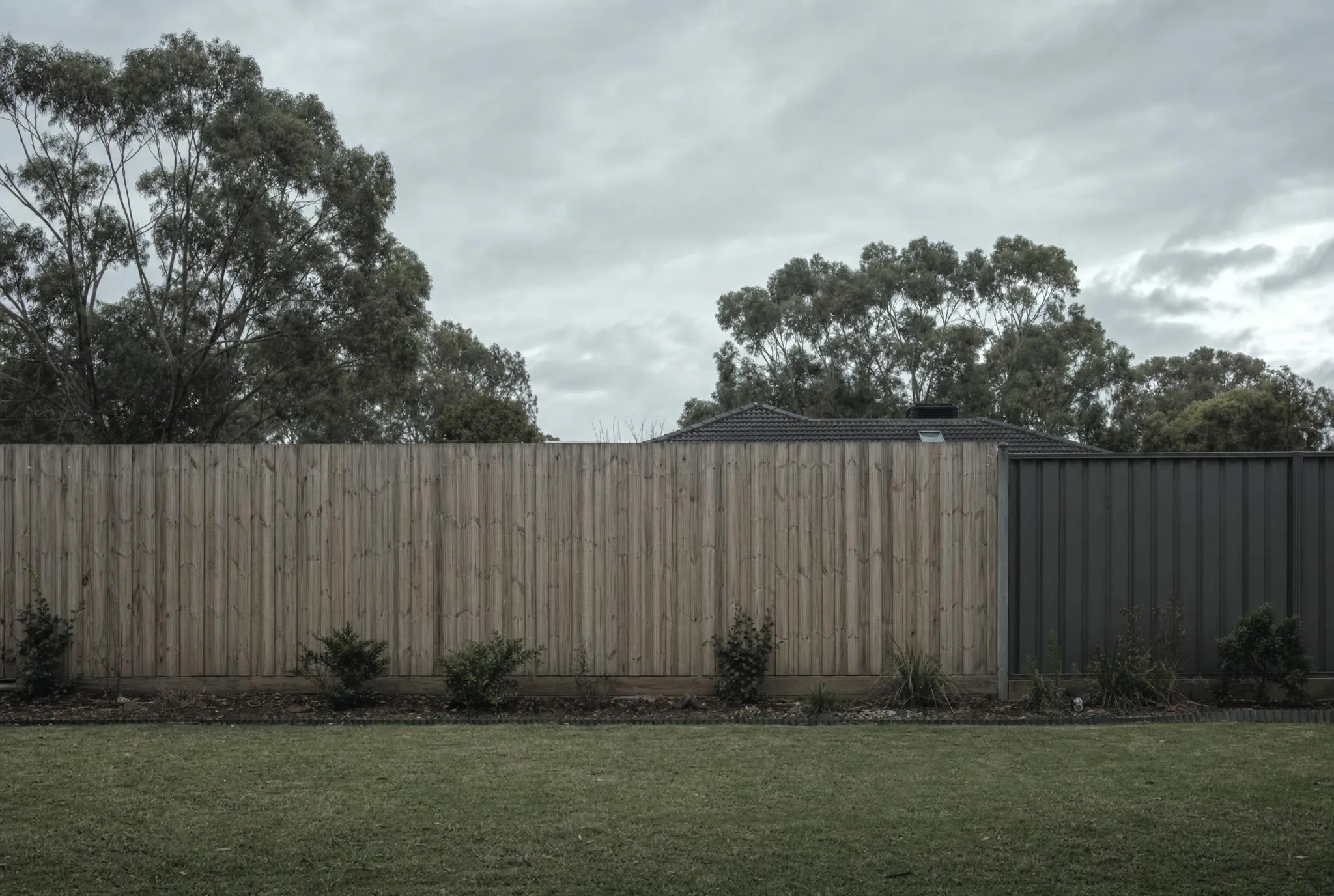
How high can a fence be in the NT?
For an ordinary house, NT law sets no maximum fence height. Any fence over 1 m that blocks wind needs a building permit and cyclone-rated engineering. Darwin has its own rule about barbed wire.
- Without approval
- A fence up to 1 m, or one the wind passes through like chain mesh. Above that you need a permit, unless the fence is a government-approved type 1
- Front fences
- No street-front cap for a single house. The 2 m road-boundary cap only binds unit and townhouse developments in medium and high-density zones 4
- Approval needed when
- Over 1 m and solid. You need a building permit from a certifier, and the fence has to be engineered for cyclone winds. There is no legal ceiling beyond that 2
- Who pays (dividing)
- Half each for a "sufficient fence", which you ask for using a form called a notice to fence. There is no set height. It is judged on your neighbourhood, and the Territory's civil tribunal settles disputes 3
- Pool fences
- At least 1.2 m, or 1.7 m for coarse mesh — a minimum, not a maximum like the rest of this page. See our NT pool fence page 3
- Barbed wire (Darwin)
- In Darwin you need council authorisation for barbed wire, unless it starts at least 1.8 m up and stays off road and public-land boundaries 5
The Territory does this unlike any state. No law caps how high an ordinary house fence can be. What the NT regulates instead is whether your fence needs engineering, which is a cyclone-country question. 1
How high can you build a fence in the NT without approval?
The chain starts strict. A fence is a “structure”, a structure is a “building”, and building work needs a building permit. 2
Then come the exemptions, and this is where the real threshold sits. Three kinds of fence need no permit. One that is 1 m or under. One the wind passes through, like chain mesh. And one of a type the Director of Building Control has approved as exempt. 1
reg 3(1)(c), (2)(a) The exemptions: 1 m, wind-permeable, or an approved type Building Regulations 1993 (NT) 1
3(1) These regulations do not apply to: […] (c) a fence that offers minimal resistance to wind loading such as a chain mesh or a similar kind of fence and in any event a fence that does not exceed a height of 1m […] (2) Sections 55 and 65 of the Act do not apply to or in relation to: (a) any building classified as a Class 10 Building that is of a type approved by the Director and is constructed in accordance with that approval […]
The approved types are published in a government document called Building Note 114, which sets out the fence designs that need no permit. 6
Why 1 m? Cyclones. A solid fence above that line has to survive design-level cyclone winds, so it needs engineering and a registered building certifier to sign it off. 6
That explains why the rule looks the way it does. The Territory isn’t limiting how high you build — it names no ceiling at all — it is limiting how much solid surface you can put up for the wind to push on. That is also why a mesh fence the wind passes through is exempt at any height, while a 1.2 m solid one is not.
So if you’re wondering whether you could put up a 4 m fence: nothing in NT law says no. The permit is what stands in your way. The taller and more solid the fence, the more wind it catches, and the more serious the footings and structure have to be. The engineering and the cost stop people well before the law does.
How high can a front fence be in the NT?
For a single house, there’s no street-front cap either. The Planning Scheme does contain a 2 m road-boundary rule, which is the number people quote. It binds less than people assume. It’s a development requirement for unit, townhouse and similar developments in medium and high-density zones, and some non-residential uses. Not for an ordinary house block. 4
cl 5.4.18.1(4)–(6) The 2 m rule — for unit developments, not houses Northern Territory Planning Scheme 2020 4
4. All fences adjacent to road boundaries or boundaries adjoining public open space are to be constructed so that: (a) the maximum height is 2m above ground level measured at the relevant site boundary; and (b) the area of materials that is not visually permeable does not exceed an area equivalent to the length of the site boundary (excluding driveways) multiplied by 1.2m. 5. Fencing within 1.5m of driveways, pedestrian entries, and street corners is to be visually permeable above 0.6m […] 6. Where the development abuts land in Zones LR or LMR, development is to provide a solid screen fence to a minimum height of 1.8m to that boundary.
What happens if you build without a permit in the NT?
The neighbour side is covered above. This is the part that costs money, and your neighbour has nothing to do with it.
A solid fence over 1 m needs a building permit, and the design has to survive cyclone winds. Building without the permit you needed carries a maximum of 85 penalty units. Finishing the fence doesn’t settle it either. The work needed approval before it went up, and it still needs approval after. 2
That’s also why the real ceiling on an NT fence is engineering, not law. The taller and more solid the fence, the more wind it catches, and the harder it is to get a registered building certifier to sign it off. 6
In Darwin there’s one more layer. If your fence uses barbed wire outside what the by-law allows and you don’t have council authorisation, that’s a separate offence with a maximum of 50 penalty units. 5
Who pays for a dividing fence in the NT?
Half each, for a “sufficient fence”, and the NT sets no height for that. NTCAT, the Territory’s civil tribunal, judges it on your neighbourhood, what the fence is for, and what’s usual locally. It can even decide no fence is needed at all. 3
s 5(2) "Sufficient fence": neighbourhood test, no height Fences Act 1972 (NT) 3
Where, in any proceedings under this Act, the Tribunal has to determine what is a sufficient fence for this Act the Tribunal must have regard to: (a) the nature of the neighbourhood in which the fence is to be erected; and (b) the purpose for which the fence is to be erected; and (c) whether any and if so what fences are usual in the neighbourhood; and (d) the need for the protection of persons or the containment of stock in the neighbourhood; and the court may determine that no fence is, in the circumstances, required.
s 6(1) Half each for a basic fence Fences Act 1972 (NT) 3
Subject to this Act and to any agreement between the parties concerned, the owners of adjoining lands not divided by a sufficient fence are liable to join in or contribute to the construction of a sufficient fence dividing their lands in equal proportions whether the adjoining lands are to be wholly or only partly separated by the proposed fence.
The process is the usual one. You give your neighbour a form called a notice to fence. You fill it in and hand it over, setting out the boundary, your proposal and the kind of fence. If you can’t agree, it goes to NTCAT. Repairs to an existing dividing fence are split equally too, storm damage included. 3
What about barbed wire in Darwin?
This is the one real council fence rule we found anywhere in the NT. Darwin’s by-laws restrict barbed wire. Without an authorisation it can’t run along or near a road or public-land boundary. The wire also has to start at least 1.8 m above the ground, out of reach. 5
by-law 91 Darwin's barbed-wire rule City of Darwin By-laws 2023 (NT) 5
(1) The owner or occupier of land must not, without an authorisation, erect or maintain a fence of barbed wire or similar material if: (a) the fence is on the boundary of the land or within 0.66m of a road or public land; or (b) the barbed wire or similar material is at a height lower than 1.8m above the ground. (2) A person commits an offence if the person fails to comply with clause (1). Maximum penalty: 50 penalty units.
Ordinary fences without barbed wire aren’t affected. Outside Darwin, check your own council’s by-laws. Darwin is the one we verified. 5
What about pool fences in the NT?
Pool barriers have their own system under the Swimming Pool Safety Act, with its own specifications, registration and inspections. None of the general fence rules on this page apply to them. 3
What it costs to get it wrong
Common questions
Is there a maximum fence height in the NT?
Not for an ordinary house. No NT law sets one. What limits you instead is that a solid fence over 1 m needs a building permit and has to be engineered to survive the NT's cyclone winds. Height becomes a question of what an engineer will sign off and what you are willing to pay, not a number in the law. 1
Could I build a 4 m fence in the NT?
Nothing in NT law says you can't, which surprises most people. What stands between you and a 4 m fence is the building permit. A solid fence that tall has to be designed to survive design-level cyclone winds under the National Construction Code, and a registered building certifier has to be willing to certify it. The taller and more solid the fence, the more wind it catches and the more serious the footings and structure become. So the cost and the engineering stop most people long before the law does. Two things to check for yourself: the exact criteria in the government's Building Note 114, and whether your own council has a fencing by-law. Darwin is the one covered on this page. 1
Do I need a permit for a 1.8 m fence in the NT?
If it's solid, like colorbond or timber palings, then yes. You need a building permit from a registered building certifier, unless the fence is a type the Director of Building Control has approved as exempt. A see-through fence like chain mesh doesn't need one at any of the usual heights. 1
How high can a colorbond fence be in the NT?
There's no set maximum. A colorbond fence blocks wind, though, so above 1 m it needs a building permit and cyclone-rated engineering. What your neighbour has to help pay for is a separate question, decided case by case. 1
Who pays for a boundary fence in the NT?
Half each, for a "sufficient fence", and the NT sets no height for that. The tribunal weighs up your neighbourhood, what the fence is for, and what's normal locally, and it can even decide no fence is needed at all. Start with a written notice to fence. Disputes go to NTCAT, the Territory's civil tribunal. Repairs to an existing dividing fence are split equally too, storm damage included. 3
Can you have barbed wire on a fence in Darwin?
Only within the by-law's limits. Without council authorisation, barbed wire can't go on or near a road or public-land boundary, and it has to start at least 1.8 m above the ground. 5
What about the 2 m fence rule in the NT?
That number is real, but narrower than people think. The Planning Scheme caps road-boundary fences at 2 m, and mostly see-through, but only for unit, townhouse and similar developments in medium and high-density zones. It doesn't apply to a single house on an ordinary block. 4
Why do NT fences need engineering certification?
Cyclones. The line is drawn at 1 m, or at fences the wind blows through, because a solid fence above that counts as a structure that has to survive design-level cyclone winds under the National Construction Code, signed off by a building certifier. 6
What is the legal height of a pool fence in the NT?
A pool fence has a MINIMUM height, not a maximum: at least 1.2 m, or 1.7 m if it is coarse mesh. That is the opposite of the fence rules on this page, which are ceilings. Pool barriers also have their own standard and their own approval path — see [pool fence rules in the NT](/pool-fences/nt/). 3
Every source on this page
The small numbered marks throughout this page point to this list — 1 means source 1 below.
- Building Regulations 1993 (NT), reg 3 (as in force 30 March 2026, REPB002R1)
- Building Act 1993 (NT), s 55; definitions (as in force 10 February 2026, REPB002)
- Fences Act 1972 (NT), ss 5–7, 14 (as in force 1 June 2015, REPF003)
- Northern Territory Planning Scheme 2020, Part 5, cl 5.4.18.1
- City of Darwin By-laws 2023 (NT), by-law 91 (as in force 10 February 2026, REPL018R4)
- NT Government — Building a garden shed, carport, fence or shade structure that doesn't need approval
- Penalty Units Regulations 2010 (NT), reg 2 — penalty unit $194
Reproduced from the Northern Territory Legislation website at 28 Aug 2026 with the permission of the Northern Territory. This is not an official version of Northern Territory legislation. For current law please go to https://legislation.nt.gov.au.
© Northern Territory of Australia. Sourced from nt.gov.au at 28 Aug 2026. Reproduced without changes. This is not an official version.
Reproduced from the Northern Territory Legislation website at 1 Sept 2026 with the permission of the Northern Territory. This is not an official version of Northern Territory legislation. For current law please go to https://legislation.nt.gov.au.
Other rules for Northern Territory
- Are e-bikes legal in the Northern Territory? Legal, with conditions
- Are e-scooters legal in the Northern Territory? Illegal
- Is it legal to record a conversation in the Northern Territory? Legal, with conditions
- What are the pool fence rules in the NT? Legal, with conditions
Fence heights rules elsewhere
- Australian Capital Territory Legal, with conditions
- New South Wales Legal, with conditions
- Queensland Legal, with conditions
- South Australia Legal, with conditions
- Tasmania Legal, with conditions
- Victoria Legal, with conditions
- Western Australia Varies by area
Page history
Every change to this page
- 28 Aug 2026
- First published. Current to the NT Building Act and Regulations, the Fences Act, the Planning Scheme and the City of Darwin By-laws as at August 2026.